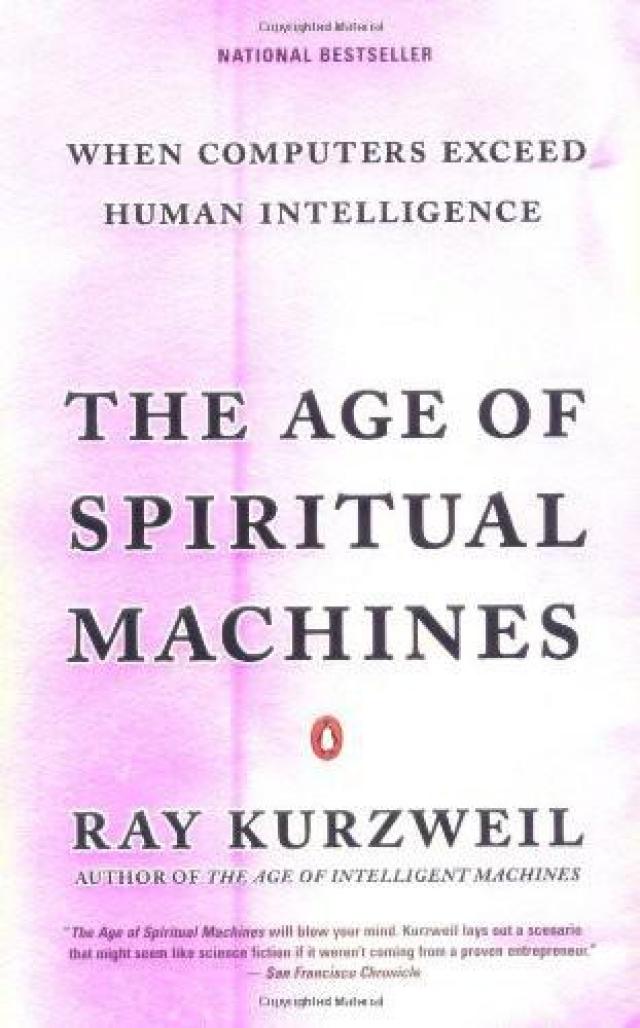
The Age of Spiritual Machines: When Computers Exceed Human Intelligence
Ray Kurzweil
Computers & Internet / Philosophy / Science
Amazon.com ReviewHow much do we humans enjoy our current status as the most intelligent beings on earth? Enough to try to stop our own inventions from surpassing us in smarts? If so, we'd better pull the plug right now, because if Ray Kurzweil is right we've only got until about 2020 before computers outpace the human brain in computational power. Kurzweil, artificial intelligence expert and author of The Age of Intelligent Machines, shows that technological evolution moves at an exponential pace. Further, he asserts, in a sort of swirling postulate, time speeds up as order increases, and vice versa. He calls this the "Law of Time and Chaos," and it means that although entropy is slowing the stream of time down for the universe overall, and thus vastly increasing the amount of time between major events, in the eddy of technological evolution the exact opposite is happening, and events will soon be coming faster and more furiously. This means that we'd better figure out how to deal with conscious machines as soon as possible--they'll soon not only be able to beat us at chess, but also likely demand civil rights, and might at last realize the very human dream of immortality.The Age of Spiritual Machines is compelling and accessible, and not necessarily best read from front to back--it's less heavily historical if you jump around (Kurzweil encourages this). Much of the content of the book lays the groundwork to justify Kurzweil's timeline, providing an engaging primer on the philosophical and technological ideas behind the study of consciousness. Instead of being a gee-whiz futurist manifesto, Spiritual Machines reads like a history of the future, without too much science fiction dystopianism. Instead, Kurzweil shows us the logical outgrowths of current trends, with all their attendant possibilities. This is the book we'll turn to when our computers first say "hello." --Therese LittletonFrom Publishers WeeklyKurzweil's reasoned scenarios of a "post-biological future" are as harrowing as any science fiction. That's the appeal of listening on tape to the inventor and MIT professor's provocative speculations on what could occur once computers reach or surpass human-level intelligenceAthen start to self-replicate. Computers, with their integrated circuit chip complexity, are sneaking up on us on an accelerated curve, he argues, citing the example of chess master Gary Kasparov's shocking loss to IBM's machine Deep Blue in 1997. Do computers represent "the next stage of evolution"? Will technology create its own next generations? Kurzweil suggests a timeline inhabited by "neural-nets," "nanobot" robots and scenarios of virtual reality where sexuality and spirituality become completely simulated. It's bracing and compelling stuff, propelled by the author's own strong egotistical will to prove his version of the future. Reader Sklar is thoughtful, if at times overly heavy on the ironies. Simultaneous release with the Viking hardcover. (Feb.) Copyright 1999 Reed Business Information, Inc.
Read online