

Ours, p.1
Ours, page 1


Also by Phillip B. Williams
Mutiny
Thief in the Interior
VIKING
An imprint of Penguin Random House LLC
penguinrandomhouse.com
Copyright © 2024 by Phillip B. Williams
Penguin Random House supports copyright. Copyright fuels creativity, encourages diverse voices, promotes free speech, and creates a vibrant culture. Thank you for buying an authorized edition of this book and for complying with copyright laws by not reproducing, scanning, or distributing any part of it in any form without permission. You are supporting writers and allowing Penguin Random House to continue to publish books for every reader.
library of congress cataloging-in-publication data
Names: Williams, Phillip B., author.
Title: Ours / Phillip B. Williams.
Description: [New York] : Viking, 2024.
Identifiers: LCCN 2023010345 (print) | LCCN 2023010346 (ebook) | ISBN 9780593654828 (hardcover) | ISBN 9780593654835 (ebook) | ISBN 9780593832226 (international edition)
Subjects: LCGFT: Novels.
Classification: LCC PS3623.I5593 O97 2024 (print) | LCC PS3623.I5593 (ebook) | DDC 811/.6—dc23/eng/20230310
LC record available at https://lccn.loc.gov/2023010345
LC ebook record available at https://lccn.loc.gov/2023010346
Cover design: Lynn Buckley
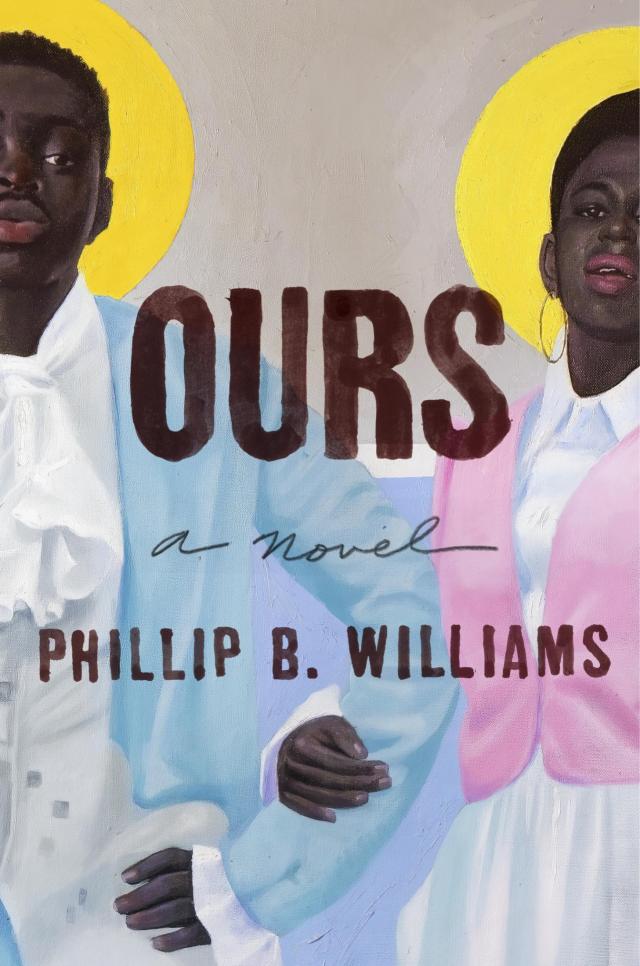
Cover art: Damilola Opedun, represented by AG18 Gallery, Austria, Vienna
Designed by Amanda Dewey, adapted for ebook by Cora Wigen
This is a work of fiction. Names, characters, places, and incidents either are the product of the author’s imagination or are used fictitiously, and any resemblance to actual persons, living or dead, businesses, companies, events, or locales is entirely coincidental.
pid_prh_6.3_146171365_c0_r0
Contents
Cover
Also by Phillip B. Williams
Title Page
Copyright
Dedication
Part One
Chapter 1: Blood and Light
Chapter 2: Go Down, Moses
Chapter 3: Plague of Arrogance
Chapter 4: The Climb
Chapter 5: Venom
Chapter 6: Expose
Chapter 7: Inside
Chapter 8: Instructions
Part Two
Chapter 9: Monsters
Chapter 10: Frances and Joy
Chapter 11: Unravel
Chapter 12: Dead-Time
Chapter 13: Hell
Chapter 14: Evergreen/Thaw
Chapter 15: Understanding
Chapter 16: The Outsiders
Chapter 17: Kwame’s Crown
Part Three
Chapter 18: White Sheets
Chapter 19: Deluge
Chapter 20: A Show of Force
Chapter 21: Communal
Chapter 22: Reunion
Chapter 23: Nothingness
Chapter 24: War
Chapter 25: God’s Place
Chapter 26: Grief
Chapter 27: Conviction
Chapter 28: Gone
Chapter 29: Homeward
Coda
Acknowledgments
Author’s Note
About the Author
_146171365_
For my grandparents, on the Otherside.
For my mother, in the Here and Now.
Part One
• CHAPTER 1 •
Blood and Light
[1]
Nearly two centuries before the boy who was shot dead at the intersection of First and Bank stood up in his own blood and spoke his name as if it were just given to him, there was a town named Ours, founded by a mysterious and fearsome woman right where the boy had been shot. But perhaps this story begins centuries before then, at the muddy waters of the Apalachicola River, or further back on a ship named the Divider carrying those misunderstood to be the future of slavery to the Western World.
To begin in any of those three places would lead back here, to this boy, age seventeen, fresh out of his junior year in high school, a bottle of orange Fanta rolling and emptying onto the street just feet away from his body from which blood spilled until it stopped, until the boy with his closed eyes opened them with a new mind and breath and understanding that shook him. He had been lying in the middle of the street for three hours with police tape squaring him off from his neighbors, friends, and family. The whole hood had rocked at the sound of the bullets popping off. Then he dropped and they all gathered, hymn-less and weathered, to see yet another one of their youngest take his last breath.
But he stood, his wounds no more than memories as he touched himself where he had been shot, a resonance of pain still there until it, too, departed, the smell of burnt corn bread in the air that someone had abandoned so that he wouldn’t have to lie there for hours alone. Yes, they had all left something behind to stand in that street together, blocked off from touching him and told to “Back up,” had it yelled at them as though they were to have as little care and consideration for the boy as the ones who had shot him.
He dusted himself off and looked around at the faces looking back at him, “What the fuck? My nigga . . .” peeling from a mouth astounded into a beautiful circle. The whole block went quiet except for that question and the loud suddenly sparked up in the crowd despite the cops right there, but who could give a fuck now when the dead have risen?
And he heard his name screamed from someone in the crowd, the voice bright and familiar, but a part of him didn’t recall exactly who had said it. He had two minds now: one in the future and one from the past.
To begin this journey, move backward. The boy’s body returns to the hot asphalt; the orange soda slides back into the bottle, and the blood back into the boy’s warming body; then the boy’s corpse rises and the bullets spin out from the right lung, the neck, the back of the head, the left hamstring, the right buttock, the right triceps, the left scapula, the—; his corpse becomes a living him as flecks of bone restructure and reenter the red-black wound, the broken wet resealed, the white meat sucked back into unbroken muscle, uncooked fat, and closing behind the retreat of the backward-flying bullet; the air the bullets once displaced returns from the curve of its displacement; the silver bullets return into the black gun like an unspeakable organ moving back into its dark element, the explosion of gunfire now the sound of wind hissing, then roaring, then suddenly silent; and the brown finger lifts from its trigger; the boy with his back to the police as the Fanta rises back into his pocket; and further back, weeks ago, the boy is asleep in bed and a small circle of light leaves his body. The legend begins where that light leads. At the end, the boy may teach you his name.
• CHAPTER 2 •
Go Down, Moses
[1]
Ours was founded by a single incident. Several white families established themselves in what was then called Graysville. The entire town relied on Graysville-Flint Bank, headed by a Mr. George Flint, who had already made hundreds of thousands of dollars in real estate somewhere in Maine, as rumors had it. He founded Graysville on a whim. With a sudden need for adventure, he packed up all he owned and sent for the rest once he made it across the Mississippi River and found himself in St. Louis, Missouri.
Banking there became a hassle; already-established branches offered little to no room for a new executive and showed no interest in his cutthroat procedure of lending to those most in need who also carried the smallest possibility of paying anything back, taking from them their very bed if debts weren’t paid on time.
Word of his arrival preceded him with the force of a plague and the entire banking community refused to have anything to do with him. With no other choice, Mr. Flint headed just a few miles north of St. Louis, discovering a nothing place burdened by woods and orioles. He used his fortune to tear down every piece of nature that challenged his financial vision. He bought up the land and divided it into plots he sold to anyone able to pay between $130 and $200.
Word got around in 1832 that a new development had started just north of St. Louis with cheap prices for large plots of land. Mr. Flint made a name for himself and his business, calling it the Oriole Street Realty Corporation. Between 1833 and 1834, more than 120 people moved into Graysville, bringing with them over three dozen businesses.
In the summer of 1834, a dark-skinned woman and man appeared on the outskirts of town. They were watched from the moment they arrived to the moment they reached the newly built branch of the Graysville-Flint Bank. It hadn’t been open for a full two years before the two opened the door and the woman asked to speak with “the superior of this bank.” Everyone working stared at her, one man so anxious he sweated the pen from behind his ear till it slid to the floor, the clink across the wood making him jump. She cleared her throat and repeated her request. Someone stood and ran to the back.
Moments later, Mr. Flint approached, a gun in his holster. People ducked beneath desks. Some of his bankers left the establishment to wait for shots to go off and for two bodies to be dragged out. He glared at the woman and then spoke to the towering, broad man who came with her.
“Your business here?” Mr. Flint said.
“I caught word that you have a few plots of land left for purchasing. I’m looking to buy one. Build myself a hom e,” the woman said. The man who accompanied her stood a couple of feet off to the side and behind her, meaning Mr. Flint had to turn around to see the woman he had briskly passed.
He didn’t like the height difference between the woman and man, she of average height but her head top reaching just under his chin. Mr. Flint stood about three inches shorter than the man, and the man’s silence paired with his daunting size and intense stare toward nothing felt deliberately hostile.
“Is this man your husband?” Mr. Flint said. “If so, he should have told you that we do not sell to coloreds here. It is illegal. There is a sign out front. If he is not your husband, then he should have told you anyway. Much time would have been saved for the both of us if you two would have”—he paused—“could have read the sign.”
“But, sir, I have money for—”
“It is impossible,” he said, and headed back to his office. “Please, let yourselves out.”
“Even with this?” The woman reached into a large mismatch pocket sewn into her dress and pulled out $1,500 in cash tied in a tight bundle with sprigs of jasmine. Mr. Flint laughed uncontrollably, and seemingly out of his mind with humor, he smiled broad as a dog’s mouth. With a “Follow me” he led her into his office.
It was true that selling to her as a realtor carried legal repercussions, but with the amount of money she carried, Mr. Flint couldn’t let her leave unattended. He was jovial, almost feeling accountable to find room for this woman and her silent companion. He decided that she would purchase her plot from an independent seller, someone who would purchase the land in their own name and legally sell it to her without any ties to a realtor. Mr. Flint said the land cost more because it came with a house already built, though that was untrue. She agreed to the price of $1,500 for 2,500 square feet and moved in right away. In less than three months the entire town evacuated, the white residents moving south to St. Louis or, in much smaller numbers, north to Delacroix. The fleeing white residents sold their properties, houses and furniture included, to Negroes for triple the price they had purchased them. They gave a third of the profits to Mr. Flint and used the rest of their earnings elsewhere. Graysville became Ours and its new citizens were thereafter called the Ouhmey.
After the woman and man arrived and settled, more and more Negroes from all over the south came to Ours led by hearsay, both freedmen and soon-to-be freedmen, around forty in total. Many found themselves running away from undesirable pasts, including slave work that had killed everyone they loved and surely would kill them next.
Negroes occupied the houses abandoned by their once-ago residents. Mr. Flint, though no longer a part of the community, visited from time to time to mark which houses had new occupants. He took copious notes of faces and names, the day they said they arrived, and where they came from. Once a week he visited Ours to collect money owed. Those who had moved in during his absence were told to buy the house immediately for $250 or pay Mr. Flint $35 a week for two months straight. Whoever couldn’t pay him what he requested within a month’s time were to be forced from the houses at gunpoint by St. Louis officers, but of course this never happened.
Mr. Flint died of a stroke one month after Ours had been named. No one bothered charging them anything thereafter, not even the government that took over all property in Mr. Flint’s name, as he had no children and left no will. Mysteriously, no evidence existed that either Graysville or Ours was ever affiliated with Mr. Flint. Allegedly, the room he died in smelled like jasmine for months after they removed his body.
[2]
The woman who pioneered the migration called herself Eleanor to Mr. Flint, no surname, and this not her actual name at all. To the no-longer-slaves she called herself Saint. The man that traveled with her was nameless and speechless.
When they reached town, Saint told those who followed her, “Wait somewhere in the wilderness until you hear word from me that you can come. When you come, bring the amount of money I gave you before we left. Keep yourselves covered in jasmine. Keep it in your pockets and rub it on your skin. We gambling here and need all the luck we can get.”
The newly freed had traveled with her from plantations all around Arkansas, plantations that she single-handedly ruined without any bloodshed but plenty of death, so most of them trusted her without question after having seen her power to liberate them.
It began on the Ross plantation in Hinton, Arkansas. One night, Saint seemed to appear out of their combined suffering taking shape in the form of a woman dressed just like they were. In one of the slave quarters, she whispered something that made everyone wake up at the same time. They all thought she was a spirit. Some hid their faces from her while others sat in awe and listened: “In three days, your self-proclaimed master will be dead, and you will follow me to freedom.” Then she walked out the door, reappearing at each place the enslaved slept.
The second night at the plantation, Saint and her companion tore down white fists of cotton and destroyed a garden reserved for the so-called master and his family. They trampled a pattern into the land that if seen from above resembled a pitchfork. Sunrise, and the mistress of the house broke into a violent fever. Every doctor that visited, three in nine hours, failed to relieve her, and everything they tried seemed to worsen her illness. It wasn’t until the mistress threatened to kill herself and everyone in the house if one more doctor tended to her that the requests for doctors ceased.
On the third night, Saint carved symbols into flat stones. When she finished carving, her companion took the stones to four different locations around the plantation and hid them beneath bushes. That following morning, the so-called master discovered every crop had withered overnight or sat soft and blackened on the ground.
Ross, the so-called master, took his rifle and, out of anger, shot at the nearest black face he saw. When he missed, his angry expression became mournful. Defeated, he grumbled as he returned to his sick wife.
On the fourth and final night, Saint and her companion rotated the location of each stone clockwise so that the southern stone became the western stone, the western the north, and so forth. That morning Ross, the so-called master, and his wife died in their sleep, both discovered in their bedroom by Ren, an enslaved cook, when neither showed up for breakfast. The three overseers were all dead, too, mouth-gaped and blank-staring at the ceiling of their cabin. Slobber slid down the sides of their cheeks like translucent worms.
Ren stumbled backward as though resisting the inward pull of the open mouths before her. She deserted the stiff corpses, running to her quarters to share the news with thirty-one enslaved Africans suddenly without a master. However, whatever joy Ren expected to feel crumbled before her because the so-called master’s son and the son’s wife appeared up the lane, their surrey growing larger over the horizon.
Saint stood on the steps of the house and watched the couple approach, led by two horses guided by a young Negro man. The so-called master’s son, enraged to see her standing on the steps of the mansion, wearing his mother’s emerald dress that he had purchased for her only months ago, rushed out of the surrey, and dropped dead the moment his feet touched ground. Panicked to see her husband fall and not get up, the wife demanded the Negro driver to help her get out of the surrey.
“Paton, open this door this instant, since you do not have sense enough to assist your master.” Paton opened the door and the woman slapped him hard, then reached for Paton’s hand. Her gloved hand in his, she stepped onto the ground and dropped dead. Paton leaned down to see her more closely.
“You touch them, and you die,” Saint said without anger. Her stolen elegant dress swiped the steps behind her like a receding wave as she made her way toward Paton. What a beautiful day: clouds, puffed up like bloated bodies, slipped between the old trees—the sight made Saint tear up, all that amorphous white, midair and aimless. When she got close enough, she touched Paton’s face with a gentleness he had never felt before and said, “This way.” She turned and walked to the field, speaking to Paton as he followed her. “Don’t ever try to touch your chains again. You might get rust on your priceless skin.”






