

Ours, p.50
Ours, page 50
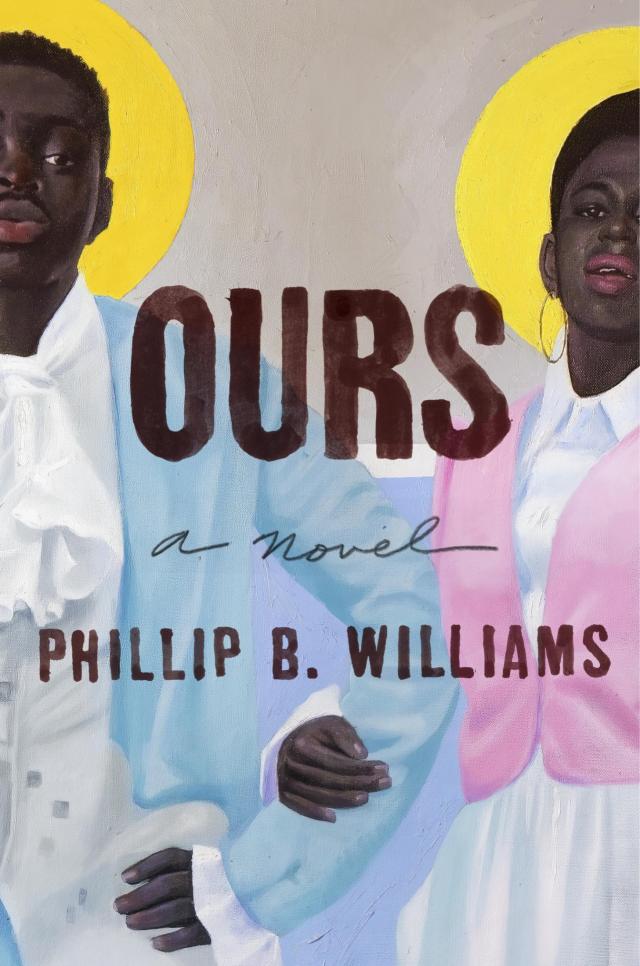


“Come look,” Thylias said, and showed Naima how to strop a razor. She slid it up, blade side facing her, then turned it and slid it down. She lathered the brush with the soap in a little bowl of water, then handed it to Naima to lather her head. Then she handed her the razor. “You will cut yourself. That’s just how it go. Go slow. Be gentle to yourself. I’ll get the mirror.”
Naima had hardly nicked herself while shaving, and Thylias’s assistance lessened the bloodletting. They burned Naima’s hair and buried the ashes out back. Restless, they took a walk about town.
‘She crazified the girl with her own crazy,’ someone thought, waving and smiling at the two as they passed by. Stares, whispers, dropped baskets, mouths covered, laughter, “I’ll be damned,” “My, my, my, my, my,” porch sweeping paused, clavicles clutched, “That’s how my mama used to have her hair,” “Girl looking cute as a song,” tears from reminiscence, nods of approval . . . they only headed west down Bank, then a right on First, then another right back down Freedom till they got to Third Street and headed south to Thylias’s house.
Closing the door behind her, Thylias worried about what Naima thought, but the girl screamed with glee, “Did you see the look on that little girl’s face back on First Street? She smiled and waved at me, and I heard her say to somebody, ‘She so pretty!’ ” Thylias nodded, knowing that Naima would be on her way to her whole self soon.
[4]
Ma’am,” Naima started.
“Yes?” Thylias said. They were sitting on the porch in a night cool enough for a shawl.
“Why Franklin kill hisself?”
Thylias waited for a while before answering. “Maybe,” she said, then stopped. She wanted to honor the gentleness she heard in Naima’s voice. “I think it’s cause he could choose to.”
“Was he sad?”
“We all sad, Naima. Sadness the first feeling, the one on the bottom. It’s what we put on top of it that helps us keep going. That’s what I believe. One time I asked Franklin if the dead had dreams and he said the dead don’t have nothing. Franklin couldn’t put nothing but more sadness on top of the sadness he already had, and when it got too heavy, he had to say, ‘Am I gone keep being sad or am I gone be something else?’ And he chose to be something else.” She paused. “He was better with being dead and having nothing, than being alive.”
“I heard Saint say he shouldn’t have never killed hisself.”
“Maybe so. Maybe so. I’m of the mind that we can never know what someone needs unless they tell us”— Thylias tightened her shawl around her shoulders—“or show us. Naima . . .”
“Yes, ma’am.”
“Many of us have had few occasions to make choices. I think Franklin choosing how he wanted to die was for him to be free his own way. I don’t like his choice. It hurt me deep that he did that. What I know well enough, though, is that he did what he wanted with his life because it was finally his. Only his. You understand, don’t you?’
“Yes, ma’am,” Naima said.
“Good,” Thylias responded, happy to know that someone understood, even if they were a child, because she herself still wondered what she knew, what she could know, and how much she had already gotten wrong.
[5]
Joy sat at her canvas and frowned after hearing a knock at the door. She had taken up painting again, landscapes, something she hadn’t done since her days with Eloise, and the disturbance distracted her to bisecting a deer with a thin, dark green line of paint, belly to spine.
Paintbrush in hand, she opened the door to Thylias and Naima, the latter holding an apple cobbler they had made together as a gift to Joy, paying their respect. Seeing the cobbler, Thylias looking healthy, and Naima with no hair and an unknown light in her eyes, Joy held her breath.
“We made this for you, ma’am,” Naima said, and the “ma’am” struck Joy across the ears. She scrutinized the two visitors, then invited them in with a soft “thank you.” They quietly ate the cobbler together right from the dish, the half-finished painting with the split deer watching close by. When they finished, they looked at the empty dish and warped into softer versions of themselves, caused by full stomachs. A house creak made Joy laugh until she realized it wasn’t Aba speaking. Embarrassed, she pushed away from the table and returned to her canvas, standing before it with growing focus.
“I started this painting after putting Aba in the ground. It’s of the tree he’s buried beneath,” Joy said.
“You saw a deer there?” Naima asked.
“The deer . . .” Joy said, then waited. The deer represented Aba’s spirit, or her grief, or an abstraction yet understood by the painter. Hope. Peace. Fear. The deer faced the viewer, perhaps startled by being perceived, perhaps welcoming whoever looked to enter the landscape with it, make of its world a new home. “. . . I saw once while out with Frances.”
“It’s very beautiful,” Thylias said.
“Like you, Ms. Joy,” Naima said.
Joy scowled. “Did somebody else die?” she asked. “Was there some other death I’m unaware of?”
Thylias laughed. “No. No one else died. Well,”—she paused—“unless by die you mean of an old self.”
Joy had not turned away from her painting, distracted by the deer of her own rendering, the white of its tail waving with the brush strokes that made it. She was tired and Naima’s sudden kindness landed clumsily. She decided to test the water. “How’s Selah, Naima?” When Joy finally turned to face her company, she saw the girl looking at her hands in her lap. Naima didn’t answer, just looked down and fiddled her fingers. Joy looked at Thylias for an answer, but Thylias just shook her head, pursing her lips. “I see,” Joy said, though she saw nothing at all. “Naima, stand for me, please?”
Naima stood and Joy embraced her, holding the back of her smooth scalp and resting her cheek on the top of the girl’s head. “I don’t know what has happened to you,” Joy said, “but I am so sorry it has happened to you.” The girl nodded. She didn’t know if this kind of attention hurt or helped. All she knew was Joy touched her and the warmth felt new.
• CHAPTER 27 •
Conviction
[1]
The day of the invasion, Selah didn’t see the horseman break through the volley of bullets and ride up just feet away from God’s Place, for the birds she had entered to watch over Ours all amassed over the town in a vortex of fear. Selah jumped from bird sight to bird sight, telling Aba what horseman she saw and by whose house on what streets.
The Ouhmey swiftly killed all intruders and suffered few injuries. Birds settled in trees after bullets ceased tearing through the town, the streets clogged by living and dead horses and the corpses of men who had no business barging into Ours demanding their children. Audacity such as this required death, which is why Selah needed little convincing to climb into that tree and direct Aba’s percussion to where the bullets needed to go. But when that one horseman rode up close, she missed him, and it took the sound of the bullet leaving his up-close gun to shock her out of the bird she had inhabited a half mile south and return to her own body, her own sight, and watch the horseman—bleeding from the eyes and nose, rotting on the inside—die slowly in Naima’s wave of sickness.
Naima’s intense focus broke at the sound of the bullet as well, and when she came to, she saw the sick, stubborn man with his gun still in hand. Outraged, Naima widened her eyes and he died in a rush of illness.
Selah listened. That bullet had entered a place important, Selah knew. ‘It’s in his breathing,’ she thought, and put her hands to Aba’s chest to keep him alive with her own life force. In the back of her mind, she saw Saint lording over her, that snake staff digging into the floor and her stern gaze digging into Selah. She shook her head to shake out the vision of Saint, but Saint’s image soon took over her vision of Aba.
The image of Saint rhythmically pounded its staff into the floor of Selah’s mind. Naima rubbed Selah’s back, but Selah didn’t feel it. Getting away from Saint and the demand that she raise the dead had erased the world.
The only time Saint had ever encouraged Selah had burned shame and fear into her memory. “We will try again some other time,” Saint had told her, “when you get stronger.” When Selah protested that it hurt too bad to pour that much into somebody to bring them back to life, that Saint’s hope that she could do it hurt the worst, Saint said, “Pain gets easier. It has no other choice.” She kissed Selah on the forehead, and what should’ve been a good feeling nauseated Selah instead.
While keeping Aba alive against his body’s wishes, Selah dove into the dark beneath the vision of Saint, into the depths of what felt to her like oil that loosened into cool water, then opened into air. Weightless in the void. To get away from Saint’s demands, she fell into the unknown and found that she knew it, at least a little, for this is where she went when under the pressure of healing those she couldn’t heal. This is where she went when the older woman took over her body. But after Frances had touched Selah that one time, the older woman couldn’t come back and no longer waited in the dark recesses of Selah’s need.
Not too long after Frances’s touch chased that woman away did Selah realize the older woman was herself but from a long time into the future. How her older self got inside her younger self she didn’t know, so in secret she took to pretending she was asleep while contemplating how to reach her older self on her own. If that woman from an approaching time could come to Selah, maybe Selah could go to her. In this moment of Aba’s dying, she needed the woman Frances had chased away, back into the after. So she dove.
She heard Joy’s voice from the outside saying “please” so sweetly that she began to feel guilty for having held on to Aba’s life in the first place. She was about to give up on finding her older self and just go on and let Aba pass away into his own peace. ‘He deserve rest,’ she thought. But the tap of Saint’s ominous staff returned to her mind like the loud ticking of a mean clock, seconds shaved off as quick as Aba’s breath sliced and seared by a bullet. If Aba died, Selah knew she would be forced to bring him back, to make the painful attempt while disregarding her own life. No. No. No. Never again. Selah released both Aba and herself from the tethers of the world, floating . . .
[2]
. . . in the great nothing, deeper than she had ever traversed, the surrounding darkness bursts open into a garden of light. Pulsing orbs of various colors speckle the canvas that had once been no different from an empty night sky. Inside the orbs, Selah sees people who look like her and Naima. Kinfolks living inside their bubbles of time. They wear bizarre clothes, enter colossal buildings carved from metal and carriages that move without horses. They carry weapons, wearing all black or suits or green and brown uniforms. Around her, their voices bleed out from their orbs, creating a cacophony from which she can’t escape. Conversations pummel into her. Screams beckon for her. Laughter removes the pain she felt while putting hands on Aba. In one orb, she sees a woman who looks like her, rocking a baby in her arms. In an adjacent orb, another woman with her face, a bit older, sits in a crowd of people who watch young blacks in caps and gowns walk across a platform, grab a document, shake white folks’ hands, then take a seat.
A dark orb depicts a ship sinking into the depths of a large body of water, the ship torn asunder by a storm. Beside it, an orb shows a town full of people celebrating a couple, a woman nearby pounding yam with a large pestle in a giant wooden bowl.
One orange orb attracts her so much that she touches it. A bright orange light overtakes her sight and when she comes to, she finds herself standing in line behind a stream of Negroes, backs straight, facing forward and focusing on the task at hand that waits beyond where she can see. She can’t control her body, as though she had entered an animal, but she knows she is inside a person this time, one who smells like sweet perfume.
She catches a glimpse of the person she has entered in a window that reads “Gloria’s Hair Emporium est 1925.” Seeing the year, she understands that she has gone into the future but not how or why, and seeing that the woman looks so much like her makes the unfamiliar world more familiar.
She learns the woman she’s inside of is named Naima, which makes her smile. “Get moving, chile. Folks is waiting. You hear me, Naima?” Hearing this, Naima turns away from herself in the mirroring shop window after giving her reflection a curious look, surprising Selah into believing this woman sees Selah resting inside of her.
When Selah sees Naima’s mother, she can barely contain herself inside the young woman’s head. She cackles at the resemblance, rubs her hands together greedily like a fly. It becomes clearer to her that this is her lineage as though the mind in which she sits has been hers all along.
The line of Negroes, all dressed in suits or skirts that hit the knee or just under, pushes forward, a slow river of people filed neatly, newspapers tucked under arms and brimmed hats blocking out the eager sun. It’s hot outside and one man in line says, “This the hottest election of all my life. And this long line don’t make it no better.” Selah doesn’t know what is happening, even after Naima enters a bank that is shut down for the day, selects several names on a ballot (one a Franklin Delano Roosevelt), and disappears the ballot into a box.
A young man calls out to Naima’s mother, calls her Dr. Holiday, explains that the “liniment worked mighty fine, Dr. Holiday. My grandfather sends his regards.” Children outside jump as a rope spins above and beneath them. Selah wants to join them. Naima passes them with her mother on the way down the street.
In a blink, Selah is back among the orbs, and without thinking touches another. In this future, she is inside an older woman in a candlelit room, white drawings of arrows curving and pointing in many directions all around her. The person she is inside of shakes small bones in her hand and throws them to the floor. A turned-over shoe shows its bottom to the woman and white arrows dart toward the toes’ direction beneath the sole. A black rooster sneaks past the door and the woman begins to speak, “Thank you for visiting me, young ancestor,” and Selah is thrown from the woman’s body and back into the orb garden.
Each orb shows to her descendants from the future. ‘These my kin,’ she thinks, and reaches for a light blue orb that shows the face of a woman who looks only a little like her, and as she flashes into this world, she finds herself in a bed, charts and metal devices all around, a man telling the person she is inside of to push while a handsome man with big puffy hair stands at the foot of the bed watching on with extravagant worry.
Minutes later, the doctor’s rolled-up sleeves reveal dark brown skin with curly hair covered in a wet sheen of sweat. There’s crying, and the doctor passes the baby to “Mrs. Johnson. It’s a boy. Congratulations,” and the handsome man with the big puffy hair says, “Evie, a son. Baby, you gave me a son!”
Music plays in the background, “Betcha by golly woooow” crooning from a small box someone brought into the delivery room. Selah wants to see more of the mysterious music box, but Evie keeps turning her head to look at the baby that Selah thinks looks a fool and a mess.
“Thank you for letting me have music in here. I know it’s not protocol,” Evie says, then the box begins to speak “That was ‘Betcha by Golly Wow,’ brand-new from the Stylistics, Dionne Warwick’s favorite male group.” Selah wonders how the man’s voice got inside the black box and what Stylistics meant and who Dena Warnick is.
She is thrown into the orb garden before she can learn more, and when she catches a glimmer of herself in another orb that appears to be filled with only water, she notices she has grown into a young woman.
She visits several more orbs, staying longer in each one, hours, days, weeks, months, years. She learns that her own age changes depending on whose orb she visits. She goes in as a thirty-six-year-old visiting a seventeen-year-old descendant and returns to the orb garden as a seventeen-year-old. That she remembers everything from the lives she eavesdrops on excites her, the puzzle of the future coming into stark clarity as she moves from Negro, to black, to African American, then to Black.
She learns what a radio is, a car, oil sheen, and Vernor’s Ginger Ale. She sees people of all races holding hands and singing against a war that wilted the flowers woven into their hair. Luster’s Pink Oil Moisturizer and disco. Aretha Franklin and Soul Train. Watching the Soul Train line in one life and dancing in the line in another. She watched the women she inhabited fall in love with men who loved them fiercely, imperfectly, but never with fist or slap, though sometimes in the embrace of addiction that lit up their veins and delivered them to early graves. The bent spoon, the blunt syringe, the white rock of disaster a rocket ship, baby, to the moon and stars that burn the smoker to the bone.
In 1990, she learns what HIV and AIDS are, sees for herself what the invisible insurgencies do to a brother who dies in her descendant’s arms in his own bed, twenty-five of his friends dead over the course of two years. Cancer and diabetes ravages one descendant in 1993, while in 1995 she learns how to bring somebody back from an overdose and how to lose them after bringing them back. The burnt spoons clink hypnotic in her brain. Blunt syringes unsew a vein. For the first time she sees poverty in Black towns and neighborhoods that knew of no such thing. But she also learns that the fighting spirit in the Ouhmey transfers into the time beyond, and that the desire to live confounds the forces that try to undo.
After living six years in the 1990s in a single descendant and the first ten years of the 2000s in another, she wants to leave the bodies in less time, but she stays longer each visit, living through years in mere moments, her own age in utter confusion, lost in the time jumps, both woman and girl, having gained hundreds of years of experience from the various women whose compiled lives welcomed her unknowingly and taught her phrases like “Keep on keeping on” while their children rolled into early graves.






