The predicament, p.1
The Predicament, page 1


About the Author
William Boyd was born in 1952 in Accra, Ghana, and grew up there and in Nigeria. He is the author of seventeen highly acclaimed, bestselling novels and five collections of stories, including Gabriel’s Moon, which was the first book to feature Gabriel Dax and became an instant Sunday Times bestseller. His bestseller Any Human Heart was longlisted for the Booker Prize and adapted into a TV series with Channel 4. In 2005, Boyd was awarded the CBE. He is married and divides his time between London and south-west France.
By the same author
Novels
A Good Man in Africa
An Ice-Cream War
Stars and Bars
The New Confessions
Brazzaville Beach
The Blue Afternoon
Armadillo
Nat Tate: An American Artist 1928–1960
Any Human Heart
Restless
Ordinary Thunderstorms
Waiting for Sunrise
Solo
Sweet Caress
Love is Blind
Trio
The Romantic
Gabriel’s Moon
Short Story Collections
On the Yankee Station
The Destiny of Nathalie ‘X’
Fascination
The Dream Lover
The Dreams of Bethany Mellmoth
Non-Fiction
Bamboo
The Mirror and the Road: Conversations with William Boyd
Theatre
School Ties
Six Parties
Longing
The Argument
A Visit to Friends (libretto)
William Boyd
* * *
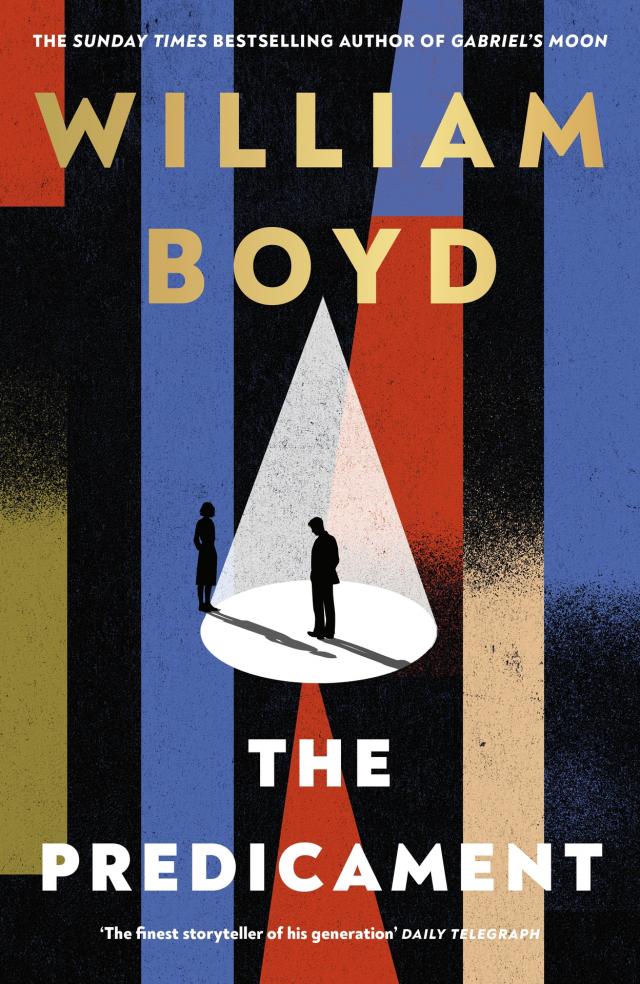
THE PREDICAMENT
A Novel
For Susan
Il y a d’abord l’histoire, puis l’histoire dans l’histoire, et ensuite une autre histoire, enfouie, à laquelle n’ont accès que de rares privilégiés.
Jean-Baptiste Charbonneau, Avis de passage (1957)
[There is the story – and then there is the story within the story. And then there is another story, buried, that only a select few are able to read.]
PROLOGUE
Claverleigh, East Sussex, England
March 1963
Gabriel Dax looked out of his kitchen window over his back garden and saw the fox slink along the foot of the beech hedge. It was moving almost daintily, its dense brush holding a steady horizontal line. He noted the rich amber of its fur offset by the dark brown of the near-leafless hedge. The fox paused for a moment, as if to allow Gabriel to register the perfect juxtaposition, and turned its sharp head to stare directly at him, with animal clarity, or so it seemed. Then it slipped through a gap and disappeared into the small oak wood that lay beyond the garden’s border.
Gabriel felt a sudden whelm of apprehension, and shivered. Was that a good omen – or an evil one? he wondered. He was still troubled by last night’s unwelcome phone call that he had received from his ‘contact’ at the Russian embassy, Natalia Arkadina. She had requested a meeting, today, at the familiar place, the Café Matisse on the King’s Road in Chelsea. He could hardly say no, given that the money Natalia and the KGB supplied him with had, to a large degree, allowed him to purchase his new home, this solid old Victorian cottage on the outskirts of Claverleigh, in East Sussex.
He knew Claverleigh, having visited the place twice during his long investigation into the cause of the fire at his childhood home that had killed his mother – a trauma that had haunted him for most of his life. It was a fair-sized village, also, with an architecturally handsome high street, and well served with shops and amenities. When he decided to leave London, East Sussex had seemed almost a natural choice – and Claverleigh, after some property-sleuthing, duly delivered the ideal house.
Rose Cottage was uninspiringly named after a large rambler that had once covered its facade, so he had been told, now long gone, replaced by a clematis over the front door. It was a two-storey square-built ashlar house with a steeply pitched slate roof. It was unpretentious and unadorned, apart from a stone ledge under the front eave with arched openings for doves (now blocked). He rather liked its simplicity and functionality. He had hoped that moving out of London might have put a symbolic distance between him and his various handlers and the complications they brought to his life. No such luck.
He stepped out through the kitchen door and wandered moodily into his garden. It was early and chilly but there had been no frost. A heavy dew spangled on the lawn and there was a blear, sulphurous morning light in the air, almost as if it were about to snow. He knew why he felt troubled, jangled somewhat. Natalia Arkadina’s telephone call reminded him of his other, unsought-for, parallel existence, his life in the shadowy fringes of the espionage world. Try as he might, he couldn’t pretend it didn’t exist. What had Faith Green said to him when he’d tried to quit, tried to tell her that his connection with MI6 and the Institute of Developmental Studies was terminated? ‘Nobody quits in this business, Gabriel. You know that.’ Yes, he thought bitterly, and now the fucking Russians are on board.
He fished in his pocket for his pack of Gitanes and lit a cigarette, making his way over to the chest-high rubble wall that bounded the side of the garden that was next to the lane. His cottage was at the very edge of the village, on the single-track B-road that led to Offham, near Lewes. He had one neighbour on the west, the village side, a widower and retired colonel from the Sherwood Foresters, Royston Mitchell-Moore. To the east was open Sussex country – distance-hazed gentle hills, woods and copses, fields and pasture. It was very private, his cottage, any comings and goings were noticeable, easily logged.
Looking over the wall, Gabriel immediately registered that the black Ford Popular was still parked on the verge opposite Royston’s rather elegant house, Barley Court. It was much grander than Rose Cottage, so much so that it merited a few lines in The Buildings of England: ‘Late C18, two storeys, five windows. The interior has good doorcases. Central first-floor Venetian window. Quietly charming.’ Royston lived there alone. He had never remarried.
Gabriel stared at the Popular. It wasn’t Royston’s car, he knew. Royston drove an Armstrong Siddeley Star Sapphire. Maybe a friend was staying with him, Gabriel thought – and therefore it was not necessarily something to ponder or worry about. Worry, yes, Gabriel recognized – his new companion, dogging his heels, always by his side, at his elbow. He strolled back into the cottage. He’d bike to Lewes, he thought, catch a London train well before noon.
He had arranged to meet Natalia Arkadina at 2 p.m. He intended to capitalize on the encounter in London by visiting his editor, Inigo Marcher, and delivering the latest chapter of Rivers. The book was almost finished, he reckoned – two more rivers would be enough, three at a pinch. He already had an idea for his next travel book – he’d suggest it to Inigo, see what he thought. Considering his real life, as opposed to his secret life, cheered him up, to a degree.
And as if to emphasize the normality of his existence he put out a saucer of milk for the creature he had dubbed the Cat. Shortly after he’d moved into Rose Cottage a large tomcat adopted him. He had seen it prowling about the garden, black with white paws. One day, when he had momentarily left the kitchen door open, it had come inside. He gave it some milk and it – he always referred to the Cat as ‘it’ in his mind – decided to stay. Gabriel had a cat-flap fitted in the kitchen door and the Cat came and went as it pleased. Gabriel bought catfood in Claverleigh’s small supermarket. The Cat deigned to eat it. Sometimes the Cat disappeared for a day or two but it always came back. Mice were caught, terminated and left as trophies on the kitchen floor, along with a small butcher’s bill of songbirds. Gabriel never stroked or petted the Cat. He had tried once and the Cat hissed at him, baring its thin sharp teeth. It slept on an armchair in the sitting room. Sometimes, rarely, he heard it purring. After a month the arrangement seemed established and natural: Gabriel now had a relationship with an aloof domestic animal; the Cat had shelter, warmth and nourishment. There was no rodent problem in Rose Cottage – and that was the reasonable quid pro quo as far as Gabriel was concerned.
He squared off the carbon copy of his Mississippi chapter and placed it in a wallet file. He was thinking of doing the Nile, next, then perhaps the Mekong or the Yangtse. The Indus? The book’s concept was, he thought, rather brilliant: great and minor rivers analysed through one specific locus – a city, town or village situated somewhere on the river’s journey to the sea with no attempt at a wider view: the part would be greater than the whole, or as great, was the theory. However, he was aware that there were no South American rivers amongst his tally – no Amazon, no Orinoco. He’d talk it over with Inigo, see what he thought.
He pulled on his black leather coat – his grandfather’s – and put on his cream Bakelite crash helmet and goggles. Outside, he wheeled his motorbike, a new Norton Navigator – a lightweight, four-stroke twin, another instance of Russian largesse – from the woodshed next to the cottage. He put his briefcase in the pannier and kick-started the machine. He straddled it, revved the engine – and immediately noticed that the Ford Popular had gone.
He drove slowly out of his driveway, thinking. The car had been there, minutes ago, and had been parked across the lane for two days. Strange. He saw Royston Mitchell-Moore in his front garden, clipping away at the decorative round box balls that flanked his front door. Gabriel throttled back and gave Royston a wave. He put down his secateurs and wandered over.
Royston was a handsome, lean sixt y-year-old, Gabriel noted once again. Even in his gardening clothes he seemed faultlessly smart: the many-pocketed olive-green jacket; crimson corduroy trousers, a French brand of wellington boot in an unusual mud-brown colour; his thick, wavy grey hair oiled back like metal from his large forehead; his regimental tie with a knot the size of a hazelnut. In his two months as his neighbour at Rose Cottage Gabriel had never seen Royston tie-less. His face was seamed and his voice was a bass, nicotined rumble. He was a sixty-a-day man.
‘Gabriel, good morrow, old fellow, what can I do for you?’ he said.
‘That car that was parked opposite your house the last couple of days,’ Gabriel said. ‘Did it belong to a friend of yours?’
‘No. I thought it belonged to somebody staying with you, actually. Why?’
‘It just seemed odd. A car parked there, all this while.’
‘I did see a chap with a rucksack come and go. Walking the Downs, I suppose.’
Gabriel thought that was the logical interpretation. But he knew all too well that it could sometimes be foolish to trust logical interpretations.
‘You didn’t happen to note the number plate, did you?’
‘What? Why on earth should I do that?’ Royston said, trying not to look too bemused.
‘Silly question. I’ll be on my way.’ Gabriel waved goodbye and accelerated down Offham Lane on the Navigator, heading for Lewes. Stupid bloody idiot Gabriel Dax, he said to himself, angrily. Why hadn’t he noted the licence plate himself and jotted it down? He realized that he had to start thinking like a spy again.
Part One
* * *
LONDON EAST SUSSEX GUATEMALA CITY
March 1963
1.
The Café Matisse
Gabriel strolled up the King’s Road towards the Café Matisse, pleased to be back in London, in Chelsea, his old stamping ground, and simultaneously wondering, somewhat ruefully, if he had made the right decision in moving to the countryside. As time had gone by he had become less and less sure. He was essentially an urban person, he felt, and village life, however comfortable Rose Cottage was, had confirmed that. Claverleigh couldn’t offer the same quotidian pleasures that living in a big vibrant city did. By simply walking up the King’s Road from Sloane Square Tube to the Café Matisse he had already seen at least two dozen interesting-looking people, and some very attractive young women, not to mention the intriguing variety of shops available and the different marques of cars in the passing traffic. Sleepy Claverleigh couldn’t compete – inevitably, of course. Still, he had made his bed and he must lie in it, he supposed, at least for a while. He was thirty-three and now a home-owner – that was a plus. He was free to sell Rose Cottage and move back to town, if he fancied. Everything in life is temporary, he reminded himself – who had said that? Henri Bergson? Samuel Beckett? Ludwig Wittgenstein …?
Outside the Matisse, Gabriel checked his watch: 1.50 p.m. He was early. He thought he should just go in and order a glass of wine – steady the nerves before his meeting with Natalia Arkadina.
He stepped into the Matisse and looked around, almost with a kind of sob of recognition in his throat, greeted by its warm fug of cigarette smoke and fried and spicy food, the enthusiastic susurrus of conversation, the stony-faced waitresses, the eponymous large blue-period Matisse poster on the back wall between the ladies’ and gents’ toilets. Nothing had changed in his brief absence: how reassuring. He found a booth at the rear and ordered a carafe of Chianti. Why had he left Chelsea? he asked himself, again. Was he insane? No. He knew the answer: after his fraught and complicated experiences with MI6 and Faith Green and the suicide of his brother, Sefton, he needed distance, a new set of circumstances, new surroundings that would reflect the change he was determined to introduce into his life – that was why. Chelsea would always be here; he could return whenever the mood took him. No, Claverleigh actually suited him at the moment. He shouldn’t complain about living in—
A shadow fell across the table and he looked up to see Natalia Arkadina standing in front of him. At her shoulder was another woman, older, with short greying hair.
‘Mr Dax, how are you?’ Natalia said as he stood up and shook her hand, very aware of the fist-thud increase in his heartbeat. His parallel life reclaiming him.
‘I’m very well, thank you, Natalia.’
‘May I introduce my colleague, Varvara Sergeevna Suvorina.’
Gabriel shook her hand. She had a square, mannish face, accentuated by the cropped hairstyle, a firm jaw and a gently hooked nose. Older than Natalia, in her forties, he reckoned. She was staring at him intently. She had very dark brown eyes, he noticed, suddenly feeling a bit uncomfortable being faced by these two Russian women. What did this extra person portend, this Varvara Suvorina? He had only met Natalia twice before, always alone, and on each occasion she had given him the present of a book, the pages interleaved with money, £10 notes. The first book, a selection of Chekhov short stories, had contained £1,000. The second, Gogol’s Dead Souls, £500. His stipend from the KGB. Money that had gone towards his purchase of Rose Cottage.
He smiled. He had a sudden urge to see Faith Green again. Faith had told him to spend the Russian money, conspicuously. Show them you’re happily using it. That will let them see you’re properly hooked, properly suborned. Gabriel Dax, a suborned man. It was both typical and annoying of Faith to use that word, he thought.
The two women sat down opposite him, both ordered tea, both refused the offer of his French cigarettes and lit their own – American ones, he noted. They spoke about the weather, his state of health, the problems of London transport.
‘How is your cottage in Claverleigh?’ Natalia asked.
How does she know where I live? he asked himself.
‘Very comfortable, thank you. A quiet life. Hard at work.’
‘And your new book? The Rivers?’
‘Nearly finished.’ He was aware of Varvara Suvorina’s continued scrutiny. He smiled at Natalia. Blonde, cheerful Natalia. She was wearing very bright lipstick today, he noticed. Cherry red.
‘I am going back to Moscow,’ Natalia said, lowering her voice. ‘Varvara here will take over my liaison with you. The same telephone numbers will apply.’
Gabriel glanced at Varvara Suvorina and smiled. Always smiling, compliant Gabriel Dax, he thought, with some discomfort, playing his double-agent game as best he could. She smiled back and the sternness in her suddenly vanished. She was wearing a black coat, with an aquamarine polo-neck sweater beneath it. She had a small gold cross at her throat, dangling from a fine chain. What you’d call a ‘handsome’ woman, he supposed. Now this enigmatic Varvara would be his go-between. He’d miss Natalia. A bit.
Varvara took a brown paper parcel from her handbag and pushed it across the table to him.
‘It’s my favourite book,’ she said. ‘A good translation, I’m told.’ She stubbed out her Peter Stuyvesant.
Gabriel tore off the wrapping. Lermontov, he saw: A Hero of Our Time. How very apt. He put the book in his briefcase, vaguely wondering how much money it contained and what he should conspicuously purchase with it.
‘Mr Caldwell sends his greetings,’ Varvara said. ‘I saw him last week.’
Gabriel swallowed. Kit Caldwell, notorious defector, Soviet double agent – except he wasn’t. He was an MI6 triple agent. Our man in Moscow and the very reason I’m sitting here with these two Russian women, Gabriel said to himself, the bitterness rising in him, as if he had a sump of bile somewhere in his body and from time to time, when agitated, it surged inexorably to the surface.
‘How is he?’
‘He’s a happy man. A hero.’
‘A hero of our time, perhaps,’ Gabriel said, thinking back to their last meeting in Warsaw – aeons ago, it seemed, another life. What was it Caldwell had said to him? ‘You don’t know how important you are.’ A nice compliment but he didn’t want to be ‘important’, thank you very much.