

How to examine a wolveri.., p.1
How to Examine a Wolverine, page 1
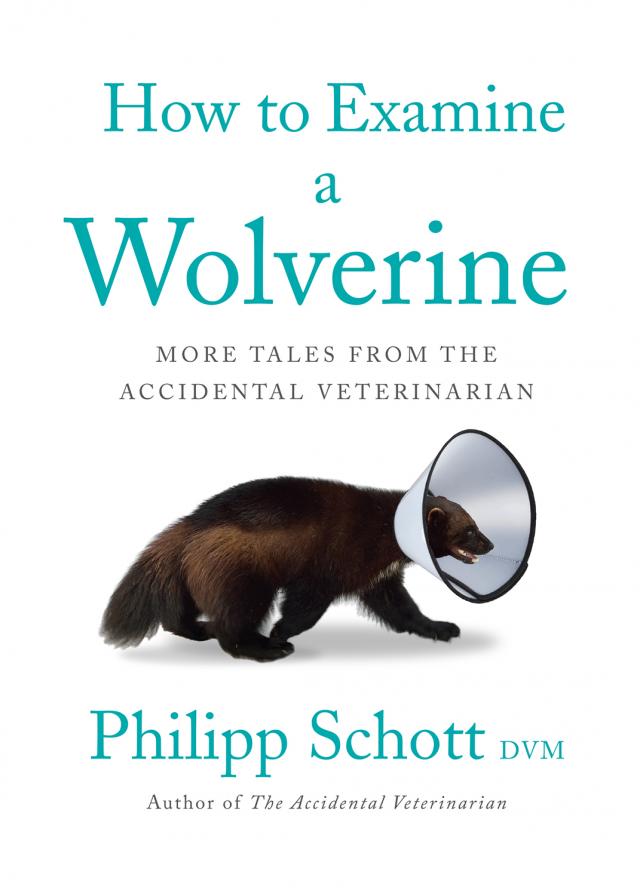


How to Examine a Wolverine
More Tales from the Accidental Veterinarian
Philipp Schott, DVM
Contents
Dedication
Preface
Part One: Dogs
Snoopy’s Magical Digestive System
Rascal Rabbit Four
Part One: Sprayed
Part Two: Poked
Part Three: Chomped
Orbit’s Off Day
Monty’s Story
Dogs Getting High
Three and a Spare
Mr. Barky Barkerson
Flat Face
Shoes Clues
Bonjour, Monsieur Poisson
The Balance of Responsibilities
Zoonoses
Alien
It’s the Dog, I Swear
Raw
The Ultimate Terror
The Mysterious Case of the Balding Poodle
Tzu-Hsi Rolls the Dice
Part Two: Cats
Behold, the Mighty Hunter
The Shoemaker’s Children
It’s a Hell New World
Caturday
Cat Barf
George
Herpes!
Doing the Nip
Brrt
The Three Fs
Blizzard
His Favourite Spot
Part Three: Vets
The Letter
An Hour Spent Sitting at a Fork in the Road
Many Creatures Great and Small
The Experimental Veterinarian
Money Is No Object
Incoming
Eat the Frog
Vets Gone Bad
Surgery for Dummies
Dr. Goliath, DVM
The Curious Tale of the Restaurant Next Door
The 80%
Vet Vet
Pet 911
Vets Abroad
Fiddling with the Dials
Alarmed
Doctor of Veterinary M . . . ?
Colonoscopy and Liver Treats
Two Holes
Busy Night
A Priest, a Rabbi and a Vet Walk into a Bar
Thank You for Saying Thank You
Everything You Wanted To Know about Euthanasia but Were Afraid To Ask
Love
Part Four: Other Beasts
The Second Duck
Bee Med
The Life and Times of Hank Ramirez
Benji
Huey
How To Make a Sheep Sit
Love, from A Distance
The Ferret Guy
Another Thing I Am Terrible At
Pet Mouse / Wild Mouse
My Largest Patient
Epilogue
For the Love of Animals
Afterword
Acknowledgements
About the Author
Copyright
Dedication
For Lucy, Gabi, Orbit, and yes, even Lillie.They may not be able to read, but it feels right to dedicate this book to them. You’ll see why.
Preface
There are a lot of metaphors for life. Even though I am not a fatalist, the metaphor that comes to my mind when I consider this book is dominos. The first domino to fall was my discovery of blogging as an outlet for my urge to write. This knocked over the next domino, which was the realization that people preferred my veterinary blog to the whisky and travel ones. The suggestion that the vet blog could become a book followed. ECW Press agreed that this was a good suggestion, and The Accidental Veterinarian was published in the spring of 2019. Click, clack, more dominos. To my astonishment, the book sold well and even went on to be translated into Polish, Hungarian, Russian and Chinese. And almost immediately the questions began, sometimes daily, about when my next book was coming out. My next book? Huh. I did have other book ideas, but I know that these people specifically meant another vet book, and I was pretty sure I had said everything I wanted to say about veterinary medicine. But I was wrong. Once the domino of that question fell, it triggered a steady procession of story ideas in my mind. Veterinary medicine really is a story engine. To be sure, there is a lot that we do as veterinarians that is routine and profoundly uninteresting, but given the collision of people and animals and love and money and life and death and chaos and beauty, it is a rare day that goes by that does not feed that story engine.
And what’s the next domino? A third book? A How to Examine a Wolverine puppet show? An interpretive dance? One of these is more probable than the other two. But I have been surprised before. In fact, I live my life being almost continually surprised, and I like it that way.
Part One
Dogs
Snoopy’s Magical Digestive System
When I’m in exam room 2 around Christmas I sometimes still think about Dixie Pawluk. I sometimes still think about her even though this was close to 20 years ago, and even though the display of “odd things removed from pets” that we kept in that room appears to have been thrown out, probably by staff tired of being grossed out every time they dusted the jars.
Dixie came in on the first day we were open after Christmas. She was normally a very lively little Cairn terrier — lively even by the peppy standards of the breed — but that day she was quiet. Normally she would run up to me and cock her head with that “So, are you giving me a treat or what?” facial expression if I went anywhere near the treat jar, but that day she just lay by Mrs. Pawluk’s feet and did not look up at me at all. Mrs. Pawluk was a widow and none of her children lived in Winnipeg anymore. Apparently, she had some friends who she played poker with every Friday night, but otherwise Dixie was by far her best friend and closest companion. She had had a succession of Cairns over the years, but she told me more than once that Dixie was the best of the lot. She often wore sweaters with pictures of Cairns on them. She had a new, red one on that day sporting a large tartan appliqué Cairn.
“So, Dixie’s not looking too well today. When did this start?” I asked.
“The day before yesterday, on Christmas Day, she did not want to eat, not even her favourite treat. I thought maybe she just ate too much on Christmas Eve, so I didn’t really worry, but yesterday it was the same thing.” Mrs. Pawluk had Parkinson’s and her hands were shaking as it was always worse when she was anxious.
“OK. Has she vomited at all?”
“No, but she does this.” Mrs. Pawluk mimed a dog opening its mouth wide, as if to yawn, while stretching her neck out. “There’s no sound at first and then a little gag at the end. Do you think something could be stuck in her throat, Doctor?”
“It’s not likely, but it’s possible. Did you feed her anything unusual on Christmas Eve?”
I know that some of my colleagues reading this will immediately recognize my error. Perhaps they’re even sticking their arms in the air and saying “oh, oh, oh” like Horshack on Welcome Back, Kotter when he knows the answer to a question. In my defence I remind them that this was a very long time ago, and assure them that I definitely learned from my mistake. But back to Dixie.
I was about to ask a few more questions when Dixie stood up and retched a couple times in very much the fashion that Mrs. Pawluk had described, although the sound at the end was louder, wetter and more violent than I had expected. I picked Dixie up and put her on the exam table. Her lungs sounded clear and her belly felt soft and empty, but she had a slight fever. The only other abnormality was that by palpating her windpipe I could get her to cough a little. To allay Mrs. Pawluk’s worry about something being stuck I opened Dixie’s mouth and looked in as far as I could, which was not very far. I put her back on the floor and then sat down on my stool to deliver the verdict.
“I’m pretty sure Dixie has a form of kennel cough. It’s unusual for them to go off their food with this, but she has a bit of a fever too, so she may have some bacterial complications. It will clear up with time and antibiotics.”
“Thank you, Doctor, I’m so relieved it’s nothing more serious!”
Cue ominous music.
I saw Dixie again four days later on New Year’s Eve. She still hadn’t eaten, and she had become increasingly depressed, hardly moving at all now. Mrs. Pawluk would have come in sooner, but the weekend had intervened, and she wanted to wait for me rather than go to the emergency clinic. Now I was worried too. This was obviously not kennel cough, or any other sort of respiratory infection. We ran blood and took x-rays. One of the nurses grabbed me and said, “Philipp, come and look at this x-ray. There’s something weird in there.”
Indeed, there was. In Dixie’s chest, slightly ahead of and above the heart, was a very dense, irregularly shaped object, perhaps half an inch across. It was a piece of bone and it was lodged deep in her esophagus, the tube that leads from the mouth to the stomach. Mrs. Pawluk had been right, sort of. Certainly righter than I had been.
As we were closing for New Year’s, and in any case were not set up to provide the overnight care she needed, we transferred Dixie to the emergency clinic. I don’t think enough of you are interested in the gory medical details to warrant a complete t elling, so I’ll summarize what happened next by saying that they ultimately decided to try to remove the bone with an endoscope. They got the bone, but unfortunately they found a large tear in the lining of the esophagus that could not be repaired. Poor Dixie struggled along for another couple of days, but it was hopeless, and Mrs. Pawluk had to make the heartrending decision to let her go.
A week or two later Mrs. Pawluk came in to give me a thank-you card, which I was not sure I deserved, and to talk. I felt terrible that I had missed the diagnosis initially and she felt terrible that she had fed Dixie pork ribs as a treat. She said that Dixie got rib bones regularly. It was not unusual. It was, in fact, her usual treat for special occasions. She had never had a problem before. She had told the truth when I had asked her whether she had given Dixie anything unusual to eat.
Before she left, she handed me a small object wrapped in brown paper. It was the bone. I put it in a jar and set it up on the shelf in room 2, beside the giant stone that had filled Guido the tiny Pomeranian’s entire bladder, and beside the rogue’s gallery of pickled parasites. Dixie’s bone was there to remind me that I should always ask, “Could she have eaten anything other than dog food?” rather than “Did you feed her something unusual?” It was also there to remind me to tell people that Charles Schultz, bless his soul, did the dog-owning public a grave disservice by depicting Snoopy powering through a stack of bones like they were Pringles. But then Snoopy is clearly a magical dog. When your dog starts fighting the Red Baron and decorating Christmas trees, we can talk about feeding him bones. Until then, know this: bones can be so dangerous, especially pork and poultry.
To be honest, the bone in the jar was kind of gross, so I understand why it’s gone. And I remember these things anyway.
P.S.
Some of you reading this will protest that the dog you had growing up on the farm ate nothing but pork and chicken bones and lived to be 103. Or something like that. This was likely the same dog who never saw a vet, not even once in his unnaturally long life, and the same dog who ran 20 miles through a blizzard to get help when grandpa got his arm stuck in the snowblower. All I can say to you is that I guess they don’t make dogs like they used to.
P.P.S.
A small but measurable percentage of you will now have the Welcome Back, Kotter theme looping through your brain for the next two days. No, there’s really no need to thank me.
Rascal Rabbit Four
As a rule, I change the names of patients and clients when writing about them, but from time to time, for a variety of reasons, I don’t. This time it’s because the name Rascal Rabbit Four still makes me smile every time I think of it, and his story wouldn’t be the same without his name. On a side note, the owners wrote “four” with Roman numerals, but “IV” would be confusing in a medical setting. Rascal Rabbit Four was a little white male toy poodle and he was called that because he was the fourth little white male toy poodle named Rascal Rabbit the Sezniks had owned.
Earl and Dolly Seznik must have been a hot couple back in the day. Well into her eighties, Dolly still wore short skirts, high heels and candy apple-red lipstick, while Earl styled his grey hair into a lavish pompadour and often wore a jaunty scarf. They drove to the clinic in a white convertible Cadillac Eldorado with Rascal Rabbit Four on Dolly’s lap, tongue lolling and long ears flapping in the breeze as he stuck his head out the side, delighted to be going for a car ride, even if it was to the vet. The other three Rascal Rabbits were before my time, but I was told that the Sezniks had not originally added a number to the name. They were apparently so unprepared to cope with the loss of the first Rascal Rabbit that they decided to get another dog that looked as similar as possible, to name him Rascal Rabbit and to carry on as if nothing had happened. They were eventually gently persuaded that this might be confusing, so they added the ordinal.
The Sezniks’ predicament was brought to mind the other day when I read an article about pet cloning. Things have progressed quickly since Dolly the sheep was cloned in 1996, in what at the time was a startling breakthrough. The process has since been perfected and no longer presents any important technical hurdles. Now there are several companies offering to clone your dog or cat. While the price is coming down, it is still not something most people would consider a bargain, with dog clones costing around $50,000 and cats a little less. Horses can also be cloned for $85,000. But for the sake of argument, let’s say that the expense doesn’t seem ludicrous and that you can afford this. You were planning on buying a sailboat anyway, but you figure you’ll get more pleasure out of a dog that is just like your favourite old pal. Fair enough. The problem, however, comes in the “just like” part. A clone is not a perpetually identical copy. Think about identical human twins. They are clones of each other. The process is different, but the genetic outcome is the same. If you know any twins, you will know that they are almost indistinguishable from each other, but only almost. DNA is a tricky little molecule and the same genes may express themselves differently in different individuals. This is the basis of the science of epigenetics, the complex study of which I have inelegantly summarized in that single sentence. Look it up if you want to know more, but for the purposes of this discussion, the takeaway is that clones, or twins, may have the same DNA, but they will not be identical in every way. And that’s just appearance. Personality will diverge even more because it is also dependent on random things that happen to you over the course of your life. Those little differences may or may not matter to you, but for many people it is akin to looking at a famous painting with one detail off — say Mona Lisa’s eyes are suddenly green instead of brown — and although the painting is substantially the same, you cannot stop thinking about the difference.
One of the most famous owners of cloned dogs is Barbra Streisand. In 2017 Samantha, Streisand’s beloved Coton du Tuléar (similar to a Bichon Frisé, if you’re unfamiliar), died and she decided to have her cloned. She even had her cloned twice to be on the safe side. Now that Miss Scarlet and Miss Violet — named after the colours of the doggie dresses she put on them to tell them apart — are full grown, they are each the absolute spitting image of Samantha. Yet, in a recent interview, Ms. Streisand hinted at what I would consider to be a deal-breaking problem. Whether it is due to epigenetics or other random factors, there are subtle differences between the two new dogs and the old one. And these subtle differences, like Mona Lisa’s eyes, threaten to become a pebble in the mind’s shoe. The entire endeavour demands that you constantly compare old and new, original and clone, beloved and not-quite-yet-beloved. Of course, one always compares regardless, but when something is meant to be identical, these comparisons can become far more fraught. I think it would seem uncanny to me, like an alien bodysnatching that was not quite completely successful. But maybe that’s just me. Maybe 99% the same isn’t a problem because it falls short of 100%; maybe it’s a solution because it blows 80% out of the water. However, if the shelters are full and that 80% desperately needs a home, perhaps there’s another angle to consider as well.
The Sezniks had a different take on this debate. They told me more than once that Rascal Rabbit Four was the best one. In fact, they felt that each one was an improvement over the last, so that each time they were grateful not to have chanced on a carbon copy. Four was the ultimate Rascal Rabbit as, sadly, there was to be no Rascal Rabbit Five. By the time Four died the Sezniks were not in a position to get another dog. Earl died shortly after, and Dolly developed dementia. They had a good long run, though, those two, or should I say, those six. I really miss them.
Fido versus the World: Urban wildlife encounters in three parts
Part One: Sprayed
Before I even saw him, I could smell Brownie. The whole clinic could smell Brownie. Probably the neighbours could smell Brownie. Maybe even the people driving by on Portage Avenue could smell Brownie. But Brownie didn’t care. He was still the same old happy, tail-wagging chocolate Lab we loved, at least until he came in and made everyone go, “Oh my God! What is that smell? Is that skunk?”
Yes, it was. Brownie had been skunked. He may not have cared but his owner was in a state of some distress. She kept apologizing for bringing him in, but she didn’t want him in the house and he had met the skunk in the yard, so she didn’t want him there either, at least until she was sure that it was safe, and it was a hot summer day, so she couldn’t leave him in the car. The only place left to go was the clinic, where she was desperately hoping we could help. We did have Skunk-Off in stock, so a brave vet tech put on a large smock and led Brownie, tail still wagging, to a distant room to apply it. Brownie was lucky because he hadn’t gotten it in the eyes, where it can be quite irritating, and he was lucky because he was up to date on rabies vaccine and it didn’t look like he had actually come into direct contact with the skunk. Skunks are the most common carriers of rabies in Manitoba.






