Mafioso, p.1
Mafioso, page 1
part #1 of The Mafia Chronicles Series


The Home of Great
Crime Fiction!
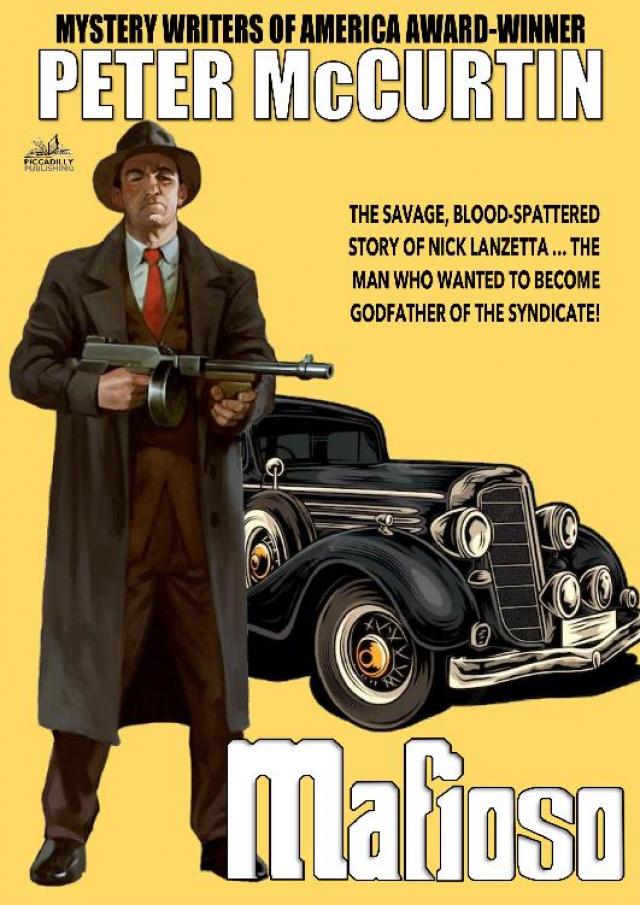
Nick Lanzetta. Born Brooklyn, N.Y. 1933. Occupation: Mafia soldier. Specialty: murder. Expert with pistol, rifle, machine gun. Has been known to use an icepick, a length of piano wire, or his bare hands. Arrested 17 times, twice for first degree homicide. No convictions since juvenile convictions for auto theft. A graduate of the old South Brooklyn gang called The Rangers, Lanzetta was admitted to membership in the Mafia under the sponsorship of Joseph Daniello, caporegime in the notorious DiSalvo Family. Since then, according to FBI reports, he has committed at least 40 murders, earning a reputation as the most feared killer on the east coast. Now 37, he thinks it’s time he moved up in the Organization.
MAFIOSO
By Peter McCurtin
First published by Belmont Books in 1970
Copyright 1970, 2023 by Peter McCurtin
First Electronic Edition: February 2023
Names, characters and incidents in this book are fictional, and any resemblance to actual events, locales, organizations, or persons living or dead is purely coincidental.
All rights reserved. No part of this book may be reproduced or transmitted in any form or by any means, electronic or mechanical, including photocopying, recording or by any information or storage and retrieval system, without the written permission of the author, except where permitted by law.
This is a Piccadilly Publishing Book
Series Editor: David Whitehead
Text © Piccadilly Publishing
Published by Arrangement with the Author Estate.
Table of Contents
Chapter One
Chapter Two
Chapter Three
Chapter Four
Chapter Five
Chapter Six
Chapter Seven
Chapter Eight
Chapter Nine
Chapter Ten
Chapter Eleven
Chapter Twelve
Chapter Thirteen
Chapter Fourteen
About the Author
Chapter One
NICK LANZETTA SET down the aluminum-framed attaché case in the darkened hallway of the building next door to the movie theater. He looked at the illuminated face of his wristwatch before he reached under the lapel of his suit jacket and took out a sliver of steel three inches long.
Probing in the lock, feeling for the point of pressure, Lanzetta heard a tiny click. The door opened and he went in noiselessly on rubber-soled shoes. He closed the door carefully and felt his way through the darkness to the bottom of the metal stairs. It was a four-story commercial building, with no elevator, no watchman. A man from a protective agency came along and checked the door every two hours.
The last door check had been made at eleven o’clock. Now it was eleven-twenty, ten minutes until the movie let out, a hundred minutes to the next door check.
Feeling his way up to the first landing, Lanzetta switched on a pencil flashlight. Then he scrambled up the stairs, two at a time, quickly and carefully. The rungs of the steel ladder that led to the roof felt gritty under the thin gray cotton gloves he wore, the kind used by undertakers.
Lanzetta didn’t like rubber gloves; they fitted too tightly and gave the hands an unnatural feel. He would have preferred to use no gloves at all, but coating the fingers with rubber cement wasn’t always reliable. The undertaker’s gloves worked fine and he used a lot of them, a fresh pair for every job.
Handling the attaché case with great care, Lanzetta unbolted the door to the roof and climbed out into the chill wind. The watch told him that he had seven minutes to get set.
Feet crunching in the gritty dust of the tarred roof, he moved quickly toward the trapdoor above the movie theater. He knew it would open because he had unlocked it thirty minutes before. Lanzetta had sat through a new-style private eye picture full of naked broads and dirty talk. Then he went silently up the stairs, past the manager’s office and the projection booth, and unlocked the door. He had to do it that way. He could try to hide in the theater, but he knew they’d check.
Lanzetta locked the door and went down the stairs. The sound of machine gun fire and honky-tonk piano rattled through the metal door of the projection room. The movie squawked to its conclusion while he waited patiently, out of sight on the darkened landing. The sound of seats being banged up and hundreds of feet moving echoed through the building.
Before the theater had completely emptied out, the operator came out of the projection room, yawning and scratching—a thick-set man with a bored face and horn-rimmed glasses. A million bad movies had taken the life out of him and he went downstairs clumsily, holding on to the rail.
Inside the projection room, Lanzetta looked for the projectionist’s john. He went in a narrow, smelly space in the wall, and closed the door most of the way. The watch hands said eleven-thirty. He waited.
Voices started up the stairs and Lanzetta took a small .32 caliber Steyr automatic pistol from the pocket of his light overcoat. He didn’t recognize either of the voices, but he knew the raspy one didn’t belong to the projectionist. The raspy voice was telling the projectionist to get back in his fuckin’ hole, to stay there until he was told to come out, to keep the fuckin’ door locked.
“I always get coffee before I close up,” the projectionist explained.
Now Lanzetta could see them; the man with the projectionist was Monk Sasso. They called him Monk because of the tonsure-like bald spot on the back of his head.
Sasso looked into the projection room; didn’t see anything that bothered him. “Screw the coffee,” he said to the projectionist. “You’re getting paid to be here to show a movie, not to fuck around. The Boss don’t like guys that fuck around.”
“Okay,” the projectionist said. “And thanks for the fifty bucks, Mr. Sasso.”
“Thanks my ass,” Sasso said. “Just lock that door and run the friggin’ movie. I got to check the stairs. The Boss’ll be here in a minute.”
With the door closed, the projectionist felt safe enough to tell himself that Sasso and The Boss were miserable wop sons of bitches. “We got a strong union, mister,” he went on.
Lanzetta heard the bodyguard go back downstairs. Rattling the cans of film, the projectionist didn’t hear Lanzetta come out of the toilet. But something made him turn around. The thick body heaved with fright and his mouth tried to say something.
“Not a word,” Lanzetta said quietly, touching the projectionist on the heart with the muzzle of the automatic. “A word and you’re dead. Understand?”
The projectionist nodded his head vigorously, his buttery face full of fear and questions. When he was finally able to speak, all he said was, “Jesus, mister!”
“Take it easy,” Lanzetta said. “Just go on with what you’re doing. Set up the movie and wait. How do you know when to start it running? They press the buzzer downstairs?”
“Yeah, mister, that’s it.”
“Where does that telephone go?”
“To the manager’s office, that’s all. Jesus, please don’t kill me. I got nothing to do with Mike Esposito. The manager said I was to run a movie. A special showing for Mr. Esposito.”
“No more talk,” Lanzetta ordered. “Shut up and do the job. Nothing’s going to happen to you. Is that clear?”
The projectionist’s head bobbed up and down. Lanzetta opened the observation port in the front wall of the room and looked down into the empty theater. The house lights were turned up full and he smelled the stale odor of bodies and cheap candy and dead cigarettes.
While he watched, Monk Sasso and two other men walked down the center aisle. He heard Sasso tell the two men to climb up on to the stage and check behind the screen. “Then check the exits. Make sure they’re locked,” Sasso called out. “Stay at the exit doors, don’t move. The rest of the boys’ll watch the front.”
The telephone buzzed in the projection room. “Remember the wife and kids,” Lanzetta said.
“Yeah, it’s all ready,” the projectionist said into the phone. “Everything ready this end.”
Quickly, Lanzetta opened the attaché case and took out a U.S. Army grenade launcher in sections. The pieces clicked together in his steady, expert hands. The phallus-shaped grenade was loaded into the chamber of the short weapon when the house lights dimmed, the signal for Mike Esposito and his friends to take their seats.
Lanzetta placed two more grenades on top of a wooden crate under the observation port. In the dim light he saw a group of shadows move down the center aisle. One of the shadows was Mike Esposito; some of the others would be Esposito’s lieutenants, Frank DeLuca and Paddy Orsini. There was no way to be sure in the bad light, and that was why Lanzetta was using the grenade launcher instead of a submachine gun.
It was an unusual weapon, even for Lanzetta, an expert in many instruments of death. After a week of practicing with dud ammunition he thought it would work well enough. For three months now he had been going after Esposito, and there were times when he was close to killing him, but never close enough. This was the best shot he was likely to get, and firing a machine gun at a group of men he couldn’t clearly see wasn’t the way to do it.
The destruction of Mike Esposito had to be total, with no chance that the Brooklyn boss would crawl away full of holes, but still alive. At the moment, Lanzetta was interested only in Esposito; if he could get DeLuca and Orsini at the same time, so much the better. It would save having to go after them later.
The telephone buzzed again.
Lanzetta watched him start the picture running. The only machines Lanzetta trusted were the guns he used and serviced himself. He let the picture run through the slow crawl of titles and credits before he chopped the projectionist twice across the back of the neck. He caught the man before he fell and laid him on his back on the floor.
The opening scene was a gun battle between prison guards and escaping cons. That was good—plenty of cover for the click and hiss of the first grenade. Lanzetta stepped back to the porthole, his eyes searching the dimly lit theater below.
They were about halfway down the center aisle and the little cluster of shapes looked odd with all the empty space around them. Lanzetta pointed the grenade launcher through the port, moved it to the center of the target and pressed the trigger. The flash and explosion came together. Lanzetta fitted another grenade and fired. The screams that started with the first grenade were stopped by the second.
The whole center of the theater was wrecked and burning. Through the destruction the movie continued to babble and laugh. Lanzetta fired the third grenade to make sure. There was no need to check the damage. One grenade was left in the carrying case and he loaded it on his way to the door. Before he opened it, he used the automatic to shoot the unconscious projectionist in the back of the head. He dropped the gun beside the body.
Lanzetta faced the stairs, the loaded grenade ready. Down below he could hear Monk Sasso screaming in rage and panic. Lanzetta knew they hadn’t figured it out yet. A fire alarm went off as he ran up the stairs toward the roof. Lanzetta was in no hurry, and he waited around the corner of the third landing. He was in no hurry: he would give them five seconds.
Monk Sasso came pumping up the stairs on his heavy legs. Mike Esposito’s top triggerman was crazed with grief and shame. The two men behind him didn’t seem so eager to get killed. Sasso was quick enough when he heard Lanzetta move into position. It didn’t do him any good. Lanzetta let loose the last grenade and threw himself flat on the landing.
The grenade, exploding between narrow concrete walls, ripped the three men to shreds, spattering blood and brains and torn flesh in every direction. Lanzetta dropped the grenade launcher and smiled. It wasn’t much of a smile, more a twitching of the lips, and there was no conceit in it. Lanzetta smiled briefly because he was satisfied.
A fire engine howled in the distance. Police cars were already in the street, their sirens running down to a growl. Lanzetta ran along the line of rooftops, fast but cautious, no strain in his breathing. He went down a fire escape behind a darkened loft building, ran to a steel mesh fence, and climbed over it into a small city playground.
Running across the green-painted cement, he could still hear the noise on the other side of the block. No one saw him climb over the fence and drop silently to the sidewalk. It was a quiet street with trees; a downtown Manhattan street of 19th century houses broken at one end by a small, outdoor parking lot. The noise was beginning to fade.
The lot was empty except for a few overnight cars. Lanzetta unlocked a nondescript two-tone sedan and started the engine. He didn’t turn on the lights until he turned the car into the street. A man walking a huge dog didn’t look up as Lanzetta drove past. There was no reason for the dog-walker to be interested. All he would have seen was an over-age car with New York plates traveling at thirty miles an hour.
The light at the corner was red, but Lanzetta’s face showed no impatience. The car went down the west side of Washington Square Park, down McDougal Street, then East along Bleecker, then turned south onto Broadway. At Canal Street, Lanzetta parked the car in a legal parking space that would take it unnoticed through the next day. He didn’t leave the cotton gloves in the car, but dropped them in the gutter before he reached the entrance to the southbound IRT subway station.
Lanzetta read the Daily News, the columns in the back, the late movie listings on television, while the train rumbled under the East River to Brooklyn. A crazy drunk with a wine bottle in a paper bag cursed at him. Lanzetta moved to another car. Nothing else happened until he got off at the Clark Street stop and took the big elevator upstairs to the outside lobby of the St. George Hotel.
On the third try he found a pay phone that worked. The number he rang answered immediately. The voice at the other end said, “Yeah.”
It was all a one-sided conversation. Lanzetta didn’t say who he was, where he was. All he said was, “Delivery made and received. Paid in full.”
The man at the other end didn’t say thanks and he hung up the receiver without saying anything at all. Lanzetta didn’t expect to be thanked, and he wasn’t offended.
It was all in a day’s work.
Chapter Two
FOR A MAN with so little to say on the telephone, Joseph Daniello, or Uncle Joe as he liked to be called, could hardly have been more demonstrative once he hung up the receiver. He rubbed his hands together, washing them in delight, then clapped them to his head, almost unable to stand the good news. Though heavy with prosperous fat, he danced lightly around the small library of his renovated town house, humming a gay tune about the ripe oranges of his native Sicily.
The tune really wasn’t about oranges; in the song the oranges meant young girls’ breasts. Joseph Daniello had a way of singing it when he was happy or stimulated or surprised. Now he was all these things.
Uncle Joe stopped, shaking his bullet head in genuine admiration. “The balls on the guy,” he informed the leather-bound books that when from floor to ceiling. “Mother of God! If that ain’t a kick in the nuts!”
Uncle Joe was an emotional man. When he had to, when the occasion or decorum demanded it, he could be cold as a clam or a blond American girl, but he didn’t like it. Uncle Joe liked to sing, liked to laugh; to eat and drink; to screw and fight. He liked to kill when the man was a traitor and a fink and a son of a bitch. That was emotion, too—good emotion, like shooting a load into a broad you liked or a broad who hated you and was afraid to say no.
Uncle Joe liked his beautiful house on Columbia Street in Brooklyn Heights. The fuckin’ Protestants who built it long before the Civil War had been too severe, too white-assed simple in their tastes to suit Uncle Joe. There was no way for a man to be comfortable in a house like that, so Uncle gutted the building from top to bottom. Arches, doorways, niches for statues, rich wallpaper, warm paneling had been added. Uncle Joe loved it now.
At home, Uncle Joe could be himself. Talk, shout, sing. Uncle Joe was happy. Lanzetta had done the job and it reflected honor on him, for Lanzetta was his man, his boy. Uncle Joe didn’t really know or understand Lanzetta, didn’t like him—who could like him?—but he admired the man. In a way, the honor was all his; Lanzetta was simply a gun and he, Uncle Joe, pointed it.
‘‘The balls on the guy!” Uncle Joe repeated, less admiring of Lanzetta and more of himself.
He unlocked a drawer in an ancient, stained-oak desk and removed a telephone. “To suck those little oranges is all my heart desires,” he sang in Italian while he waited for the telephone at the other end to answer.
“To suck and suck and suck,” Uncle Joe sang. “Is all ...”
A soft, slightly accented voice said, “Yes,” and Uncle Joe stopped singing. It was hard for him not to praise himself. It took an effort not to praise himself, to fish for compliments. Honor and compliments were certainly his due, but he forced himself to adhere to procedure. Better than anyone, hating the thought, Uncle Joe knew the phone might be tapped. Might be! Who could doubt it?
“Delivery made and accepted. Paid in full,” Uncle Joe announced, adding, “No doubt about it.”
The voice that spoke to him was courteous; it contained just the faintest admonition. “You would not have called with doubt.”
“No doubt,” Uncle Joe said. “No doubt at all.”
“Good,” the voice said. “And goodnight.”
Uncle Joe hung up. For a moment he felt let-down, but after a glass of American rye whiskey, followed by a cold bottle of imported Peroni beer, he felt fine again. Honor was certainly his due and he would get it. True, Lanzetta, the cold-faced killer, had pulled the trigger; but where would such men as Lanzetta be without a wise head to guide them? It was he, Uncle Joe, who had supplied the vital information that Mike Esposito had a madness for American gangsters films. He couldn’t find enough of them on television, or didn’t like the ones shown.