Monsieur teste, p.1
Monsieur Teste, page 1


PAUL VALÉRY (1871–1945) was born in Sète, Occitanie, on the Mediterranean coast of France, and raised in the nearby city of Montpellier. His father was a Corsican-born customs officer and his mother the daughter of an Italian diplomat. As a young man he hoped to enter the navy, but his math was not up to naval academy standards. He began to write poetry; he attended law school; but above all he made plans to devote himself to a life of the mind, to be lived out in his notebooks, which, by the end of his life, had swelled to monumental proportions. In the 1890s, Valéry moved to Paris and briefly worked for the Ministry of War before becoming the private secretary of an executive at the Agence Havas (the world’s first news agency)—a position he held for twenty years. He established an international reputation as a brilliant and unparalleled thinker and writer: his work was a touchstone to T. S. Eliot as much as to André Breton, and his “Cemetery by the Sea” stands as one of the greatest of twentieth-century poems. In 1925, he was elected to the Académie française.
CHARLOTTE MANDELL, a Chevalier dans l’Ordre des Arts et des Lettres and recipient of the Thornton Wilder Translation Prize from the American Academy of Arts and Letters, has translated more than forty books, including Jean Genet’s The Criminal Child and André Breton and Philippe Soupault’s The Magnetic Fields (both available from New York Review Books). Her forthcoming translations include works by Proust, Céline, Jonathan Littell, Mathias Énard, and Sabine Huynh.
RYAN RUBY is the author of Context Collapse: A Poem Containing a History of Poetry and The Zero and the One: A Novel. For his essays and reviews, which have appeared in Harper’s, The New Yorker, and The New York Times, he received the Robert B. Silvers Prize for Literary Criticism. He lives in Berlin.
MONSIEUR TESTE
PAUL VALÉRY
Translated from the French by
CHARLOTTE MANDELL
Introduction by
RYAN RUBY
NEW YORK REVIEW BOOKS
New York
THIS IS A NEW YORK REVIEW BOOK
PUBLISHED BY THE NEW YORK REVIEW OF BOOKS
207 East 32nd Street, New York, NY 10016
www.nyrb.com
Translation copyright © 2025 by Charlotte Mandell
Introduction copyright © 2025 by Ryan Ruby
All rights reserved.
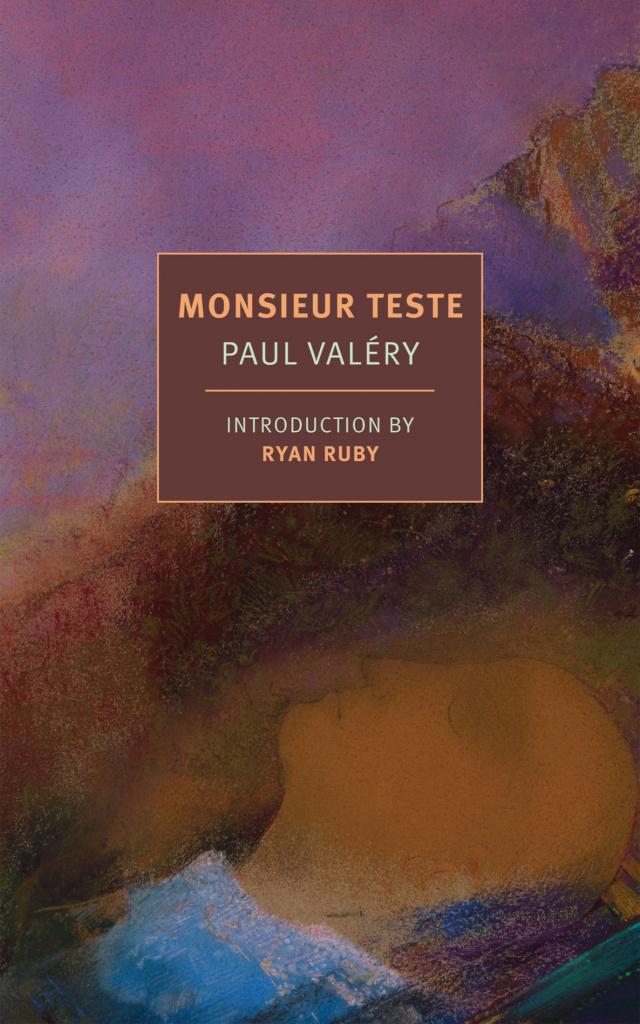
Cover image: Odilon Redon, Orpheus, c. 1903–10; The Cleveland Museum of Art
Cover design: Katy Homans
Library of Congress Cataloging-in-Publication Data
Names: Valéry, Paul, 1871–1945, author. | Mandell, Charlotte, translator.
Title: Monsieur Teste / by Paul Valéry; translated by Charlotte Mandell.
Other titles: Monsieur Teste. English
Description: New York: New York Review Books, 2025. | Series: New York Review Books classics |
Identifiers: LCCN 2024008816 (print) | LCCN 2024008817 (ebook) | ISBN 9781681378923 (paperback) | ISBN 9781681378930 (ebook)
Subjects: LCGFT: Novels.
Classification: LCC PQ2643.A26 M5213 2025 (print) | LCC PQ2643.A26 (ebook) | DDC 843/.914—dc23/eng/20240301
LC record available at https://lccn.loc.gov/2024008816
LC ebook record available at https://lccn.loc.gov/2024008817
ISBN 978-1-68137-893-0
v1.0
CONTENTS
Cover
Biographical Notes
Title Page
Copyright and More Information
Introduction
Preface
The Evening with Monsieur Teste
Letter from Madame Émile Teste
Extracts from the Logbook of Monsieur Teste
Letter from a Friend
The Stroll with Monsieur Teste
Dialogue: A New Fragment Concerning Monsieur Teste
For a Portrait of Monsieur Teste
A Few of Monsieur Teste’s Pensées
End of Monsieur Teste
Translator’s Acknowledgments
INTRODUCTION
FOR THE ancient Greeks, the reward of the examined life was tranquillity. Not so for the men of the post-Enlightenment. By the nineteenth century, the Socratic ideal of self-knowledge had curdled into self-consciousness and reason had turned into the vinegar of ratiocination. A taste for abstract thought was more often an impetus to social isolation, disappointed vanity, and nihilism than it was to wisdom, humility, or flourishing. The self had become the subject, a prison cell, and the cosmos had become the noumenal world, whose existence was at best dubious and at worst abyssal.
In Germany, Max Stirner, a student of Hegel, concluded The Ego and Its Own, his paean to individualism with the line “all things are nothing to me,” while Philipp Mainländer, a student of Schopenhauer, climbed a stack of the review copies of his treatise The Philosophy of Redemption, in which he argues that nonbeing is the supreme principle of morality, to hang himself. The Russian literature of the period is full of such overeducated, alienated, “superfluous men.” Think of Lermontov’s Pechorin, whose love of Byron and incurable boredom drives him to womanizing and dueling; or Dostoyevsky’s underground man, spitting vituperation in his basement apartment; or Goncharov’s Oblomov, who can barely summon the will to leave his bed and put his affairs in order. Although he doesn’t know it, Oblomov had a distant cousin in the land of Descartes by the name of Jean des Esseintes, the sole character of Joris-Karl Huysman’s À Rebours, the last scion of a once proud aristocratic line, who retires to his country estate to live among hothouse plants, ornamental furniture, a bejeweled tortoise, and a library stocked with pessimistic philosophy and symbolist poetry. Tout-Paris was scandalized by Huysman’s plotless portrayal of decadence, much to the delight of Oscar Wilde, who gave his copy of the “poisonous French novel” to Dorian Gray.
It is on des Esseintes’s fictional shelves that a young man from Sète, a small port town in the south of France, who kept À Rebours on his bedstand as though it were the Bible, discovered the work of Stéphane Mallarmé. With the help of Pierre Loüys, a writer friend better connected to literary goings-on in the capital, the twenty-year-old University of Montpellier law student Paul Valéry sent the great poet a sampling of his own early efforts in verse on the theme of Narcissus, that symbol of fatal self-regard. Privately, Mallarmé was underwhelmed, but others were not: “Narcissus Speaks” was published in Loüys’s journal and anthologized in Les Poètes d’aujourd hui, establishing Valéry as a writer to watch. He was invited to take part in the salon at Mallarmé’s apartment on the rue de Rome, where the crème de la crème of the Parisian avant-garde congregated every Tuesday evening. He befriended the future Nobelist André Gide, and slowly became Mallarmé’s most loyal adept and trusted confidante. (A few years later, he would be the first person to be shown the proofs of Un coup de dés jamais n’abolira le hasard).
Following the collapse of a tormented love affair, Valéry experienced a spiritual crisis on a stormy night in Genoa. He renounced his poetic ambitions, although he continued, for a time, to publish prose, including a study of Leonardo da Vinci and a bizarre novella called The Evening with Monsieur Teste, whose narrator and protagonist take the figure of the superfluous man to new extremes. Within a few years Mallarmé—undoubtedly one of the inspirations for the title character—would be dead, and the door on the enervated nineteenth century would revolve into the apocalyptic convulsions of the twentieth. Valéry left his position as a clerk in the Ministry of War to become the secretary to the director of the French Press Association. The reading public would not hear from him again until 1917.
According to Valéry, the “monster idea” of Edmond Teste was conceived at 9 rue de la Vielle-Intendance—in the same apartment, fittingly enough, where the positivist philosopher Auguste Comte was born—in October 1893, exactly one year after his first meeting with Mallarmé and the crisis in Genoa. The name “Teste” is the old French spelling for tête, or “head,” and is meant to draw attention to the character’s ultra-cerebral personality, though other associations such as testifier (to testify) and testicule (testicle) also come to mind. In The Evening with Monsieur Teste, we encounter the prematurely ancient forty-something philosopher through various forms of mediation: the account of an unnamed narrator, a younger man who follows him into cafés and restaurants at night; a letter sent to the narrator by Teste’s wife, Émilie; and the pessimistic aphorisms, or “paper mirrors,” of Teste himself. What seems to draw the narrator and Émilie to Monsieur Teste is his immense self-absorption, which they mistake for spiritual autarky, as though Teste were a Robinson Crusoe whose ship happened to crash into the belle epoque instead of Más a Tierra. Paradoxically, the narrator sees his own narcissism reflected in Teste.
As with all narcissists, but particularly with intellectual ones, his admiration for this abstracted “man of glass” who has “made an idol” of his own mind and become the “master of his thought” is not untouched by envy and anxiety. “It seemed that between you and me,” he writes to Teste, “there were two distances, one still imperceptible, the other already immense; and I did not know which should be taken as the more real of the two . . .” The men speak of their desire for friendship, but know they can only be friends with someone whose solitude is total. “The Cartesian life is simplest,” as Valéry’s epigraph has it, but Teste has cause to doubt whether it’s even really living at all. “From what have I suffered most?” he asks himself. “Perhaps from the habit of developing all my thoughts—of going to the very end in me.”
Perhaps someone browsing the Paris bookshops in the ensuing dec ade took a moment to wonder what had ever happened to that promising poet Paul Valéry, the creator of the eccentric Monsieur Teste. The Teste texts had showed Valéry to be an aphorist of distinction—a worthy heir to Nietzsche’s Zarathustra (conceived, incidentally, in Genoa) and an anticipator of Hofmannsthal’s Lord Chandos—capable of the exquisite reversals of logic and diamantine turns of phrase that are hallmarks and provide the pleasures of the “little form.” Emil Cioran, himself a past master of the genre, would later characterize Valéry as a “syntactic genius” and a “maniac of lucidity,” who, having achieved perfect literary mastery in Teste and his essay on Leonardo, privately embarked upon “an exhausting quest for infinitesimal precision.”
Gide was one of the few who knew of this quest: that Valéry woke up every morning at five sharp to fill page after page of notebooks with drawings, scientific theories, philosophical speculation, literary fragments, and probing analyses of his own states of mind—for no audience but himself. (Teste would have approved.) Gide had meanwhile become an important tastemaker, having published a string of novels and founded the Nouvelle Revue française. He tried to coax his old friend out of literary retirement by promising to bring out an edition of his early poems. Often quoted as saying that poems are never finished, only abandoned, Valéry was a fastidious, even obsessive reviser of his own work. In the eight years he spent preparing the collection—it probably would have taken longer had an exasperated Gide not intervened—he experienced a burst of creative activity whose only parallel in twentieth-century poetry can be found in the one later experienced by his friend Rainer Maria Rilke at Duino Castle.
In 1917, the forty-five-year-old Valéry published “The Young Fate,” a 512-line poem in rhyming couplets about the girl-hood of one of the three goddesses of fate, to instant acclaim. He followed it up with his Album of Early Verse in 1920 and Charmes in 1921. Charmes included “Fragments of ‘Narcissus,’” “The Pythia,” “Palm,” “Sketch of a Serpent,” and “The Cemetery by the Sea,” the last of which, a meditation on being and nothingness set in the graveyard in his hometown, is arguably the most important French poem of the twentieth century. Having secured himself a place as the rightful heir of Mallarmé in the canon of French modernist poetry, Valéry settled into the socially—if not necessarily financially—comfortable role of public intellectual and man of letters, penning essays and giving talks on an array of topics, from the political events of the day to questions of aesthetics. He was elected to the Academie française; a chair in poetry at the Collège de France was created especially for him; he could count among his admirers not only Gide and Rilke, but also André Bréton, T. S. Eliot, Robert Lowell, and Edmund Wilson, who devoted a chapter to him in Axel’s Castle, his study of symbolist literature. When Valéry died in 1945, having seen the entirety of the Third Republic, one of the most fertile periods in French culture, he was given a state funeral, and buried in the graveyard where his best-known work takes place.
Yet Valéry still had a few surprises in store. After his death, the public finally became aware that his published writing constituted a mere fraction of his intellectual output, when the record of his quest for infinitesimal precision—the 261 notebooks he had been keeping since 1894, totaling more than 30,000 pages—was revealed. Also discovered among his papers was a series of documents related to Monsieur Teste, including the narrator’s account of a stroll with Teste, a pen portrait, a philosophical dialogue, an account of their last meeting, and several new aphorisms. It seems as though Valéry, that incorrigible reviser, had not quite gone to the end of his character after all. Surveying Monsieur Teste again from the vantage point of twenty-first-century America, where isolated, overeducated men, starting into the mirrors of their screens, seek consolation in monstrous ideas and find only the abysses of themselves, it seems that we are not quite done with him either.
—RYAN RUBY
PREFACE
THIS IMAGINARY character, whose author I became during a youth that was half literary, half unsociable or . . . inward, has gone on living, it seems, since that vanished time, with a certain life—with which his reticence, rather than his avowals, has led some readers to endow him.
Teste was begotten—in a room where Auguste Comte spent his early years—during an era when I was drunk on my own will, and subject to strange excesses of self-awareness.
I was afflicted with the acute disease of precision. I was striving for the extreme of a mad desire to understand, and I was searching in myself for the critical points in my faculty of attention.
So I was doing whatever I could to increase the duration of certain thoughts a little. Anything that was easy for me was uninteresting, almost my enemy. The sensation of effort seemed to be what I needed to seek out, and I did not prize the fortunate results that are nothing but the natural fruits of our native abilities. That is, results in general—consequently, the works themselves—mattered much less to me than the energy of their worker—the substance of things hoped for. This proves that theology can be found pretty much everywhere.
I was suspicious of literature, even the rather precise work of poetry. The act of writing always requires a certain “sacrifice of intellect.” We are well aware, for example, that the conditions for reading literature are incompatible with any excessive precision of language. The intellect would readily seek out perfections and purities of language that are not in the power of ordinary language. But rare are the readers who find enjoyment only through straining the mind. We win their attention only by dint of some amusement; and this kind of attention is passive.
It seemed unworthy to me, moreover, to divide my ambition between the desire to produce an effect on others and the passion of knowing and recognizing myself as I was, without omissions, without deception or complacency.
I rejected not only Literature but also almost the whole of Philosophy, as belonging to the Vague and Impure Things I denied myself with all my heart. Traditional speculative subjects aroused such annoyance in me that I was astonished at philosophers or at myself. I had not understood that the most elevated problems are rarely self-evident and that they borrow much of their prestige and attraction from certain conventions one must know and accept in order to enter the ranks of philosophers. Youth is a time during which conventions are, and must be, poorly understood: either blindly fought against or blindly obeyed. In the early stages of the reflective life, one cannot conceive that only arbitrary decisions allow us to create anything: language, societies, knowledge, works of art. As for me, I had such a poor conception of this that I made it a rule to hold secretly as null or contemptible all the opinions and habits of mind that arise from living with others and from our external relations with other people, which vanish in voluntary solitude. I could even think only with disgust of all the ideas and feelings engendered or stirred in humans merely by their ills and fears, their hopes and terrors, and not freely by their pure observations of things and themselves.
I was trying, then, to reduce myself to my actual characteristics. I had little confidence in my abilities, and I easily found in myself everything that was necessary to despise myself; but I was strong in my infinite desire for clarity, my scorn for convictions and idols, my disgust with ease, and my awareness of my limitations. I had made for myself an inner island and spent my time exploring and fortifying it . . .
•
Monsieur Teste was born one day from a recent memory of such states of mind.
In this way he resembles me as closely as a child, conceived by someone in a moment of profound change in his own being, resembles that father who has stepped outside himself.
It may happen, from time to time, that we abandon to life the exceptional creature of an exceptional moment. It is not impossible, after all, that the singularity of certain individuals, their deviant qualities, good or bad, may sometimes be due to the momentary state of their conceivers. It may be that instability is transmitted in this way and given free rein. Besides, in matters of the mind, is this not the function of our works, the act of talent, the very object of our labors, and in brief, the essence of the bizarre instinct to make our rarest achievements outlive us?