Sarajevo firewood, p.1
Sarajevo Firewood, page 1
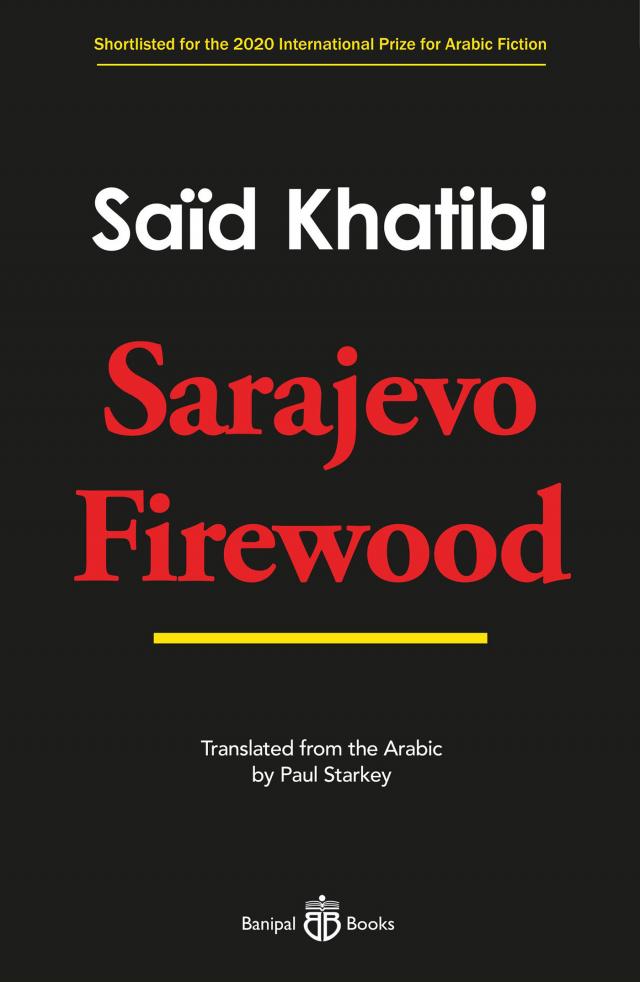


Sarajevo
Firewood
Shortlisted for the
2020 International Prize for Arabic Fiction
Sarajeo Firewood
First published in English translation
by Banipal Books, London, 2021
Arabic copyright © Saïd Khatibi, 2021
English translation copyright © Paul Starkey, 2021
Hatab Sarajevo was first published in Arabic in 2018
Original title:
Published by Editions Al-Ikhtilef, Algiers, Algeria, October 2018
The moral rights of Saïd Khatibi to be identified as the author and Paul Starkey as the translator of this work have been asserted in accordance with the Copyright, Designs and Patents Act, 1988.
No part of this book may be reproduced in any form or by any means without the prior written permission of the publisher
A CIP record for this book is available in the British Library
ISBN 978-1-913043-23-0
E-book: ISBN: 978-1-913043-24-7
Banipal Books
1 Gough Square, LONDON EC4A 3DE, UK
www.banipal.co.uk/banipalbooks/
Banipal Books is an imprint of Banipal Publishing
Typeset in Cardo
Printed and bound in Great Britain by Clays Ltd, Elcograf S.p.A.
To Lounès
No one speaks but me
But I will speak with mouth closed.
Jamel Eddine Bencheikh
We are brothers in suffering
Except for that: Everything divides us.
Vesna Hlavaček
A note on pronunciation
The text contains a number of Bosnian and Slovenian names and other words. Most letters in the two languages are pronounced more or less as in English, but there are a few exceptions, as well as a few extra letters. Readers less familiar with the languages may like to note the following rough approximations:
c = ts as in shorts
č = ch as in church
ć = ch as in cheese (a bit lighter than č)
j = y as in yes
lj = ll as in million
š = sh as in she
ž = like the s in vision
Salim
I lived as any anonymous person might live, working, eating, drinking and from time to time contriving to be alone with Malika. I would crawl like a deranged cat on top of her thin body and put up with her recklessness, fear and laughter. That was before my life changed, beginning on that day when Farouk called me and I became a different person. He told me that my uncle had bought a new house and was inviting me to visit him in Slovenia. His suggestion took me by surprise. Had he had an inkling of my desire to escape from the news of deaths, I asked myself. I accepted and rang off. Then I felt a headache coming on. I stayed there stretched out in my office, trying to picture the shape of the country where Si Ahmad – as we used to call my uncle at home – was living. Before I went out, I thought of buying a Slovenian dictionary so that I could make use of some easy words and phrases for quick conversations.
I hailed a taxi as the shops were closing. The driver made me pay in advance, as here no one trusts anyone else. He examined the dinars I handed him then slipped them into his top jacket pocket before speeding off, chatting to his other passengers about the cost of living, the loss of value of salaries and the rising cost of foreign currency. As soon as I reached my apartment I checked the tap. As usual, the water had been cut off. “Faces of evil, no mercy!” I muttered. There were two full medium-sized pails next to each other in a corner of the bathroom which I reckoned would be enough until tomorrow. I noticed some dust on the wooden table in the living room, along with half a two-day-old baguette and two triangles of cheese with a picture of a laughing youth on top of them. I remembered that I hadn’t cleaned the apartment for more than a week. I was too lazy to pick up the broom and I’d neglected to clean the little furniture that shared the place with me. Beetles continued to lurk under my feet, running and jumping up at night then disappearing by day. Sometimes I chased them away and sometimes I left them in peace. That day I hadn’t eaten anything since my morning coffee, which I drank with a couple of pieces of bread and butter and apricot jam in the Ahbab café at the edge of the neighbourhood, and I really hadn’t had any appetite at all.
I raised my head to look at the clock hanging on the wall. I remembered that it had stopped and I had been too lazy to change its batteries. I tried thumping it with my right fist on the front and on the back but it wouldn’t work. I put it back in its place as a decoration, nothing more. Its hands had stuck at two o’clock, though I didn’t know whether it was two o’clock in the afternoon or two in the morning! I relied for waking up on a small alarm clock, which had a red cockerel in the middle that moved its yellow beak as if it were picking up a grain of wheat every second, and I knew the time from my wrist watch, which had no name on it of its country of manufacture, so most likely it was from a country in Asia. I bought it from a travelling salesman in Bab El Oued and it had never ever stopped even though I had never changed its battery.
I was no longer concerned about the passing of the hours, and I didn’t bother to count the years of my life either. Before graduating from university aged twenty-two and moving from innocence to something like the life of the desert, I would count the days and the months, regulating my life with precision. If someone asked me how old I was, I would answer immediately with the year, month, day and hour. The local registrar had been careful to record the time carefully on my birth certificate. I knew by heart the birthdays of some famous singers and writers and footballers, and the birthdays of my parents, brother, uncle, and three aunts. But my memory had become erratic as time passed. I started to forget my wallet on occasion, or the name of a colleague at work. Still, I hadn’t forgotten the years when writers, intellectuals, journalists, artists, friends or colleagues I had been fond of had died: Mouloud Mammeri 1989; Djillali Liabès and Tahar Djaout 1993; Abdelkader Alloula and Cheb Hasni 1994; Rachid Mimouni, Bakhti Benaouda and Rabah Belamri 1995, Cheb Aziz 1996. And Mustafa Belgharbi passed away in the same year. We had studied together in intermediate and secondary school. We nicknamed him ‘Palm Tree’ because he was so tall. He failed his baccalaureate exam three times then passed at the fourth attempt. He died in a traffic accident after graduating from veterinary college. “His face was crushed by a lorry and his body was scarcely recognisable,” we were told by his younger brother Kamal. I knew the dates when they all died though I had forgotten the dates of their births. In recent years I had learned to train my memory to forget, to free myself from memories. When I forget things I just store them in a black hole in my memory and return to them when I need them, and when I forget people I give them an opportunity to be recalled later. My wall clock had stopped but I hadn’t forgotten it. I would look at my wrist watch and always forget the time it was showing. As if I was looking at it in order to forget it as well.
I turned on the radio, not to listen to the news but just to break the dreadful silence in the apartment. I knew all the news, and had written about some of it in the newspaper. Listening to it again made it trivial, relieving my tension and making me think about other more important things. The newsreader announced a third defeat in the football cup against Cameroon, following two earlier defeats against Guinea and Burkina Faso, and our exit from the Africa Cup. He commented at length, expressing his sadness and anger at the players and trainer, as well as his sorrow and regret – as though he had lost someone dear to him —, so as not to come too quickly to the other news, which was even more miserable, painful and blacker. He described the defeat in the football cup as being a passing calamity, which it would be possible to move on from, and added: “It is time to rebuild what has collapsed.” He took a deep breath, was interrupted by a clip of what sounded like military music, and in a dry tone began to read the news of blood and enumerate the victims of a war for which we hadn’t agreed on a name … A booby-trapped vehicle had exploded here, a number of citizens had been treacherously killed in a single night there … he spoke about death in clipped words, as if he had been forced to recite this news of the deceased and had found himself in the job of announcer against his will. He finished the news bulletin by repeating: “We are God’s, and to God will we return,” before adding, “And now I will pass the microphone to my colleague Salwa to give us the weather news.” Death had turned into a ritual that we were used to. The astrologers had laughed at us. They had written on the walls and tombstones and minarets that the city guarded by God’s holy men and dervishes, and by old women with tattoos on their chins and foreheads, would be untouched by the plague and unaffected by fear. The plague had avoided us, but fear had spread through the streets and alleys of the city, depriving us in the morning of a nervous sun that appeared suddenly, and preventing us closing our eyes at dead of night.
As death is our destiny, I decided to put it out of my mind, though my crisis-ridden life did not so much push me forward as remind me always of death. Before Farouk contacted me on that day that divided my life into two, the chief editor had asked me to go to Sidi Labqa‘ – only half an hour from the capital, Algiers, by car – to write a report on that village, where thirty people had been slaughtered.
Sidi Labqa‘ had been attacked directly after iftar on the sixth day of Ramadan by men armed with Kalashnikovs, MAT-49 submachine guns and daggers. They were wearing woollen tunics over jeans, and some of them were wearing American or German sports shoes, with Afghan buckled felt hats, and long beards. The y chose their victims carefully. They drew up a list of names of their targets on a piece of paper. They butchered the adults like chickens, cut the corpses of the children in half lengthwise, and then left. The military only arrived after the massacre had ended. Why did I still remember the atrocities that happened? Hadn’t I forced myself to forget them?
I felt my blood boil and needed to call Malika, to hear her sweet voice, which was the voice of a young girl of fifteen or sixteen. Words came out of her lips like a sweet song. They certainly didn’t give the listener the impression there was a woman in her third decade behind the sounds. I would tell her about the mission I had been entrusted with and about my intention to travel. But the telephone at home was out of action. I had neglected to pay the bill and the Post and Telecommunications officials had promptly cut off the line. I made up my mind to contact her the following day from the office or a public telephone and to pay my phone bill when I found a spare moment. Or else wait till I could visit her in her apartment.
It often happened that I quarrelled with Malika, or else we quarrelled with each other, like silly teenagers, separated for some days then quickly coming back together. She was five years older than me, but the difference in age was not apparent in our relationship, except when she was angry or sad, and then she would sometimes treat me like a younger brother and forget herself, or talk to me in a bossy tone like I was one of her students in secondary school.
I had got to know Malika at a cultural centre that had been turned into a political party headquarters, where she spent some months giving supplementary lessons in English to Baccalaureate pupils, getting some additional income from it. I used to go there to play dominoes or table tennis with my old friends, from the Islamic scouts, who have now all dispersed and gone their separate ways. Some joined the army, some went to work in the desert, and some emigrated.
One day, while I was sitting in the office with Mas‘ud, the centre director that Farouk had introduced me to, talking about this and that, she came in, bringing in with her her smell of perfume. The office looked like that of any bureaucrat in our one-party state. I wasn’t focused on her looks. “Do you have any spare chairs, sir?” “No,” replied Mas‘ud coolly. As soon as she had turned around, disappointed, I got up. “There are three chairs in the hall,” I said, “I’ll bring them to you.” “Thanks,” she replied. Mas‘ud gave me an angry look, the reason for which I only understood a year later. Then I attended one of her classes and sat at the back like a well-behaved student who follows and questions his teacher in a lively and polite way. She liked this and carried on smiling and responding enthusiastically to my questions for the whole class. I went to two more classes. Then life got between us until we met by chance a year later at the National Theatre after a performance of Eugène Ionesco’s The Bald Soprano and went and sat in a café off Port Said Square.
“I need some extra English lessons.”
“Just English? Nothing else?” she replied in a teasing tone, as she turned her face away from me to look at the passers-by.
Our relationship developed quickly after that. She opened for me a wide door of references. We started chatting on the phone or sitting gossiping in a café or cheap restaurant on Tanger Street or Larbi Ben M’hidi Street. She told me Mas‘ud had wanted to arrange a rendezvous with her and when she had refused he became angry with her, and that she felt some magnetism drawing her to me despite the fact that she didn’t easily open her heart to any man. “I tried to avoid you but I couldn’t,” she told me. Three years ago she invited me to the apartment she rented in the eastern part of Algiers, in a posh quarter where her neighbours were top civil servants. She lived there with her younger sister, Houriyya, a student in law school, and her excuse was that I should help her fix a satellite dish to pick up foreign stations. After I had helped her, she led me through to her room, which was neat and tidy, completely the opposite of my own. While her sister was in the kitchen looking at books and notebooks, I tasted the honey of her lips to the soft voice of Cheb Khaled. “I’m older than you but I’m less knowledgeable in matters of love,” she told me, and laughed until her teeth showed.
At that time she had just ended an unsuccessful relationship with a man called Hamid, who was four years older than her and worked as a pharmacist. He had emigrated to France, forgetting his promises to her of marriage, a family and children.
“He undervalued me.”
Malika wasn’t beautiful but she was attractive. She was short, with fair skin, a straight, well-proportioned nose, brown hair and extremely red lips. The most distinctive thing about her was the colour of her large eyes – the right iris was blue and the left one brown.
“You see the world in two different colours, that’s why we can’t agree,” I teased her.
“My heart also has two colours; one loves you and the other hates you,” she replied, laughing.
In the first days of our relationship, I imagined her as the twin of Sophia Loren in the film The River Girl. She had a deceptive smile, like Sophia’s. When she was trying to control her temper, she would make fun of me by speaking to me in perfect English. The fact is that it was with her I regained my English, which I had almost forgotten amidst the bustle of life. When she was annoyed, the blood would rise to her head, her face would turn pale, and I imagined claws growing in place of her nails and scratching my face as she mouthed a dictionary of oaths in a coarse, masculine colloquial. She would turn into a ‘man woman’.
In spite of what drew us together, she never asked me to marry her. On the contrary, she once asked me (I don’t know whether it was serious or in jest) about the qualities of the woman I would like to marry.
“Will you marry a journalist like yourself?”
“I’m not thinking of marriage.”
“…”
“Would you be jealous if I married someone else?”
“No, it would be her who would be jealous, because you have loved me.”
She chuckled, then added: “If you don’t find a suitable woman, we’ll marry you off to my sister Houriyya.”
Malika, who mingled seriousness with jest, tried to appear unconcerned in front of me when she received a threatening letter from the ‘soul reapers’, as we used to call the armed Islamist groups. They demanded she stop teaching and under their words they drew a dagger and a revolver.
“A bad drawing and worse writing!”
She informed the police, who took down her information and asked her to exercise caution. She continued her life as if nothing had happened.
Once she said to me in English: “He who fears death will never enjoy the good things in life.”
I think she had taken that phrase from some book, for Malika was afraid of death without admitting it. She never left the house without a scarf over her hair. She wore flowing clothes and a long skirt to go to work, unlike at home where she insisted on wearing jeans which hugged her waist or shorts that showed her plump thighs. I knew she was right to wear a head covering and cover the whole of her body when in the street in order to avoid any hostility or annoyances, and so I didn’t want to embarrass her by commenting on it.
I spent an hour thinking about the words I should use to inform her of my intention to travel to Si Ahmad’s country, Slovenia, and before that of my assignment to go to Sidi Labqa‘. Should I tell her: “I’m going to record the testimonies of the survivors of a massacre, then will travel and leave you,” or should I say “I will write about the families of the victims, then fly to Slovenia and we’ll just communicate by phone.” I reckoned they were both harsh sentences. I had to think of some other formula. She had a head that was hard as granite. She claimed she respected my personal freedom but I know she also wanted to own me. It wasn’t the restless love with Malika that was killing me; what kept me awake was the death that hovered like a corpse crow all over the city sky and which might reach me at any time.
I examined my passport and thought about what I should take with me: some clothes, and a box of Deglet Nour dates as a present for Si Ahmad. I was then surprised by a gentle tap on the door.