

The 1619 project, p.1
The 1619 Project, page 1
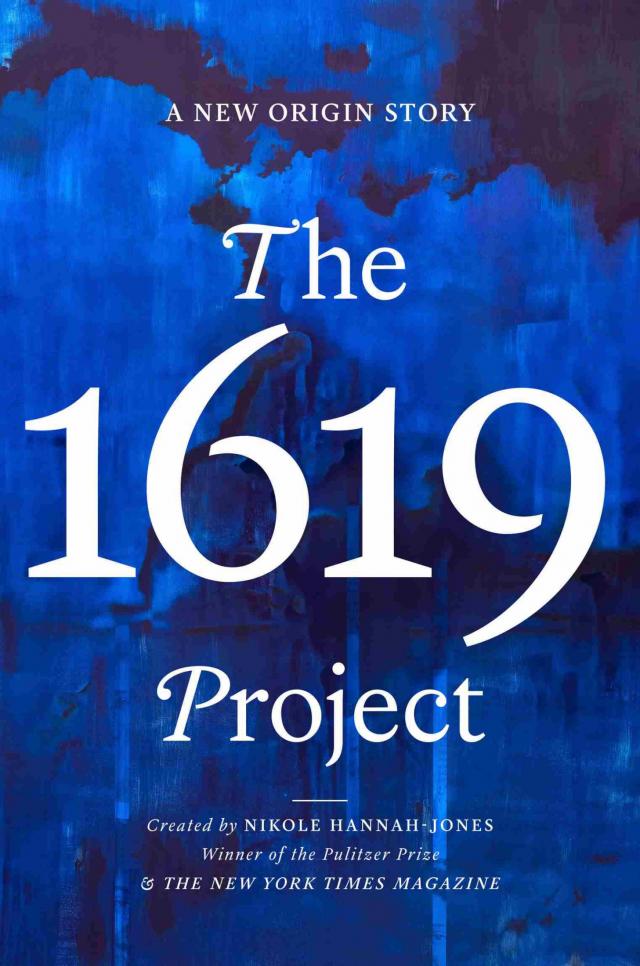


Copyright © 2021 The New York Times Company
Additional copyright details available on this page.
All rights reserved. No portion of this book may be reproduced—mechanically, electronically, or by any other means, including photocopying—without written permission from The New York Times Company. Inquiries concerning permission to reprint any part of this book should be addressed to The New York Times Company c/o Pars International by phone at 212-221-9595, by email at nytpermissions@parsintl.com or at NYTreprints.com.
Published in the United States by One World, an imprint of Random House, a division of Penguin Random House LLC, New York.
One World and colophon are registered trademarks of Penguin Random House LLC.
Contains some material previously published in THE NEW YORK TIMES MAGAZINE in August 2019, sometimes in different form.
Image credits and permissions are located on this page.
Library of Congress Cataloging-in-Publication Data
Names: Hannah-Jones, Nikole. | New York Times Company.
Title: The 1619 Project : a new origin story / created by Nikole Hannah-Jones and The New York Times Magazine.
Description: First edition. | New York : One World, [2021] | Includes index. Identifiers: lccn 2021019866 (print) | lccn 2021019867 (ebook) | isbn 9780593230572 (hardcover) | isbn 9780593230589 (ebook)
Subjects: LCSH: Slavery—Political aspects—United States—History. | African-Americans—United States—History. | United States—Race relations. | United States—Civilization. | 1619 Project.
Classification: lcc e441 .a15 2021 (print) | lcc e441 (ebook) | ddc 973—dc23
LC record available at https://lccn.loc.gov/2021019866
LC ebook record available at https://lccn.loc.gov/2021019867
Ebook ISBN 9780593230589
oneworldlit.com
randomhousebooks.com
Design by Bobby Martin, Champions Design, adapted for ebook
Title page and chapter title pages: Set in A2 TYPE’s NYTMag Serif and NYTMag Sans
Cover design: Michael Morris
Cover illustration: Lorna Simpson, Beclouded, 2018
Ink and screenprint on gessoed wood, 108”x 96”x 1-1/4”in (274.3 x 243.8 x 3.2 cm) © Lorna Simpson. courtesy of the artist and Hauser & Wirth (photo: James Wang)
ep_prh_5.8.0_10096500_c0_r0
Contents
Cover
Title Page
Copyright
Author's Note
A Note about This Book
Epigraph
Preface: Origins by Nikole Hannah-Jones
1619
The White Lion, poem by Claudia Rankine
Chapter 1: Democracy by Nikole Hannah-Jones
1662
Daughters of Azimuth, poem by Nikky Finney
1682
Loving Me, poem by Vievee Francis
Chapter 2: Race by Dorothy Roberts
1731
Conjured, poem by Honorée Fanonne Jeffers
1740
A Ghazalled Sentence After “My People…Hold on” by Eddie Kendricks and the Negro Act of 1740, poem by Terrance Hayes
Chapter 3: Sugar by Khalil Gibran Muhammad
1770
First to Rise, poem by Yusef Komunyakaa
1773
Proof [dear Phillis], poem by Eve L. Ewing
Chapter 4: Fear by Leslie Alexander and Michelle Alexander
1775
Freedom Is Not for Myself Alone, fiction by Robert Jones, Jr.
1791
Other Persons, poem by Reginald Dwayne Betts
Chapter 5: Dispossession by Tiya Miles
1800
Trouble the Water, fiction by Barry Jenkins
1808
Sold South, fiction by Jesmyn Ward
Chapter 6: Capitalism by Matthew Desmond
1816
Fort Mose, poem by Tyehimba Jess
1822
Before His Execution, poem by Tim Seibles
Chapter 7: Politics by Jamelle Bouie
1830
We as People, poem by Cornelius Eady
1850
A Letter to Harriet Hayden, monologue by Lynn Nottage
Chapter 8: Citizenship by Martha S. Jones
1863
The Camp, fiction by Darryl Pinckney
1866
An Absolute Massacre, fiction by ZZ Packer
Chapter 9: Self-Defense by Carol Anderson
1870
Like to the Rushing of a Mighty Wind, poem by Tracy K. Smith
1883
no car for colored [+] ladies (or, miss wells goes off [on] the rails), poem by Evie Shockley
Chapter 10: Punishment by Bryan Stevenson
1898
Race Riot, poem by Forrest Hamer
1921
Greenwood, poem by Jasmine Mans
Chapter 11: Inheritance by Trymaine Lee
1925
The New Negro, poem by A. Van Jordan
1932
Bad Blood, fiction by Yaa Gyasi
Chapter 12: Medicine by Linda Villarosa
1955
1955, poem by Danez Smith
1960
From Behind the Counter, fiction by Terry McMillan
Chapter 13: Church by Anthea Butler
1963
Youth Sunday, poem by Rita Dove
On “Brevity”, poem by Camille T. Dungy
Chapter 14: Music by Wesley Morris
1965
Quotidian, poem by Natasha Trethewey
1966
The Panther Is a Virtual Animal, poem by Joshua Bennett
Chapter 15: Healthcare by Jeneen Interlandi
1972
Unbought, Unbossed, Unbothered, fiction by Nafissa Thompson-Spires
1974
Crazy When You Smile, poem by Patricia Smith
Chapter 16: Traffic by Kevin M. Kruse
1984
Rainbows Aren’t Real, Are They?, fiction by Kiese Laymon
1985
A Surname to Honor Their Mother, poem by Gregory Pardlo
Chapter 17: Progress by Ibram X. Kendi
2005
At the Superdome After the Storm Has Passed, poem by Clint Smith
2008
Mother and Son, fiction by Jason Reynolds
Chapter 18: Justice by Nikole Hannah-Jones
2020
Progress Report, poem by Sonia Sanchez
Dedication
Acknowledgments
Notes
Contributors
Credits
The poetry and fiction that appears on gray pages between the nonfiction chapters of this book occurs on a timeline that runs chronologically from 1619 to the present.
While the nonfiction chapters are not strictly chronological, they have been arranged with the historical narrative in mind.
Preceding each chapter is a photograph that relates to the topic of the essay. The individuals pictured are not well known; in some cases, their names have been lost to history.
A NOTE ABOUT THIS BOOK
This book uses a variety of terms to describe aspects of the era of slavery. In almost every case, the editors have avoided the word “slave” to describe persons held in bondage; the alternate term “enslaved person” accurately conveys the condition without stripping the individual of his or her humanity. In some instances where it does not refer to a person (e.g., “slave state”) and in some of the historical poetry and fiction, “slave” does appear.
The editors have also attempted to limit the use of terms that are sometimes used euphemistically, such as “plantation” or “master,” or to substitute when possible other terms that more accurately convey the historical situation of enslavement. As this book contains the work of many different authors, some of them representing different scholarly fields, there remains some heterogeneity in how these terms are deployed.
—The Editors
I am the American heartbreak—
The rock on which Freedom
Stumped its toe—
The great mistake
That Jamestown made
Long ago.
—Langston Hughes,
“American Heartbreak: 1619”
PREFACE
Origins
Nikole Hannah-Jones
I was maybe fifteen or sixteen when I first came across the date 1619. Whenever I think about that moment, my mind conjures an image of glowing three-dimensional numbers rising from the page. Of course, in reality, they were printed in plain black text on the cheap page of a paperback. Still, while the numbers did not literally glow, I remember sitting back in my chair and staring at the date, a bit confused, thrown off-kilter by an exhilarating revelation starting to sink in.
For as long as I can remember, I have been fascinated with the past. Even as a young girl, I loved watching documentaries and feature films about events that took place in a bygone era. As a middle school student, I read all of my dad’s Louis L’Amour westerns and the entire Little House series because they transported me to the mythic American frontier. I loved sitting in my grandparents’ basement, leafing through aged photo albums filled with square black-and-white images and asking questions about the long-dead relatives frozen in the frame. My favorite subjects in school were English and social studies, and I peppered my teachers with questions. History revealed the building blocks of the world I now inhabited, explaining how communities, institutions, relationships came to be. Learning history made the world make sense. It provided the key to decode all that I saw around me.
Black people, however, were largely absent from the histories I read. The vision of the past I absorbed from school textbooks, television, and the local history museum depicted a world, perhaps a wishful one, where Black people did not really exist. This history rendered Black Americans, Black people on all the earth, inconsequential at best, invisible at worst. We appeared only where unavoidable: slavery was mentioned briefly in the chapter on this nation’s most deadly war, and then Black people disappeared again for a full century, until magically reappearing as Martin Luther King, Jr., gave a speech about a dream. This quantum leap served to wrap the Black experience up in a few paragraphs and a tidy bow, never really explaining why, one hundred years after the abolition of slavery, King had to lead the March on Washington in the first place.
We were not actors but acted upon. We were not contributors, just recipients. White people enslaved us, and white people freed us. Black people could choose either to take advantage of that freedom or to squander it, as our depictions in the media seemed to suggest so many of us were doing.
The world revealed to me through my education was a white one. And yet my intimate world—my neighborhood, the friends I rode the bus with for two hours each day to and from the schools on the white side of town, the boisterous bevy of aunts, uncles, and cousins who crowded our home for barbecues and card games—was largely Black. At school, I searched desperately to find myself in the American story we were taught, to see my humanity—our humanity—reflected back to me. I snatched Roll of Thunder, Hear My Cry from our elementary school library shelf because it was the one book with a Black girl on the cover. In high school, when my advanced placement English teacher assigned us a final project on a famous American literary figure, I wrote about the only Black poet I had been exposed to: Langston Hughes.
My public high school in Waterloo, Iowa, offered a one-semester elective called “The African American Experience,” which I took my sophomore year. Only other Black kids filled the seats each day, and the only Black male teacher I’d ever have taught the course. Rail-thin and mahogany-skinned, with a booming laugh that revealed the wide gap between his front teeth, Mr. Ray Dial deftly navigated our class through the ancient Mali, Songhai, Nubian, and Ghana empires (it was he who taught me that “from here to Timbuktu” referred to an African center of learning), surveying the cultures and knowledge and civilizations that existed among African peoples long before Europeans decided that millions of human beings could be forced across the ocean in the hulls of ships and then redefined as property. He taught us about Richard Allen founding the first independent Black denomination on this soil, and how hard enslaved people fought for the legal right to do things every other race took for granted, such as reading or marrying or keeping your own children. He taught us about Black resistance and Black writers. He taught us about Martin but also Marcus and Malcolm and Mamie and Fannie.
Sitting in that class each day, I felt as if I had spent my entire life struggling to breathe and someone had finally provided me with oxygen. I feel a pang of embarrassment now when I recall my surprise that so many books existed about Black people and by Black people, that Black people had so much history that could be learned. I felt at once angry and empowered, and these dueling emotions drove an appetite for learning Black American history that has never left me. I began asking Mr. Dial for books to read beyond the assigned texts, devouring them, then asking for others.
“Dr. Hannah!” he exclaimed one day, flashing his trademark toothy grin as he put a book in my hands: Before the Mayflower, by the historian and journalist Lerone Bennett, Jr. As soon as I got home that afternoon, I sat down at our dining room table and pulled it from my book bag. A few dozen pages in, I read these words:
She came out of a violent storm with a story no one believed…. A year before the arrival of the celebrated Mayflower, 113 years before the birth of George Washington, 244 years before the signing of the Emancipation Proclamation, this ship sailed into the harbor at Jamestown, Virginia, and dropped anchor into the muddy waters of history. It was clear to the men who received this “Dutch man of War” that she was no ordinary vessel. What seems unusual today is that no one sensed how extraordinary she really was. For few ships, before or since, have unloaded a more momentous cargo.1
Wait.
I had assumed that Before the Mayflower referred to Black people’s history in Africa before they were enslaved on this land. Tracing my fingers across the words, I realized that the title evoked not a remote African history but an American one. African people had lived here, on the land that in 1776 would form the United States, since the White Lion dropped anchor in the year 1619. They’d arrived one year before the iconic ship carrying the English people who got the credit for building it all.
Why hadn’t any teacher or textbook, in telling the story of Jamestown, taught us the story of 1619? No history can ever be complete, of course. Millions of moments, thousands of dates weave the tapestry of a country’s past. But I knew immediately, viscerally, that this was not an innocuous omission. The year white Virginians first purchased enslaved Africans, the start of American slavery, an institution so influential and corrosive that it both helped create the nation and nearly led to its demise, is indisputably a foundational historical date. And yet I’d never heard of it before.
* * *
—
Even as a teenager, I understood that the absence of 1619 from mainstream history was intentional. People had made the choice not to teach us the significance of the year. And it followed that many other facts of history had been ignored or suppressed as well. What else hadn’t we been taught? I was starting to figure out that the histories we learn in school or, more casually, through popular culture, monuments, and political speeches rarely teach us the facts but only certain facts.
In the United States, few examples better reveal this than how we’re taught about the foundational American institution of slavery. A 2018 report by the Southern Poverty Law Center (SPLC) called Teaching Hard History found that in 2017 just 8 percent of U.S. high school seniors named slavery as the central cause of the Civil War, and less than one-third knew that it had taken a constitutional amendment to abolish it. The majority of high school students can’t tell you that the famous abolitionist Frederick Douglass had once been enslaved; nor can they define the Middle Passage, which led to the forced migration of nearly 13 million people across the Atlantic and transformed—or, arguably, enabled—the existence of the United States.2
Considering the confusing and obfuscatory way school curricula tend to address the institution of slavery, this is unsurprising. Myriad examples exist. As recently as six years ago, a McGraw-Hill world geography textbook referred to African people brought to the Americas in the bowels of slave ships not as the victims of a forced migration who were violently coerced into labor but as “workers,” a word that implies consensual and paid labor.3 Within the last decade, Alabama social studies courses for second graders listed Harriet Tubman, the woman who became famous for escaping slavery and then helping others do the same, as an “exemplary” American without ever mentioning the words “slave” or “slavery.”4 In Texas, which, because of its large population, plays an outsized role in shaping the content of national textbooks, the Republican-led state board of education approved curriculum standards that equated the Confederate general Thomas “Stonewall” Jackson, who fought against the United States government, with Douglass as examples of “the importance of effective leadership in a constitutional republic.”5






