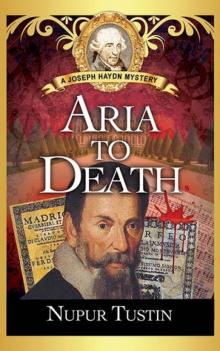
A minor deception, p.1
A Minor Deception, page 1


A MINOR DECEPTION
A Joseph Haydn Mystery — Book 1
NUPUR TUSTIN
FOILED PLOTS PRESS
First Digital Edition, November 2016
ISBN-13: 978-0-9982430-0-9
For more information, visit ntustin.com
Copyright © Nupur Tustin, 2016
Cover Design by Karen Phillips
All rights reserved. No part of this book may be used or reproduced in any form or by any electronic or mechanical means, including information storage and retrieval systems, without written permission from the author, except for the use of brief quotations in a book review.
This is a work of fiction. Names, characters, places, and incidents are either a product of the author’s imagination or are used fictitiously. Any resemblance to actual persons, living or dead, business establishments, events, or locales is entirely coincidental.
A Minor Deception is the first book in the Joseph Haydn Mystery Series.
Kapellmeister Joseph Haydn would like nothing better than to show his principal violinist, Bartó Daboczi, the door. But with the Empress Maria Theresa’s visit scheduled in three weeks, Haydn can ill-afford to lose his surly virtuoso.
But when Bartó disappears—along with all the music composed for the imperial visit—Haydn must don the role of Kapell-detective, or risk losing his job.
Before long, Haydn’s search uncovers pieces of a disturbing puzzle. Bartó, it appears, is more than just a petty thief—and more dangerous. And what seemed like a minor musical mishap could modulate into a major political catastrophe unless Haydn can find his missing virtuoso.
Table of Contents
Title Page
Copyright
Dedication
Cast of Characters
Overture
Chapter One
Chapter Two
Chapter Three
Chapter Four
Chapter Five
Chapter Six
Chapter Seven
Chapter Eight
Chapter Nine
Chapter Ten
Chapter Eleven
Chapter Twelve
Chapter Thirteen
Chapter Fourteen
Chapter Fifteen
Chapter Sixteen
Chapter Seventeen
Chapter Eighteen
Chapter Nineteen
Chapter Twenty
Chapter Twenty-One
Chapter Twenty-Two
Chapter Twenty-Three
Chapter Twenty-Four
Chapter Twenty-Five
Chapter Twenty-Six
Chapter Twenty-Seven
Chapter Twenty-Eight
Chapter Twenty-Nine
Chapter Thirty
Note from the Author
Acknowledgements
About the Author
For Matt Tustin, my husband and best friend. Your loving support makes everything possible.
CAST OF CHARACTERS
Optional Reading for the Curious
In the Year of Our Lord, 1766
HISTORICAL PERSONAGES MENTIONED
Political Figures, In Order of Rank
Her Imperial Majesty, Empress Maria Theresa (Ruled 1740-1780): Archduchess of Austria, Queen of Hungary & Bohemia, daughter of the Holy Roman Emperor Charles V and widow of Holy Roman Emperor Francis I. The lure of Joseph Haydn’s music has tempted her to come out of mourning for a state visit to Eisenstadt, a Royal Free Town on the Hungarian side of the river Leitha.
Although technically Dowager Empress of the Holy Roman Empire—only men may be elected rulers of this loose confederation of Habsburg domains and German states—the reins of power for both the Habsburg lands she inherited from her father and the Empire remain firmly in her hands.
Archduke Joseph, Emperor Joseph II (Ruled 1780-1790): Maria Theresa’s eldest son, a miserly man of little tact and unfortunately autocratic tendencies. Elected King of the Romans, he automatically became Holy Roman Emperor upon the death of his father in 1765. His mother has appointed him co-regent over the Habsburg Domains as well, but mother and son have a contentious relationship.
And as long as she is alive, the Empress will never fully relinquish control to him or abdicate in his favor. He is referred to by his title of Archduke of Austria in this novel.
Ferenc II Rákóczi (1676-1735): A long-dead Prince of Transylvania, who led an uprising against the Habsburgs between the years 1703 and 1711, attempting to free Hungary from Habsburg control and re-unite Transylvania with Royal Hungary. The revolt was led by nobleman like Ferenc II, but the Hungarian peasantry joined in as well.
The Empress’s grandfather, Leopold I, was Emperor at the start of the uprising. By the time it was successfully crushed, her uncle, Joseph I, had ascended the throne for his very brief reign.
His Serene Highness, Nikolaus Esterházy, Prince of the Holy Roman Empire: A member of one of the wealthiest and most powerful Hungarian noble families, the Prince is known for his love of splendor. He is also the employer of the composer Joseph Haydn.
Steadfastly loyal to the Habsburgs, the Esterházy family received the hereditary title of Prince of the Holy Roman Empire from the Emperor Leopold I. Their position as court favorites, however, may be jeopardized by Archduke Joseph’s recent rise to power. The Prince hopes the lavish entertainment he has planned for the Empress will induce her to use her influence on his behalf with the Archduke.
Count Harrach: A noble family with estates in Haydn’s hometown, Rohrau. They, too, are quite influential in the imperial court. Haydn’s mother worked as their cook.
Count Pergen: A man who is helping to develop a vast network of spies and a sophisticated police state for the Archduke Joseph.
Peter Ludwig von Rahier, Estates Director: Haydn’s immediate superior in the Esterházy court, Rahier is responsible for the smooth working of the court. He is rather jealous of Haydn’s position in court, though, and takes every opportunity to tread upon the Kapellmeister’s authority.
* * *
MUSICIANS AND THEIR FAMILIES
Joseph Haydn, Court Kapellmeister to the Esterházy family: Hired by the reigning Prince’s older brother, Paul, Haydn has quickly become a composer of international renown. His instrumental works, symphonies, quartets, and concertos, all in the new style, have helped to catapult him to the position of Director of Music to one of the most powerful magnate families in the Austrian court. The court newspaper hails him as the “Darling of the Nation.”
Maria Anna: Haydn’s wife. Known for her shrewish temper and her extravagance with his money, she has little interest in music, in general, or in her husband’s work. Haydn has been known to remark that he could have been an innkeeper at one of the many heurige (wine-taverns) that dot the countryside for all she cares.
Johann: The Kapellmeister’s youngest brother, a singer in the Esterházy chapel. Although a capable singer, Johann is no virtuoso, leaving him free to act as his older brother’s assistant in many capacities. He is also staunchly loyal to Haydn, and serves to preserve the peace between his older brother and sister-in-law.
Michael: Haydn’s, pompous, slightly belligerent middle brother. A composer, like Haydn, Michael is employed at the court of the Archbishop of Salzburg. He is better known for his sacred compositions.
Mathias: Haydn’s father, now dead, God rest his soul. He was a wheelwright in the small market-town of Rohrau, and was later appointed a local magistrate of the area.
Leopold Mozart: Michael’s colleague in Salzburg, and father of the little genius, Wolfgang.
Wolfgang Mozart, Wolferl: The little genius from Salzburg whose performance on the keyboard and violin and whose compositions are taking Europe by storm.
Oboist Zacharias Pohl and cellist Xavier Marteau: In real life, two of Haydn’s best musicians. An ill-fated bar-fight between the two resulted in the oboist losing his right eye, causing an eternal enmity between the two men. Minor characters in the novel.
Luigi Tomasini: A virtuoso violinist, Haydn’s trusted friend and Konzertmeister. Unfortunately for Haydn, he is on loan to the court of the Archduke Joseph in Vienna, a move engineered by the Estates Director to curry favor with the new Emperor.
Gregor Werner: Haydn’s predecessor until his death in May 1766.
* * *
FICTITIOUS CHARACTERS
Albert: The Estates Director’s nephew, Albert is a violinist of little talent, whom Haydn is compelled to employ.
Bartó Daboczi: A violinist formerly employed at the court of the Archbishop of Salzburg, Bartó arrived in Eisenstadt a few months back to take on the position of principal violinist and temporary Konzertmeister. His immense talents barely make up for a surly temperament.
Count Nádasdy: Haydn’s friend, also a powerful Hungarian magnate and distantly related to the Esterházys. He was the impetus behind the string quartets the Kapellmeister is so famous for.
Herr Hipfl: Eisenstadt’s barber-surgeon, a man who, in addition to cutting hair, performs surgical operations. Since the unpleasant tasks of examining corpses and performing autopsies are consigned to barber-surgeons, he also serves as the small town’s medical examiner.
Herr Groer: Bürgermeister, or mayor, of the Royal Free town of Eisenstadt, his authority is circumscribed by that of His Serene Highness who acts as High Sheriff of the county. And thanks to Archduke Joseph and Count Pergen, it is also constrained by the Police Commissioner.
Herr Lichtenegger: Police Commissioner (PC) of Eisenstadt, he reports directly to Count Pergen. Ordinarily small towns are not assigned their own PCs, but the Prince, in a zealous effort to go along with the Archduke Joseph’s reforms, insisted the little Hungarian town have one assigned to it.
Lorenzo: Principal of the second violinists, he had hoped to be promoted to acting Konzertmeister in the absence of Luigi Tomasini.
Niklas: Principal cellist and new father. The Kapellmeister and his wife are godparents to the cellist’s son. The infant’s christening ceremony is to take place shortly before the imperial visit.
Greta: A buxom, blond all-purpose maid assigned to the musicians and artists at court.
Rosalie Szabó: A pretty maid from the Kapellmeister’s hometown of Rohrau, and Greta’s friend. She obtained her position as all-purpose maid to the musicians and artists by virtue of Haydn’s recommendation. Her mother, too, worked as a cook in Count Harrach’s kitchen.
Sándor Szabó: Rosalie’s brother, an extraordinarily gifted violinist, but discouraged from pursuing his musical interests by his parents, who wish a more secure living for him.
OVERTURE
On a chilly December morning in the year 1766, the inhabitants of the little town of Eisenstadt bustle about in a state of feverish anticipation. Eisenstadt might be no different from any other obscure free town in Royal Hungary; too insignificant to merit a spot on the postal route. Nevertheless, it has drawn the attention of the entire Empire upon itself.
The widowed Empress Maria Theresa is to grace the little town in her Hungarian domains with a visit in three weeks; bringing to an end a year-long period of mourning for her beloved husband.
But the man whom the town credits for this remarkable event is at this very moment beginning to fear something might go amiss in the weeks to come.
CHAPTER ONE
The sound of two violins, a cello, and a bass playing a section from a string quartet wafted out from the open window of the Music Room of the Esterházy Castle. Franz Joseph Haydn—resplendent in his livery of blue and gold—waved his baton.
He was still waving it when the music came to an abrupt close.
“No, Bartó! No!” Haydn shook his head, baton suspended in mid-air. “The phrase continues there. Your solo begins on that note.” He tapped the sheet music on his ornate silver stand with his baton.
The expression on the faces of Haydn’s second violinist, the bearded cellist, and the youthful blond bass player mirrored his own exasperation. They had played the same phrase twenty times at least, and his principal violinist, Bartó Daboczi, recently appointed to the post, had made the same mistake every time.
Bartó put his violin down, his thin lips compressed into a stubborn line. “Herr Kapellmeister, I do not understand.”
Quite forgetting he was wearing a wig, Haydn dragged his hand through its locks, pushing it so it sat askew on his head. God grant him patience! At this rate, they would never be ready for the imperial visit.
“What is it you fail to understand, Bartó?” Haydn strove to keep his voice down. The Estates Director, hearing their voices raised in argument earlier, had already availed himself of one opportunity to read them a lecture on decorum. Haydn was determined not to give him any more.
“Why must this new phrase begin here, Herr Kapellmeister?” Bartó jabbed a finger at the score. “It is the middle of the measure.”
“Yes, Bartó, that is the middle of the measure,” Haydn conceded the point. He dabbed at his forehead with a handkerchief, wishing he could dispense with propriety and, like his musicians, relieve himself of his jacket and waistcoat. Arguing with his principal violinist could make even a cold day such as this seem unbearably warm.
“But that is the beauty of the piece, you see. Your solo begins on the very note on which the four instruments playing in unison ends.”
Bartó folded his arms and sat back in his chair, staring impassively at Haydn. “And what purpose does it serve, Herr Kapellmeister, to begin my solo on the same note?”
The cellist and the bass player muttered impatiently. But Lorenzo, the second violinist, had clearly reached the end of his tether.
“Ach, you dolt!” he growled, grabbing the music off the stand. He thrust the score before his colleague, and prodded at the offending note. “Don’t you see your solo develops the theme from the section before in which we all play together?”
Bartó was on his feet in an instant. “Whom do you think you’re calling a dolt, you idiot!” He thrust his face close to the second violinist, his clenched fist inches away from the other man’s jaw. “What can you know of composition, you talent-less donkey?”
“That is enough, Bartó!” Haydn braced himself against the principal violinist. How had the two men come so easily to blows?
Bartó struggled to move toward Lorenzo, who was rising to his feet, a murderous expression on his face. But Haydn kept his hand firmly on his principal violinist’s chest, pushing his second violinist back into his chair at the same time.
“You are musicians and officers of the court, gentlemen. Endeavor to behave as such.”
He took a deep breath, aware that his second violinist was staring at him, expecting him to hold his ground. But the Kapellmeister had no desire to continue the argument.
“Very well, Bartó. If it will allow you to play the piece better, we can move the note to the next measure.” He took a silver pen out of his pocket to make the changes.
Bartó, seeming mollified at this capitulation to his demand, sat down. He adjusted the ruby ring on his forefinger, and put his violin under his chin.
“Let us play through the entire piece now, Herr Kapellmeister. I think you will agree it sounds much better.”
The Kapellmeister did nothing of the sort, but, in the interests of preserving the peace, said not a word in reply. The session over, the musicians began to file out of the room, but Lorenzo lingered by the door.
“There was no need to yield to him, Herr Kapellmeister,” he said. “What is it about him that makes you so tolerant of his behavior? He is just asking to be dismissed, and you know it!” He stared Haydn squarely in the eye, then left.
* * *
“How long you will continue to tolerate his behavior is the better question.”
Haydn, about to close the door, spun around in the direction of the voice. Peter von Rahier, elegantly clad as always, leaned against a marble figurine, his arms crossed. How long had the Estates Director been standing in the hallway?
Rahier, his arms still folded, came forward. “We all know why you tolerate it.”
He walked past Haydn into the Music Room, stopped to inspect the fortepiano for dust, and turned around.
“You begin to recognize the importance of his talents to the success of our upcoming program, then?” Haydn stood near the doorway, an eyebrow raised in mock surprise.
““Do not quibble with me, Herr Kapellmeister. You know exactly what I mean. It is because the man came armed with references from your brother in Salzburg that you hired him in the first place. And now, despite his intolerable attitude, you are willing to keep him on.”
“The question of hiring a violinist would never have arisen, if Tomasini were here.”
It was at the Estates Director’s advice that the Prince had loaned Haydn’s Konzertmeister to the Archduke Joseph, the Empress’s son and co-regent. It was a temporary absence, but it had come at a most inopportune moment, the Empress having already consented to the Prince’s invitation to undertake the journey of thirty miles or more from the capital, Vienna.
The Estates Director sniffed. “The Archduke specifically asked for your Konzertmeister. To ignore his request at any time would be unthinkable. More so now that he is Holy Roman Emperor… But the subtleties of cultivating political favor are completely lost on you, are they not, Herr Kapellmeister?