

Kindling, p.1
Kindling, page 1


praise for flyaway by kathleen jennings
“An unforgettable tale, as beautiful as it is thorny.”
— The New York Times Book Review
“Flyaway is a nearly perfect novella. It sings with pain and roars with power. Although it is short, it is neither spare nor unfulfilled. Kathleen Jennings has a voice unlike any other, and I long for more.”
— Alex Brown, Tor.com
“In spellbinding, lyrical prose Jennings lulls readers into this rich, dreamlike world. Lovers of contemporary fairy tales will find this a masterful work.”
— Publishers Weekly, starred review
“I love the imagery, the atmosphere, the incredible tactile quality of the world as described, the structure. . . . Some of the best prose I’ve ever read.”
— Smart Bitches, Trashy Books
“It should be no surprise that Kathleen Jennings’s debut novel is splendid and unusual, that it feels like a dispatch from another, finer world, that it frightens and enchants in the same breath.”
— Katharine Coldiron, Locus
“Part ghost story, part murder mystery and part fairy tale, Flyaway feels like a perfect combination of all Jennings’ experiences and imagination.”
— Book Page
“An entrancing and unforgettable debut.”
— The Southern Bookseller Review
“An impressive mixture of gothic and folklore.”
— Canberra Times
“Jennings’s debut novella is pure, poetic Australian gothic, filled with haunting emotions, fairy-tale action, and sharp prose.”
— Library Journal
“A deliciously mysterious Gothic fairy tale wrapped in elegantly descriptive prose.”
— Booklist
“Half mystery, half fairy tale, all exquisitely rendered and full of teeth.”
— Holly Black, author of Book of Night
“A fairytale wrapped about in riddles and other thorny bits of enchantments and stories, but none of them quite like any you’ve heard before. Kathleen Jennings’ prose dazzles, and her magic feels real enough that you might even prick your finger on it.”
— Kelly Link, author of White Cat, Black Dog
“A superbly told tale of folklore-infused fantasy, full of rising dread, set in a sharply observed Australian outback town.”
— Garth Nix, author of Sabriel
“I feel as if a very new voice has whispered a very old secret in my ear, and I’ll never be able to un-hear it. Nor will I ever want to.”
— C. S. E. Cooney, author of Saint Death’s Daughter
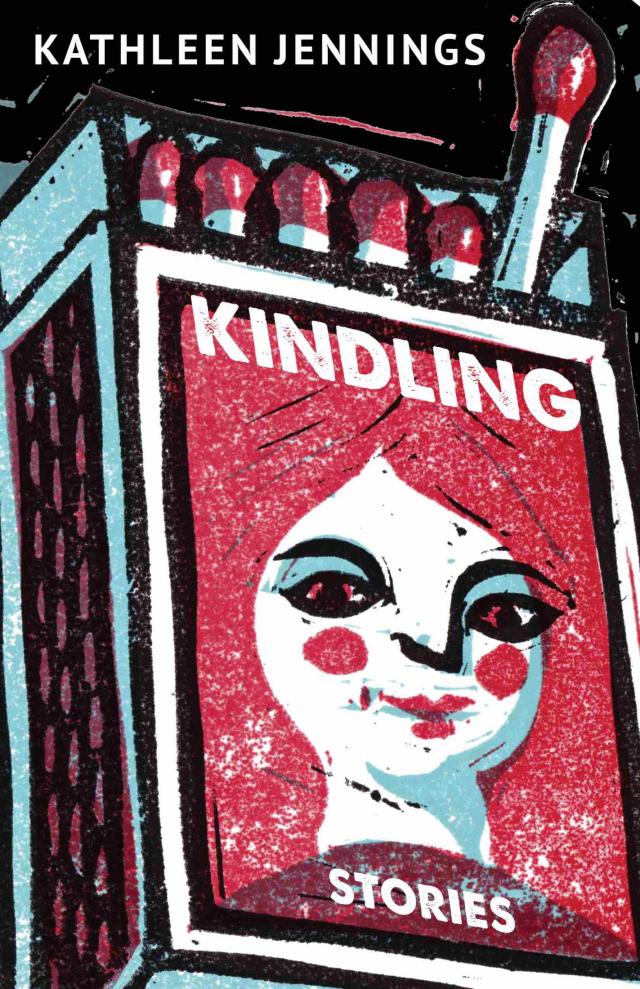
Kindling
STORIES
Kathleen Jennings
Small Beer Press
Easthampton, MA
This is a work of fiction. All characters and events portrayed in this book are either fictitious or used fictitiously.
Kindling: Stories copyright © 2024 by Kathleen Jennings. All rights reserved. Page 267 is an extension of the copyright page.
Small Beer Press
150 Pleasant Street #306
Easthampton, MA 01027
smallbeerpress.com
weightlessbooks.com
bookmoonbooks.com
info@smallbeerpress.com
Distributed to the trade by Consortium.
Library of Congress Cataloging-in-Publication Data
Names: Jennings, Kathleen, 1980- author.
Title: Kindling : stories / Kathleen Jennings.
Description: First edition. | Easthampton, MA : Small Beer Press, 2023.
Identifiers: LCCN 2023024859 (print) | LCCN 2023024860 (ebook) | ISBN
9781618732132 (paperback) | ISBN 9781618732149 (ebook)
Subjects: LCGFT: Short stories.
Classification: LCC PS3610.E5585 K56 2023 (print) | LCC PS3610.E5585
(ebook) | DDC 813/.6--dc23/eng/20230623
LC record available at https://lccn.loc.gov/2023024859
LC ebook record available at https://lccn.loc.gov/2023024860
Hardcover (9781618732170), trade paper (9781618732132), & ebook (9781618732149).
Paper edition rinted on 30% PCR recycled paper by the Maple Press in York, PA.
Author photo: Ngaire Naran.
Cover art copyright © 2023 by Kathleen Jennings. All rights reserved.
For Angela Slatter
The Heart of Owl Abbas
Once, before the great Empire of Else enveloped the land between the red mountains and the quiet sea, the city-state of Owl Abbas was a mere bird-haunted forest temple. But protected by treaties, suffocated by safety and benevolent neglect, it had swollen and grown in upon itself, roiling and fomenting, so slowly that only (perhaps) a few dust-dry wraiths of abbots hanging motionless in enclosed footings of the Palace Aster would have marked the change from one century to another.
The gains and losses of its citizenry had been gradual. Its resentments and injustices oozed like moisture down the dank wall of a forgotten reservoir, unremarked by either the clustered, crushing commonality or the Little Emperor, cloyed and gorged in his great gilt chambers. Drip, drip, until the dark water was high against its bowed, ill-repaired walls. Until it lapped at the foundations of palace and hovel alike.
In all Owl Abbas, before it burned (after the Falling but before the Cartographer’s War and the Recurrence of Owls), there were among its many windows only two that need concern us.
The first was fogged with spiderwebs. It belonged to a garret, precarious above the spring-carts and spirit-lamps of Petty Street. Behind it was installed a wretched scribbler, who eked out a living writing songs for the populace. Let us call him Excelsior, for that is the name with which he signed his work.
Across the cobbleskulls and flints, and a full other storey over that abyss of jam merchants and glove-skinners that was Petty Street, above the hanging signs of teahouse and slop house, workhouse and whorehouse, higher even than the knotwork of laundry-, bell-, delivery- and ladder-strings, was another, airy casement.
The tenant of that room was only recently arrived to Owl Abbas—itinerant, mendicant, but admitted at the Mountain Gate because of the journeyman’s seal it bore on one exquisite brass shoulder. Even had the gate guards consulted the annals of the Elevated Guild of Horologists and Artificers, they would have found no reason to turn aside the masterpiece of an obscure craftswoman whose exile was self-imposed. Wonders, then, were a daily import of the palace, and—hemmed in as the city-state was by ancient vows and the benign disregard of the Empire of Else, in whose armpit it festered—the peace of the Little Emperor of Owl Abbas was threatened by nothing but thieves.
Excelsior, who seldom ventured even to his window, let alone to the street, had never seen this neighbour, whom time would call the Nightingale. From his lower garret, Excelsior could glimpse only a ceiling painted with blue dove-shadows and rose-gold candle glow.
He could, however, hear the Nightingale’s voice. Pure and high, discs of spinning glass singing against chamois, it fell like tumbling bells, like spilled silver wires.
It sang “Love Like the Guillotine,” “The Too-Taut Heart,” “When I am Duke of Petty Street (You Shall Be the Clown)”—all the choruses bawled by rampant youth loitering over gutters below, trilled by the delivery boatmen in the oily, olive canals, hummed even by agued ancients scrubbing the pearl-floored halls of the Palace Aster. Cheap songs. Excelsior’s.
He could have written a dozen more like them in his sleep, for his scribbling of lyric and melody, accompaniment and refrain was a mechanical task, calibrated to please the fecund and fickle tastes of the crowds of Owl Abbas, their perennial lusts and losses.
And what appetites for music that city-state had then, for all its decay and poverty! Forgotten were the bone groves and the quietude of owleries that once nested where the city had grown. The last owl-abbots were long starved in the gutters where they had begged, their skulls cambering the roadway. The owls had departed the sleepless streets for the zoological gardens of Else and the monk’s-fringe forests of the red mountains. Now, though the finest delights were reserved for the Little Emperor, balladuellists caterwauled on roofsheets; ladies’ cantating parrots swung in brass rings; lovers in teahouses threw coins into the throats of cheap songboxes, to wind the gears that set the teeth that struck the notes from the spinning metal tongues, sending slivers of copper to Excelsior, that he might buy ink and nibs and spirit-oil, cheap paper, wine hard as a fist and, when he remembered, a little bread.
Rough songs he wrote, like all the lesser scribblers of Owl Abbas. Raw songs, tunes to dull sense and sensation, ditties to hem in a little portion of pleasure between hunger and the grave.
Excelsior had never crept out of his garret to crouch at the outer palace walls to hear rare notes escaping from an Imperial Performance. Nor had he attended the Collegiate Academy of Guilded Instrumentalists, which existed to supply the artful music of the palace: formal stylings for sleep and dressing and every course of a dozen served at each of the eight tables laid daily for the Little Emperor. Even had Excelsior done so, he would not have heard anything to match the Nightingale’s abilities.
He listened to the deconstructed threads and parts, the wheeling, rewriting rehearsals, the little broken, mended, rough-edged fantasias with which the Nightingale warmed and amused the bright apartment, there above Petty Street, in that merryloud quarter of Owl A bbas where surely no one who mattered could overhear. The Nightingale, learning the music of the streets, the heartbeat of the city.
Bells and wires and strings, keys and barrels and tumblers, reeds and pipes, skin and wind. Melody, harmony, disingenuous discord. The hearts and throats of caged larks, of free birds, of trained choristers. All these were in the voice of the Nightingale.
But the voice carried, as the bounty of the palace never did. From Petty Street to the knotted alleys of the Maresnest, from Agnes Lane where once a disgraced clockmaker had kept her stinking workshop, to the last nested hovel before the avenue of guildhalls. Though neither understanding nor caring, the denizens of Owl Abbas stepped a little more lightly, laboured with an ear half-turned, unwitting, to those strains.
Excelsior eked out the end of the daylight, the nightlight, the moonlight, the ghostlight. He scrimped and slaved until he gathered courage and words enough to light a fire-inch and burn a whole pennyweight of ground copper. He offered the coin to the Phantom of the Window-sash, and summoned that obscure spirit almost to its full weight of feathers and claws.
The Phantom of the Window-sash was not a shade that embraced change. It had once had its own antique, unmusical views on such matters as songlust and bodymusic. But those, like the shade itself, were the shabbiest of memories.
Summoned by the soul of coins, it obeyed its commission without remark. Clustering Excelsior’s rolled onionskin to its vanishingly sharp breastbone, the phantom fell from the garret sill—fell, then lifted on a gust of oil-spiced laughter to the glowing window opposite and there dissolved before the Nightingale could question it, leaving its dry burden to flutter on the floor.
Excelsior could not watch.
He hauled closed the leaning shutters and pulled down the sash, cross-latched it and rubbed drawing gum along the edges. He etched more webs into the panes, spitting glass like flour from beneath his good penknife, that his garret might look tenantless. He raked the curtains across, pinning pumice-cloth and blotting paper over the moth holes.
Then for good measure he put out writing-lamp, hearth-glow, bed-candle and moth-pilot, closed his eyes, and waited.
He waited for three clock-unwinding days, feeling the long springs of his world loosen, while the ink crusted in the glass well and the nibs began to rust in the little moisture from the breath of creeping rats or spiders.
On the third day, a thrill stirred the dull panes, the curtains. Excelsior could not have told when it had begun. He crouched, resolutely unhoping.
The insinuation became a hum, a melody. Excelsior heard what had never been heard before, except in the signs and symbols of his dark garret, in his private equations: the song he had composed in the light of the last of his lamp-spirits, for which he had burned the last coin; the paper words for which he had sent the phantom winging.
The Nightingale’s voice, now, was a high, thin curling, like the frost on a glass of Abbas-White, or like red snow ribboning off the tops of the mountains. It was melody uncomplicated by harmony or the thrilling trills of ornament, tentative only in its simplicity, the singer’s questing guided by all the confidence of the supreme master of an art.
Over and again that voice followed Excelsior’s script, the words seeking notes, notes seeking paths as water flows across a dry land. Then gradually that glass-and-golden voice found a pattern, gathered force, rilled and frothed along the edges of its new-cut banks, built undertows and laughing sprays of sound. It poured down through the alleys where craftsmen and labourers starved, trickled through Agnes Lane where a young clockmaker had once studied the grafting of metal to splintered bone, funneled into the inlooped ways of the great warren of the Maresnest.
High over Petty Street, the Nightingale sang for the first time Excelsior’s composition—not a commission, not a command, but . . . Well, even the scribbler could not have said whether it had been gift or tribute or sacrifice.
The Nightingale sang and Excelsior, weak with waiting, listened.
He wrote another, immediately he had revived. It was unworthy. Dissatisfied, he broke it apart into bare penny-shave popular ditties. Ragged and rancid, he did not care to take them down himself, but sent them by errand urchins to the punch-shop, where they were pricked relentlessly into parchment rolls and delivered to tea shops and pleasure warrens, fed into mere pinching, playing songchests, which nipped fingers as well as paper, and singly-minded cranked out Excelsior’s abandoned tunes.
“Love, love,” sang the high-painters in their blood-dipped, paint-dripped hats.
“You are a far dying star,” sang the menials toiling with bow-bent spines and mole-fur cloths along the Palace Aster wainscoting.
“You test the hearts of the court, and find them wanting,” sang the xylophone-ribbed parrot trainers, chorusing from cage to cage, that their clients’ birds might have the newest tunes.
Excelsior, having ill considered how his words might be mis-sung, covered his ears against the rattle and racket of the streets, uncovered them again in terror that he might miss the Nightingale’s next effusive variations.
The copper slicings rattled up in the delivery basket. There, thought Excelsior. He could fit a new song to that high, rhythmless beat.
The ghost of a sigh is a weighty thing. The Phantom of the Window-sash unfolded itself heavily into the haze of the copper-burnings, not in the least elevated by music.
It gathered up the onionskin in layers of ether and slunk to Excelsior’s window, sagged over the sill, bore itself by grudging degrees up layers of garlic breath, pipe smoke, midden scent, fresh soap, crushed leaves, and wet feathers to the higher floor, opposite.
If Excelsior could have seen, he would have watched in affront as it uncoiled, graceless, and spilled on the ruddy tiles his heart’s offering, his hope of immortality.
Now, ghosts are little more than animate nostalgia. New songs in old patterns were a sop, a soporific, and old songs by new singers no more than reinforced the rule of the city. But so fine a thing as the scribbler and the singer together might make was a danger to the unquestioned squalor, the eternal twilight, the restlessness without ambition, the struggle over no more than bread and beds, which were the groundwork of the Little Emperor’s reign, the foundation of the false peace of Owl Abbas.
The phantom lay unspooled on the cool tiles until the Nightingale, shod in shell and horn, clicked and bent to it and lifted spirit and onionskin together.
The sheets of music, raw as bone, fresh as blood, lured the singer, but the spirit was a tragedian. How it dangled and feinted.
Sensibility is the stock-in-trade of any performer, long dead or unliving. The Nightingale set the song aside and attended the messenger.
Burnt feathers revived the spirit a little, burnt copper restored it, a dusting of finger-chalk to better reveal its form the phantom found quite unnecessary. It arched itself grateful and looping around the bronze joints, the magnificent alabaster throat of its benefactor.
“Strange spirit,” said the Nightingale. “Were you bird once? Are you, then, the heart of Owl Abbas? If so, I have been overwrought, and you were easier to capture than my maker thought.”
No, its spasm of ghostly laughter implied. It was a humble ghost, dusty and old. Far below the notice of such as the Nightingale.
The Nightingale’s maker had never been interested in spirit, only in the melding of metal with flesh—had, indeed, taken her leave of Owl Abbas when the Guild mocked her designs for a Patent Brass Hip, a Magnetic Hand, a Better Limb, as an affront and bastardisation of their craft. The phantom’s claim therefore satisfied the Nightingale. It turned to the onionskins and began to try the first notes, the melodies.






