Graveyard to hell, p.1
Graveyard to Hell, page 1
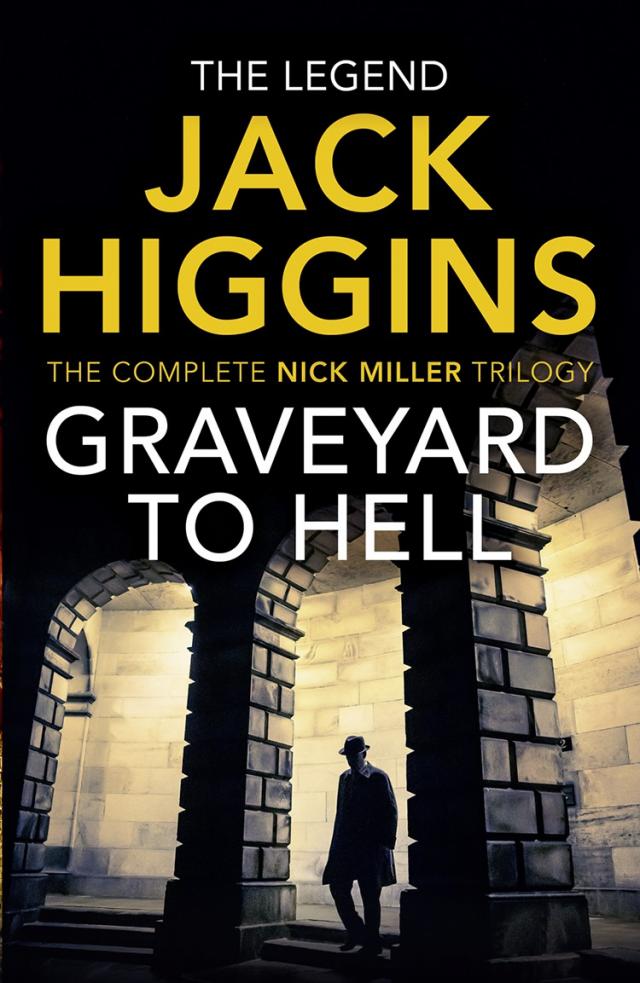


GRAVEYARD TO HELL
THE NICK MILLER TRILOGY
The Graveyard Shift
•
Brought in Dead
•
Hell is Always Today
WITH AN INTRODUCTION BY
MIKE RIPLEY
Jack Higgins
Copyright
HarperCollinsPublishers
1 London Bridge Street
London SE1 9GF
www.harpercollins.co.uk
Published in one volume by HarperCollinsPublishers 2021
First published in Great Britain by John Long Ltd 1965, 1967, 1968
Copyright © Harry Patterson 1965, 1967, 1968
Introduction © Mike Ripley 2021
Cover design by Stephen Mulcahey © HarperCollinsPublishers Ltd 2021
Cover photograph © Laurence Winram/Trevillion Images
Jack Higgins asserts the moral right to be identified as the author of this work.
A catalogue record for this book is available from the British Library.
This novel is entirely a work of fiction. The names, characters and incidents portrayed in it are the work of the author’s imagination. Any resemblance to actual persons, living or dead, events or localities is entirely coincidental, and may depict ethnic, racial and sexual prejudices that were commonplace at the time it was written.
All rights reserved under International and Pan-American Copyright Conventions. By payment of the required fees, you have been granted the non-exclusive, non-transferable right to access and read the text of this e-book on screen. No part of this text may be reproduced, transmitted, down-loaded, decompiled, reverse engineered, or stored in or introduced into any information storage and retrieval system, in any form or by any means, whether electronic or mechanical, now known or hereinafter invented, without the express written permission of HarperCollins.
Source ISBN: 9780008483579
Ebook Edition © August 2021 ISBN: 9780008483593
Version: 2021-06-30
Epigraph
When the times change, all men change with them. So many of both the friends and critics of the police talk as if police constables were not men.
—WITNESS, ROYAL COMMISSION ON POLICE POWERS
To the ordinary soldier, the battle is his own small part of the front.
—GENERAL GRANT
CONTENTS
Cover
Title Page
Copyright
Epigraph
Introduction
The Graveyard Shift
Brought in Dead
Hell is Always Today
About the Author
Also by Jack Higgins
About the Publisher
INTRODUCTION
The name Jack Higgins will be eternally associated with the 1975 bestselling novel (and film) The Eagle Has Landed. But spectacularly successful as it was, it was anything but an overnight sensation, as Jack Higgins had already earned his spurs as an author guaranteed to provide action-packed, fast-paced thrillers.
Before that famous eagle landed, Jack Higgins had written – under several pen-names – 35 novels, and has written 37 more since then, proving beyond doubt his legendary status as a born story-teller.
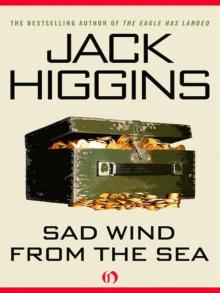
His career as a novelist began in 1959 when, as a 29-year-old teacher with a growing family to support, he sold his first book, Sad Wind from the Sea, a treasure-hunt adventure set in Macao and China, for the princely advance of £75. He never looked back and regularly produced two books a year, often set in exotic locations, always providing red-blooded – though far from perfect – heroes and suitably nasty villains, with the action always moving at a furious pace. He used the pen-names Martin Fallon, James Graham and Hugh Marlowe, as well as his given name, Harry Patterson. In an early novel (Cry of the Hunter) he was suitably self-depreciating when the main character is revealed to be a writer and admits: ‘I write thrillers under two different names … All they do successfully is pay the bills and keep me in whisky.’
From similar modest beginnings, Jack Higgins’ fan base grew inexorably during the 1960s, a golden decade for British authors of adventure thrillers, with novels by Alistair MacLean, Hammond Innes and Desmond Bagley regularly topping the international bestseller lists. Jack Higgins was soon to join their company. As it was also a decade when relatively few readers had travelled abroad unless in the armed forces, adventure stories set in locations such as China, Albania, Tibet, the Greek islands, Greenland, the Bahamas and the Brazilian jungle provided an additional touch of the foreign and dangerously exotic. He also offered a variety of settings, from wartime Egypt, Portugal, Austria and the Channel Islands, to Prohibition America, Mexico in the 1920s, Ireland in the nineteenth century and, treading where few other thriller writers dared to tread, contemporary Northern Ireland with its legacy of sectarian violence.
Higgins’ books were populated by a rich cast of colourful characters, some heroes but more often anti-heroes, at least to begin with, who were no strangers to violence and could handle themselves in a rough house, and were skilled at handling weapons, fast boats, aeroplanes and scuba-diving equipment. They may have dabbled in gun-running or smuggling, be washed-up pilots or whiskey-priests, ex-IRA gunmen, former soldiers or sailors down on their luck seeking one last chance of a quick fortune or a last shot at redemption. Whatever their background and their motives, they would come good and do the right thing in the end, usually revealing a rather romantic sensitivity along the way – especially when there was a damsel in distress.
Yet for thriller readers, and cinemagoers, the dominant flavour of the 1960s was the spy story, from the fantastical escapades of James Bond and his many imitators to the more downbeat and cynical accounts of spies and spying as documented by John Le Carré and Len Deighton, and on television by James Mitchell’s Callan.
Jack Higgins was not slow to recognize the trend, and in 1962 – the year Dr No hit the cinemas and The Ipcress File the bookshops – he launched the career of the half-English, half-French secret agent Paul Chavasse in The Testament of Caspar Schultz. A much-underrated recruit to the Sixties’ panoply of fictional spies, Chavasse’s first published assignment saw him on the trail of a Nazi war criminal, one of the most popular thriller plotlines, not just then but for many years after.
For whatever reason, Higgins did not extend the fictional life of his secret agent beyond 1969, by which time he had also turned his restless pen to the crime thriller, with a new hero, and his first protagonist to be a serving British policeman – Detective Sergeant Nick Miller.
Not that the three novels in the Nick Miller trilogy, published between 1965 and 1968, were the sole focus of Higgins’ creative energy. Far from it, as in the same period he produced seven other novels of secret agents, rogue gunmen and high adventure under his various pen-names, a quite remarkable achievement for an author who had not yet given up ‘the day job’. (It was around this time that he ran into a friend he had not seen for a while who greeted Higgins with: ‘Are you working – or just doing the books?’)
What drew Jack Higgins to the crime novel in the mid-Sixties? Secret agents and tales of high adventure in dangerous foreign parts dominated popular fiction, and he had proved his worth in both those fields. The crime novel was something different to the thriller, often referred to as a ‘detective story’ or a ‘whodunit’, where part of the pleasure for the reader was to guess who the murderer was (there was usually a murder) before the fictional detective did. In the thriller, of course, it was not what had happened before that propelled the story but what was going to happen next – how was the hero going to triumph or, indeed, survive?
Unlike the devil-may-care adventurers who populated thrillers, policemen were restrained by law and legal procedure as to what they could do when confronted with the villain of the piece. In Britain, the police were not usually armed, although well-publicised criminal gangs of the period certainly were and were not afraid to use violence in robberies or in territorial disputes with rival gangs; plus there was a growing drugs problem.
How did fictional British policemen deal with all this? The answer is probably not very well. Those future ‘queens of crime’ P.D. James and Ruth Rendell were only just starting out and the British crime novel was going through a rather lethargic period, certainly compared to the boom in British thrillers. If anything, American crime novels were now more popular than the domestic product, especially those featuring the resourceful private eye acting independently of the police, a figure notably absent (apart from a very few examples) in British crime-writing.
On television, the British police were depicted with either a warm glow of nostalgia, as in the evergreen Dixon of Dock Green, or with stiff-upper-lip reverence for British values of decency and fair play as personified by Commander George Gideon in Gideon’s Way or Detective Superintendent Lockhart in No Hiding Place. True, there was an inclusion of harsh realism in new Sixties’ shows such as Z-Cars but the violent action, guns and car chases of The Sweeney were still a decade away.
If anything, Jack Higgins was ahead of the curve with his Nick Miller trilogy, for here was a hero who could have stepped straight out of the pages of one of his thrillers. All crime novels had to be exciting in some way, if only in the competition between detective and reader to discover ‘whodunit’; but Jack Higgins wrote them as thrillers, packing them with incident, violence and action that could only be sorted out by a resourceful, supremely confident detective unafraid to follow his hunches.
Not that he neglected the traditional ele ments of the crime novel in these books. The setting – a modern urban landscape where it seems to rain constantly, with a harsh underbelly of seedy bars and gambling clubs populated by drug addicts and prostitutes – was a world away from the traditional country house murder mystery, but Higgins still played by the rules of the game, and in both The Graveyard Shift and Hell is Always Today there are fairly laid clues early on as to the identity of the main villain. (And it should be noted that Hell is Always Today features a serial killer who predates both the real Yorkshire Ripper and the fictional Hannibal Lecter.)
By contrast, Brought in Dead, the second book in the trilogy, is more of an all-action revenge thriller in which the identity of the villain is never really in doubt. The suspense Higgins generates comes from whether Miller can – or should – prevent a private, very personal, vendetta in a gripping shoot-out in the countryside.
Nick Miller may not be a typical British policeman, but he was certainly a typical Jack Higgins hero. At the age of 26 and with a law degree, he is young for a Detective Sergeant, having been, as we would say today, ‘fast-tracked’ through the recruitment process, and has already collected six official commendations. This naturally causes resentment among his fellow officers who have ‘come up through the ranks’ and possibly explains why Miller draws so many night (‘graveyard’) shifts.
Not that this seems to worry Nick Miller unduly, as he is certainly not a man to skulk in the shadows. He drives the latest souped-up Mini-Cooper and, thanks to a family business, not only has financial security but also access to an E-type Jaguar. He has his own fashion sense, favouring Chelsea boots, a hand-stitched dark blue Swedish trenchcoat and a German army style ‘rain cap’ (well, it was the Sixties); and as an accomplished pianist, he is not afraid to duet with the resident jazz pianist in one of the many nightclubs he has to visit.
Naturally, when it comes to the rough stuff Miller can take care of himself: he has a brown belt in judo and is something of a dab-hand at karate, an almost compulsory skill for the heroes of thriller fiction at the time, notable examples being Adam Hall’s Quiller, James Munro’s John Craig and Andrew York’s ‘Eliminator’ Jonas Wilde, not forgetting Cathy Gale and Emma Peel from The Avengers.
The Nick Miller trilogy is, of course, of its time, but no less interesting for that, depicting a gritty world of dank canals, coal fires, gas lamps, Bobbies on the beat, telephone boxes, Sunday sports papers and stocking-tops. It was a world where the ‘officer class’ could, and sometimes did, get away with murder and where, lower down the social scale, simply seeking to change a £10 note was regarded as highly suspicious and probably an arrestable offence.
Yet the stories in Graveyard to Hell were not written as social commentary – though the author was one of the earliest sociology graduates in the country – they were written as thrillers, and Jack Higgins thrillers at that, which guaranteed rapid, no-frills action and excitement.
Even if they were a departure from the tales of high adventure in exotic foreign lands for which he was already well-known (and which he was to continue writing with great success), all the familiar Jack Higgins trade-marks are present and correct: the underlying romantic tendencies in even the toughest characters, the adoration of ‘the old country’ of Ireland and the former criminal seeking redemption, personified no better than by ‘Gunner’ Doyle in Hell is Always Today.
If early fans of the Nick Miller books yearned for a longer series, they were to be frustrated. Higgins moved on to write more character-driven – though no less exciting – thrillers such as the highly-rated A Game for Heroes and A Prayer for the Dying before the gigantic success of The Eagle Has Landed and a clutch of bestsellers with Second World War themes: To Catch a King, Storm Warning and The Valhalla Exchange. He also showed that he could strike a topical nerve, controversially so, as with his spy novel Exocet, which appeared in 1983 in the wake of the Falklands War.
Apart from global fame and sales of his books now being measured in hundreds of millions, that eagle which landed in 1975 left another legacy in the shape of rogue Irish gunman Liam Devlin, a hugely memorable character. After four novels putting Devlin centre-stage, Higgins created a younger, contemporary version in Sean Dillon and those fans who prefer their heroes to feature in a long-running series of adventures certainly got their wish, with Dillon appearing in more than twenty bestselling novels.
Today, Sean Dillon and Liam Devlin are undoubtedly Jack Higgins’ best known characters. Nick Miller may be a new name to many of his readers, despite his inception more than fifty years ago, but if they are fans of Jack Higgins, they will not be disappointed.
MIKE RIPLEY
April 2021
Mike Ripley is the author of Kiss Kiss, Bang Bang, a history of the British thriller from Casino Royale to The Eagle Has Landed, which won the 2018 H.R.F. Keating Award for non-fiction.
Central Index POLICE DEPARTMENT Form No. 272
30/3B/112 File No.
SERVING OFFICER’S RECORD CARD 372/1/6
NAME: MILLER Nicholas Charles NUMBER 982
ADDRESS: ‘Four Winds,’ Fairview Avenue
DATE OF BIRTH: 27th July, 1939
AGE ON JOINING DEPARTMENT: 21
OCCUPATION ON JOINING DEPARTMENT: Student
EDUCATION: Foundation Scholar at Archbishop Holden’s Grammar School
Open Exhibition to London University 1956
London School of Economics
EDUCATIONAL ATTAINMENT: Bachelor of Law with Second Class
Honours, University of London, 1959
SERVICE RECORD: Joined Department, 1/2/60
Passed out District Training centre, 1/5/60
Certified as passing probationary year satisfactorily, 1/2/61
Appointed to Central Division, 3/3/61
Appointed Detective Constable and transferred to ‘E’ Div. on 2/1/63 (See File National Bank Ltd., 21/12/62)
Need to sit promotion exam waived by Watch Committee and put forward for place at Bramshill, 2/12/63 (See File Dale-Emmett Ltd., 3/10/63)
Completed Special Course Bramshill with Distinction and promoted sub-stantive Detective Sergeant, Central Division, effective 1/1/65
COMMENDATIONS: 1/8/60 See File 2/B/321/Jones R.
5/3/61 See File 2/C/143/Rogers R. T.
4/10/61 See File 8/D/129/Messrs. Longley Ltd.
5/6/62 See File 9/E/725/Ali Hamid
21/12/62 See File 11/D/832/National Bank Ltd.
3/10/63 See File 13/C/172/Dale-Emmett Ltd.
CONFIDENTIAL ASSESSMENT: A highly intelligent officer with a genuine capacity for police work who possesses potential leadership qualities of a high order. Greatest fault, a tendency to work on his own. Tends to unorthodoxy in methods. It should be noted that this officer is a judo brown belt and an exponent of the art of karate, a Japanese mode of self-defence by which it is possible to kill an opponent with the bare hands. The undesirability of using such methods in the execution of his duty has been pointed out to this officer.
BOOK ONE
THE GRAVEYARD SHIFT
As always – for Amy
1
Fog drifted up from the Thames, pushed by an early morning wind, yellow and menacing, wrapping the city in its yellow shroud, and when the duty officer at Wandsworth opened the judas gate and motioned the half dozen waiting men through, they stepped into an alien world.
Ben Garvald was last in line, a big, dangerous-looking man, massive shoulders swelling under the cheap raincoat. He hesitated, pulling up his collar, and the duty officer gave him a quick push.
‘Don’t want to leave us, eh?’
Garvald turned and looked at him calmly.
‘What do you think, you pig?’
The officer took an involuntary step back and flushed. ‘I think you always did have too much bloody lip, Garvald. Now get moving.’
Garvald stepped outside and the gate clicked into place with a finality that was strangely comforting. He started to walk down towards the main road, passing a line of parked cars and the man behind the wheel of the old blue van on the end turned to his companion and nodded.