Carnosaur, p.22
Carnosaur, page 22
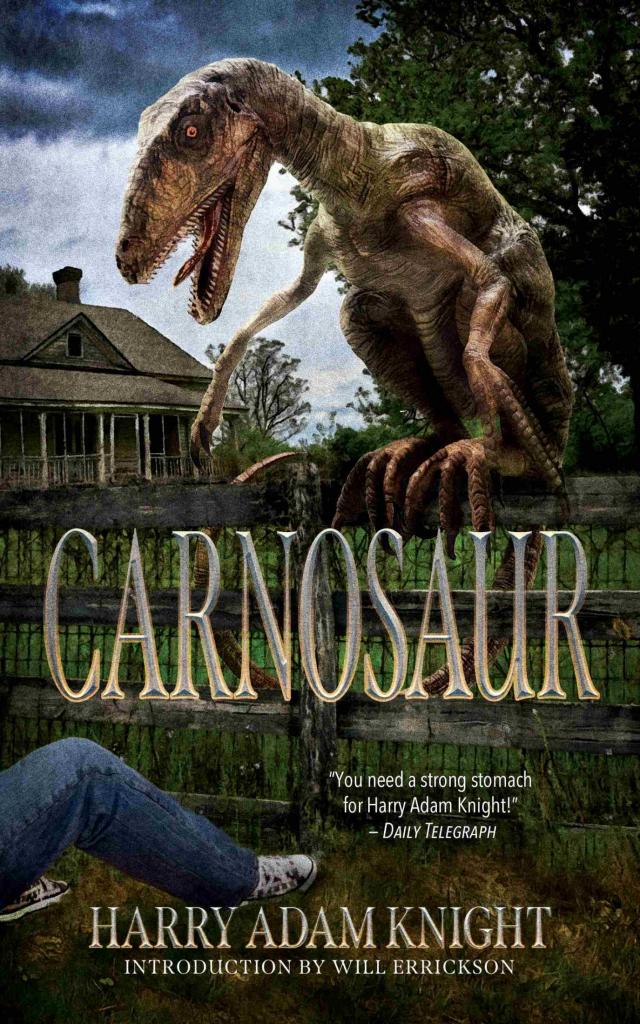


Then suddenly Driscoll and Hazelmere were there beside them firing their revolvers at the animal. The guns looked ridiculously small and puny to be used against such a creature but the bullets, aimed at its head, seemed to have an effect. Screeching with pain it withdrew behind the barrier.
The two policemen kept firing until their guns were empty. By then Pascal had managed to hustle Jenny back across the street. ‘You stupid bitch! Don’t ever do that again!’
But she merely grinned and held up the camera. ‘I’m going to develop these in Henry’s darkroom right away! These are going to make us famous!’
Pascal was about to tell her he didn’t give a damn about being famous if it meant risking her life when she was interrupted by the approach of Warchester’s one and only fire engine, its siren wailing.
The fire engine pulled up in front of the shopping centre and its crew spilled out onto the street. At the same moment the Tarbosaurus resumed its awesome assault on the grille and the firemen froze into postures of disbelief. In different circumstances Pascal would have enjoyed the expressions on their faces as they gazed at the dinosaur, but now it was too alarmingly clear that the grille would shortly give way completely and that the animal would be loose in the high street.
‘Connect your hoses! Connect your hoses!’ someone screamed. ‘It’s our only chance of stopping it. Move, damn you!’ It was Driscoll, running among the firemen, yelling at the top of his voice and waving the empty gun at them. Pascal saw immediately what he had in mind and, fortunately, some of the firemen caught on too. They began to unwind the fire hoses from the appliance and connected them to nearby hydrants.
They were just in time. No sooner had two of the hoses been readied than several metal bolts exploded out of the entrance wall like rifle bullets and the whole grille collapsed onto the footpath. The dinosaur, ducking to get under the top of the entrance, emerged into the street.
It was instantly hit by two powerful jets of water from the fire hoses. The force was sufficient to knock it off balance and it fell over onto its side with a thud that made the ground shake. Struggling to rise, hind legs kicking frantically, it gave an ear-splitting shriek of rage.
‘We’ve got to get more hoses on it!’ cried Driscoll, but by now the rest of the firemen had roused themselves from their dazed state and were connecting the other two hoses.
The Tarbosaurus finally succeeded in regaining its footing. It tried to lunge forward at its frail attackers but one of the hoses was kept trained on its head, blinding it. Then the other two hoses were brought into play and the combined strength of the four jets of water was enough to force it backwards.
‘Push it back into the mall!’ ordered Driscoll. ‘We can trap it then – block both the front and rear entrances with vehicles . . .’
Foot by foot the protesting, struggling prehistoric animal was forced back into the shopping centre. The firemen followed it inside, using the jets of water as battering rams; knocking the creature off its feet again and again.
The Tarbosaurus was by now becoming confused. The constant impact of high-pressure water in its eyes and against its sensitive ear cavities had disorientated it badly.
Finally it panicked.
Bellowing loudly it turned from its attackers and tried to escape. But instead of heading towards the opposite end of the mall where it had originally broken in, the great beast charged blindly into one of the columns supporting the mezzanine floor above.
The momentum of the animal’s seven ton bulk was enough to shear the column in two. And as it collapsed it brought down a whole section of the mezzanine floor with it.
Shrieking with pain the dinosaur vanished under tons of falling debris. A great cloud of dust rose into the air and with it came silence.
The Tarbosaurus was dead.
Mrs Myra Goodwin woke to hear the sounds of her ten-year-old son Philip playing in the front garden. What on earth is he doing up at this hour? she asked herself irritably. She looked at the clock on her bedside table. It was only 5.50 a.m. and just getting light. Damn the boy! He was becoming a real little nuisance. It was his father’s fault. He was away too much on sales trips to be a proper father to the boy, and when he was home he never disciplined him, just spoiled him rotten.
Philip was laughing excitedly. Vaguely she wondered what he’d found that was so entertaining at ten to six in the morning. Then she heard another sound; it was like a cross between a sheep’s bleat and the honk of a goose.
Frowning, she got out of bed and went to the window. Down in the front garden she saw her son, in pyjamas and dressing gown, feeding handfuls of grass to some kind of animal. At first she thought it was a baby elephant but then saw that what she’d mistaken for a trunk was in fact the creature’s neck. The head on the end of the neck, which was very long, was quite small and out of all proportion to the rest of the animal.
She opened the window and called out, ‘Philip, what is that you’ve got there?’
Both boy and animal looked up at her. The animal bleated. ‘It’s a dinosaur, Mummy! Can I keep him, please?’
Mrs Myra Goodwin sighed. Another pet! ‘I don’t know,’ she told him. ‘You’ll have to wait and ask your father.’
The residents of Warchester – the ones still alive – woke up to a world that was vastly different to the one they’d gone to sleep in. There were police cars moving slowly up and down the streets issuing amplified warnings to people to stay in their houses. Helicopters, most of them with military markings, were constantly flying back and forth at very low levels. Then suddenly there were armoured cars and light Scorpion tanks rolling through the streets as well. What was going on? Was it war?
The local radio didn’t provide much information at first, except to say that a number of dangerous animals had escaped from Sir Penward’s zoo and to repeat the police warning that people should not leave their homes until they were told it was safe to do so. This didn’t satisfy many people. Even if several big cats had escaped from the zoo wasn’t this large military presence something of an over-reaction?
Then, in a late news bulletin on Good Morning Britain the word dinosaur was mentioned for the first time . . .
Bit by bit the residents of Warchester got to know of the true situation: there were prehistoric monsters on the loose around the town and in the surrounding countryside. As incredible as it seemed, Sir Penward had actually manufactured the creatures by means of genetic engineering. And as the day wore a series of experts were paraded on radio and TV news bulletins, explaining how Sir Penward had probably achieved this. Gradually it began to seem less and less incredible and just very, very frightening.
Of course many people in the area didn’t need expert confirmation on the existence of the dinosaurs – they’d already had first-hand experience of the creatures. Like Sylvia Pitt, wife of the late Stanley Pitt, MP for Warchester. She had spent several terrified hours hiding in the wine cellar after seeing, through her front window, two policemen torn to pieces by the Dilophosaurus, the same dinosaur which had earlier killed her husband.
She had tried to warn the two policemen by signalling from the window as they got out of their patrol car – she had glimpsed the creature walking round the side of the house a short time before – but they continued to walk up. The next thing she knew the huge two-legged reptile had pounced on them. One policeman died instantly – bitten almost in two – but his partner had tried to run back to the car. He almost made it, but the reptile caught up with him before he could open the door. To Sylvia Pitt, who’d quickly looked away from the window, his screaming seemed to go on for ever.
The Dilophosaurus, with its distinctive crested head, was next seen by a milkman an hour later. The dinosaur was calmly walking down the middle of a road in one of Warchester’s most expensive residential areas. The milkman jumped from his still-moving float and raced to the front door of the nearest house, where he hammered and banged frantically until it was finally opened by an irate elderly man. The milkman simply pointed at the dinosaur, which was now passing directly in front of the house, and pushed past the old man. The man took one look at the animal and slammed the door. They then tried to call the police but they couldn’t get through. By then many others were also trying to ring the station.
One of them was a farmer by the name of Stan Lewis who, to his amazement, had just seen a large reptile some twenty feet long, with a big spiny fin down its back, chasing his herd of milking cows across one of his fields. After trying repeatedly to call the police, without success, he got his rifle and went off to try and deal with the bizarre problem by himself – against his wife’s advice.
He never came back.
Another frustrated caller was a salesman called Vincent Haye. Driving towards Warchester he had passed three incredible sights in quick succession: first was the body of some kind of giant lizard lying in the road, next had come a gory mess barely recognisable as the remains of a man, and then, as he’d driven past the stationary juggernaut, he saw a large, black panther sprawled on the bonnet of the truck. It had turned to look at him as he went by, then returned its gaze to a girl cowering in the cab.
The salesman didn’t even consider stopping. Instead he put his foot down until he reached a call box a couple of miles further along the road.
One caller who did succeed in getting through was another early motorist who saw what appeared to be an entire pride of lions in a field he passed. Ironically, the big cats were to present an even bigger problem to the police and army units than the dinosaurs. For one thing there were many more of them – over sixty lions, tigers, panthers, leopards, jaguars and pumas had escaped from the zoo and most of them, frightened by the giant reptiles, had left the estate and spread across the countryside. Several members of the hastily-assembled army of inexperienced hunters were to fall victim to fatal attacks by the big cats before the day was over.
The hunters scored their first dinosaur at 10.20 a.m. An army unit cornered the Dilophosaurus in the playground of the Warchester Primary School. It proved difficult to kill: after being hit repeatedly by rifle fire it was finally despatched with a cannon shell fired by one of the Scorpion tanks that had swiftly arrived on the scene.
The second dinosaur kill occurred an hour later. The crew of an Army Lynx helicopter spotted it eating a cow in a field. It was the finned dinosaur that had been seen by farmer Stan Lewis – who by then was lying dead in another field along with several of his cows. Its official name was Altispinax and unlike the other carnosaurs that Penward had resurrected it walked on all fours. A native of prehistoric England, it had formerly flourished in the Lower Cretaceous period.
The Lynx swooped down on it and opened fire with its 20mm AME 621 cannon. The Altispinax started to run but quickly received a number of direct hits, one of which shattered its skull. It collapsed nose-first onto the ground, its four ton mass skidding for over twenty feet before it came to a stop. Even with its brain destroyed by 20mm shell, the body continued to twitch and jerk for a half an hour.
The reptile that proved most difficult to deal with wasn’t even, theoretically, a proper dinosaur – it was the plesiosaur. The canal boat containing the survivors of the late Dickie Radford’s party wasn’t discovered until after 9 a.m. By then there were only twelve students huddled in the cabin; a further three had been snatched by the creature after Radford had been killed.
The soldiers, once they understood what sort of animal it was, began using hand grenades as makeshift depth charges. The water in the vicinity of the canal boat was seeded with numerous grenades, but though a lot of mud was churned up and a few dead fish floated to the surface, the plesiosaur was nowhere to be seen. It eventually became clear that the amphibious reptile was no longer in that section of the river. The big question was – had it gone up or down stream?
An urgent request for an anti-submarine Westland Sea King helicopter, equipped with dipping sonar, was sent to the Navy. In the meantime soldiers in rubber boats, powered by outboard motors, proceeded in opposite directions away from the stranded canal boat and tossed grenades into the river at regular intervals.
The first clue to the creature’s whereabouts came when a call was received at the police station – which had been converted into the operations nerve centre – from a hysterical woman who said that her husband, a dedicated angler, hadn’t returned from his customary dawn fishing session on the river. His regular fishing spot, it was learnt, was near a traffic bridge that crossed the river almost in the centre of town.
The soldiers in the rubber boats sped to the location. Grenades were again thrown into the water. The residents of Warchester, already battered by a series of staggering surprises that morning, were now subjected to the ominous thump, thump of the exploding grenades. Some even suffered broken windows from the concussions.
At first it seemed that the plesiosaur had moved on – after twenty grenades had been dropped in the water near the traffic bridge the soldiers began to relax – but then suddenly the great head on its long neck reared up out of the water right beside one of the rubber boats. Taken by surprise the boat’s four occupants didn’t react fast enough. They were still staring at the creature in stunned amazement when the head plunged downwards – straight into the middle of their frail craft. One man was killed by the impact, another was dragged beneath the surface by the reptile. The other boats converged on the spot and quickly pulled the two survivors from the water: then more grenades were dropped.
When the beast surfaced again it was obvious it had been mortally wounded. Dark blood gushed out of its mouth and it whipped its neck about in a frenzy of pain. The soldiers opened fire with their 7.62mm automatic rifles but they needn’t have bothered; the plesiosaur was as good as dead. When it finally stopped its threshing about and rolled slowly over onto its back the soldiers could see that its massive belly had been ruptured by the grenades. Soon the only sign of life was a weak movement in one of its long flippers.
At 11.13 a.m. army units had entered the Penward estate and were cautiously heading towards the manor house and zoo. Leading the way were several light Scorpion tanks, and it was one of these that became the first casualty of the clean-up operation.
Less than a quarter of a mile from the house and zoo complex the crew of the lead tank saw a large dinosaur busily munching shrubbery near the roadway. It was about twenty-five feet long and resembled a giant armadillo. It was covered with great bony plates from which protruded horns and spikes. Its most distinctive feature was its tail. Immensely thick, it ended in an enormous bony club with two giant spikes growing out of it.
The Scorpion tank turned off the road and approached the dinosaur, which immediately lowered itself flat on the ground in a clearly defensive posture. In that position the animal was a living blockhouse, invulnerable to all attack.
Inside the tank the crew debated whether a shell from their 20mm cannon would penetrate the dinosaur’s natural armour or whether they should try to kill the thing at all. It was obviously herbivorous and might not present any threat to human life. The tank commander was about to suggest they wait until the scientists arrived from the Natural History Museum, when the dinosaur jumped to its feet and charged them.
Its bone-covered, beaked head ploughed straight into the side of the Scorpion, caving in the tank’s light armour. Then the dinosaur delivered the coup de grace: it swung its tail round and sent three hundredweight of spiked, bony club crashing into the rear of the vehicle. The effect was the same as if the tank had suffered a direct hit with a 90mm shell. The Scorpion blew up.
Startled but unharmed the dinosaur – a Scolosaurus from the Upper Cretaceous era – trotted away from the blazing wreck. Brief moments later its small brain had already forgotten the incident, and it resumed feeding.
The shocked crews of the other tanks and armoured cars went swiftly into action. Keeping well clear of the animal they opened fire with cannon and heavy calibre machine-guns. It took a remarkably long time to die and they kept firing even when it no longer moved. The firing only stopped when the animal was nothing but chunks of smoking meat and bone scattered about the ground.
From then on the soldiers took no chances – they shot at everything that moved.
By 12.45 a.m. the ‘battle’ for Penward Hall had been won. The dinosaurs were all dead. There had been only one further casualty sustained by the military – a soldier entering one of the top floor rooms in the manor house had been surprised by Deinonychus – the Terrible Claw – and ripped open before his companions could shoot the creature.
After that it was all over.
Or so it seemed.
24
As the only two people who knew the full story behind the appearance of prehistoric animals in Warchester, Pascal and Jenny were questioned endlessly by a succession of police officers, army officers, government officials and scientists for most of the day. When it became clear that Pascal knew more about the situation than Jenny she was allowed to leave the police station, which was serving as the command post. Pascal was obliged to stay on and endure yet more interrogation.
His only respite during the day was a quick trip to the hospital where a harassed doctor examined him, stitched up the gash in his back, told him his ankle wasn’t broken but badly sprained, and pronounced him relatively fit. Then it was back to the police station again.
As the day progressed and the death toll mounted, his feeling of guilt increased. He couldn’t help thinking that if he hadn’t meddled with Penward’s secrets none of this would have happened. He tried to reassure himself with the thought that sooner or later Lady Jane might have done the same thing anyway for some other reason – and it occurred to him that she might have been the cause of the Deinonychus getting out in the first place. And if he hadn’t interfered, perhaps Penward would have activated his frightening plan of letting loose dinosaurs all over the world and killing even more people. But the nagging sense of guilt remained. He couldn’t forgive himself for the way he’d exploited Lady Jane and then callously betrayed her. He couldn’t escape the fact that he had provided the spark that set off the day’s conflagration.