The stranger i wed, p.1
The Stranger I Wed, page 1


Praise for Harper St. George
“A glittering ballroom romance bursting with the industry and wealth that so define Gilded Age heiresses.”
—Entertainment Weekly on The Heiress Gets a Duke
“The Heiress Gets a Duke is a charming, compulsively readable delight and I can’t wait for the next book from Harper St. George’s magical pen!”
—USA Today bestselling author Evie Dunmore
“St. George marries classic elements from historical romance greats like Lisa Kleypas and Julia Quinn with subtle winks and nudges about the genre that would appeal to the more experienced romance reader.”
—Forbes
“A sparkling jewel of a love story, full to the brim with Victorian wit, romance, and heart-stopping heat. Road trips in a carriage and four don’t get much sexier than this.”
—USA Today bestselling author Mimi Matthews, on The Devil and the Heiress
“A sexy, emotional, romantic tale . . . Harper St. George is a must-buy for me!”
—USA Today bestselling author Terri Brisbin, on The Heiress Gets a Duke
“Wit, seduction, and passion blend seamlessly to create this deeply emotional romance. St. George weaves an intriguing plot with complex characters to provide the perfect sensual escape. There’s nothing I didn’t love about The Heiress Gets a Duke, especially its lush, captivating glimpse into history.”
—USA Today bestselling author Anabelle Bryant
“With sizzling chemistry, brilliant banter, and an unapologetically strong, feminist heroine, Harper St. George sets the pages ablaze!”
—USA Today bestselling author Christi Caldwell
“Fun, tender, and definitely sexy, The Heiress Gets a Duke is already at the top of my list for the best books of the year. Don’t sleep on this refreshing and feminist romance.”
—BookPage (starred review)
“Harper St. George just gets better and better with every book, penning the kind of page-turning stories that you will want to read again as soon as you finish each one.”
—Lyssa Kay Adams, author of the Bromance Book Club series
“A rich, compelling, and beautifully written romance. St. George brings us the story of Violet Crenshaw, an American heiress with distinctly modern ideas about love and marriage.”
—Elizabeth Everett, author of The Love Remedy
“Luscious historical romance.”
—PopSugar
“Rich with period detail, The Heiress Gets a Duke brings to life the Gilded Age’s dollar princesses in this smart, sexy, and oh-so-satisfying story.”
—Laurie Benson, award-winning author of the Sommersby Brides series
“You’ll sigh, you’ll cry, and you’ll grin yourself silly as this independent and cynical heiress finally gets her duke.”
—Virginia Heath, author of Never Wager with a Wallflower
Also by Harper St. George
The Gilded Age Heiresses
The Heiress Gets a Duke
The Devil and the Heiress
The Lady Tempts an Heir
The Duchess Takes a Husband
Berkley Romance
Published by Berkley
An imprint of Penguin Random House LLC
penguinrandomhouse.com
Copyright © 2024 by Harper Nieh
Excerpt from Eliza and the Duke by Harper St. George copyright © 2024 by Harper Nieh
Penguin Random House supports copyright. Copyright fuels creativity, encourages diverse voices, promotes free speech, and creates a vibrant culture. Thank you for buying an authorized edition of this book and for complying with copyright laws by not reproducing, scanning, or distributing any part of it in any form without permission. You are supporting writers and allowing Penguin Random House to continue to publish books for every reader.
BERKLEY and the BERKLEY & B colophon are registered trademarks of Penguin Random House LLC.
Library of Congress Cataloging-in-Publication Data
Names: St. George, Harper, author.
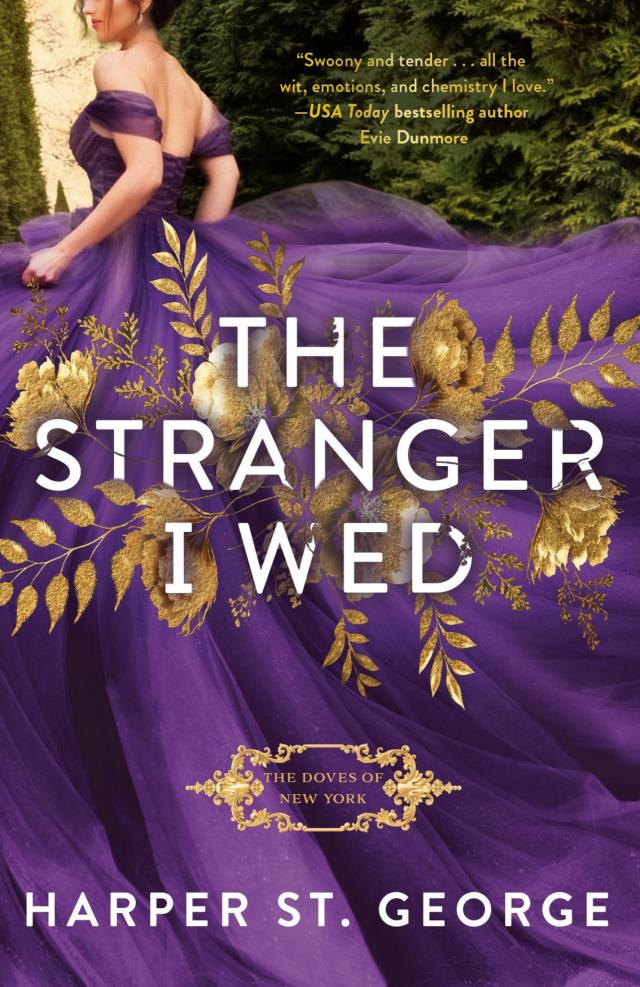
Title: The stranger I wed / Harper St. George.
Description: First edition. | New York: Berkley Romance, 2024. | Series: The doves of New York ; 1
Identifiers: LCCN 2023031479 (print) | LCCN 2023031480 (ebook) | ISBN 9780593441008 (trade paperback) | ISBN 9780593441015 (ebook)
Subjects: LCGFT: Romance fiction. | Novels.
Classification: LCC PS3619.T236 S77 2024 (print) | LCC PS3619.T236 (ebook) | DDC 813/.6—dc23/eng/20231016
LC record available at https://lccn.loc.gov/2023031479
LC ebook record available at https://lccn.loc.gov/2023031480
Cover design by Rita Frangie Batour
Cover image of woman by Anna / Adobe Stock
Book design by George Towne, adapted for ebook by Maggie Hunt
This is a work of fiction. Names, characters, places, and incidents either are the product of the author’s imagination or are used fictitiously, and any resemblance to actual persons, living or dead, business establishments, events, or locales is entirely coincidental.
pid_prh_6.3_146746584_c0_r0
Contents
Cover
Praise for Harper St. George
Also by Harper St. George
Title Page
Copyright
Dedication
Part One
Prologue
Chapter One
Chapter Two
Chapter Three
Chapter Four
Chapter Five
Chapter Six
Chapter Seven
Chapter Eight
Chapter Nine
Part Two
Chapter Ten
Chapter Eleven
Chapter Twelve
Chapter Thirteen
Chapter Fourteen
Chapter Fifteen
Chapter Sixteen
Chapter Seventeen
Chapter Eighteen
Chapter Nineteen
Chapter Twenty
Chapter Twenty-One
Chapter Twenty-Two
Chapter Twenty-Three
Part Three
Chapter Twenty-Four
Chapter Twenty-Five
Chapter Twenty-Six
Chapter Twenty-Seven
Chapter Twenty-Eight
Chapter Twenty-Nine
Chapter Thirty
Chapter Thirty-One
Epilogue
Author’s Note
Acknowledgments
Excerpt from Eliza and the Duke
About the Author
_146746584_
For Lois Glanzer, who was always the heroine of her own story.
We love you and miss you.
Part One
Men have everything, most women nothing but what men give them. When women want anything, be it bread or a kind word, they must pay the price that men exact for it, and it is nearly always “a pound of flesh.”
—Susan B. Anthony
Prologue
Upper East Side, Manhattan
Autumn 1877
Fifth Avenue was Cora’s birthright, but that’s only if one adhered to biology rather than social expectation. People usually didn’t, which is why she and her sisters had never been invited to any of the exclusive addresses on the street. They were illegitimate. Secrets to be whispered about, sometimes scorned by otherwise polite citizens, and flatly ignored by Charles Hathaway. Despite her best efforts, Cora had never quite figured out how to not let that bother her.
Her knees were shaking as the driver helped her out of the cab in front of the Hathaway mansion. He eyed her dubiously, uncertain whether to place her among the residents or the servants that populated the street. She couldn’t blame him, because sometimes she didn’t know, either. The serviceable navy dress she wore was more suited to a governess than a Hathaway daughter. She thanked him with a coin, which he palmed while tipping his hat to her. His eyes seemed to wish her luck.
She inhaled deeply and took in the mansion before her. It was her first actual sighting of her father’s house. Five floors of brick and limestone, the home was imposing but not gaudy, built to blend in with the brownstones around it. A tiny lawn of grass and shrubbery was neatly contained within a wrought iron fence. It was exactly what she had expected from the Hathaway family. Ostentatious displays of wealth were better left to the new money that bled through the city. Old families like the Hathaways had no need to prove their affluence, because that had been established two centuries ago.
Her knees continued to tremble as she took the steps that led to the front door. The door opened before she could ring the bell. The butler, an older man with pale skin and drooping jaws, looked down at her as if he was on the verge of sending her around to the servants’ entrance. “May I help you, miss?”
Infusing steel into her voice to stop the inevitable waver, she said, “Good morning. I am here to meet with Mr. Charles Hathaway.”
The lines in his forehead deepened and his lips flattened. “Not possible, miss. The household is in mourning. Mr. Hathaway is not home to visitors.”
“Yes, my condolences. However, he’ll want to see me. Please tell him that Miss Cora Do ve is calling.”
Her name didn’t seem to mean anything to the butler. His expression was as skeptical as ever. “I’m afraid that is impossible.”
Having anticipated this very reception, she withdrew the letter that had brought her here. She kept a tight hold on it but held it up so that he could see the Fifth Avenue return address on the envelope. Curious enough to not slam the door in her face, he withdrew a pair of half-rim spectacles from his pocket and leaned forward to read the text. It was from the late family matriarch, Ada Hathaway. The handwriting was spidery and frail, uneven from being written on the woman’s deathbed, Cora assumed, but it was legible nonetheless.
Not above a little ruthlessness when the situation called for it, she said, “I know that Mrs. Hathaway and her children are not at home.” The papers had written about how they had retired to their Westchester farm after the funeral. “I can return later when they are, if you’d prefer.”
His eyes narrowed with a shadow of contempt. Ah, perhaps he did know her name after all. They both knew that Mr. Hathaway’s wife would not like it that she was here. He gave a telling glance toward the street—so far, none of the people hurrying down the sidewalk had taken notice of them—and he loosened his grip on the door. “Come in, Miss Dove.”
The house was the epitome of elegance. A thick Persian rug covered the marble floor of the entryway and led to a wide and curving staircase, the balustrade a gleaming mahogany carved with tiny rosettes. Two rooms flanked the hall, each of them furnished with sofas and chairs covered in rich textiles and cushions; tables were strewn with delicate baubles, and walls were adorned with priceless artwork. The windows were dressed in black crepe, but she suspected they typically bore stylish and copious drapery.
It was all very tasteful and moderately extravagant—they weren’t the Vanderbilts, after all. The Hathaways were one of New York’s oldest families. They hadn’t earned their wealth through modern industry. It had been gained by new-world commerce—trading and importing—then inherited and reinforced through the generations by rising property values.
The butler indicated one of the drawing rooms. “Wait in here and I’ll let Mr. Hathaway know you have come.”
Cora might have done just that, but she spotted the portrait above the fireplace. Mrs. Hathaway stared out at her. She was a woman in her midthirties who might have been pretty had she appeared less severe. Her hair was pulled back so tight that it gave her a nearly cat-eyed appearance, and her mouth was held firm in disapproval. Cora almost felt as if Mrs. Hathaway were looking out at her, condemning her for daring to step foot inside her home.
The woman was seated, and standing behind either shoulder was a young boy and an older girl. From the papers, Cora knew the girl’s name was Agnes and she was around fifteen, only a few years younger than Cora’s youngest sister, Eliza. She stood tall behind her mother in a dress that probably would have supported Cora’s family for a year or more. Her heart ached for all that her own little family had been denied. It was strange to think that if things had turned out differently, she might have lived here.
“No, take me to him.”
The butler sputtered in protest. She insisted. She eventually prevailed when a young maid rushed into the hall holding a stack of linen, saw them, and scurried away. There would be gossip now, and prolonging their disagreement in the front hall would only make it worse if more servants came to gawk. He turned toward the deep recesses of the house with Cora on his heels.
The butler came to a stop at the back corner of the house and knocked at a set of polished mahogany doors. A voice inside called out, and he gave her a sharp look that held her rooted to the floor before he disappeared inside. He returned moments later and motioned her in before closing the door behind him with a slam that was a smidge harder than strictly necessary.
She paused to gather herself, taking in her surroundings, not ready to look toward the figure waiting on the other side of the room. Her courage had yet to catch up with her bravado. The study was paneled in dark wood with hundreds of leather-bound books lining bookcases. Eliza would love this room. A fire crackled in the hearth; the scent of woodsmoke, not coal, mixed with the sweet pungency of cigars. Charles Hathaway rose from his place behind his desk, and she had no choice but to finally acknowledge him. He stood larger than life after all this time.
She had last seen him around twelve years ago, but he hadn’t changed much. Silver wings now tipped his dark hair, and a few lines creased his face, only serving to make him appear more dignified. His looks perfectly matched his smart wool suit, his elegant home, and his disapproving wife. He was handsome in a bland and conventional way, as if his physical traits had come together to render him pleasing but never anything so garish as beautiful.
She’d only been eight or nine when she last saw him; now that she was older, she found herself looking for similarities. The middle Dove sister, Jenny, was their mother reborn, but Eliza had his strong chin. Cora had his eyes, grayish blue. She also recognized the slightly prominent slope on the bridge of his nose as a mirror of her own, though on a larger scale.
“Hello.” For a moment, she forgot what it was she had come there to say.
He searched her features, puzzling them out as if he, too, were looking for signs of himself in her. “Cora.”
Relief and welcome were evident in his voice, not the censure she had expected. Despite every other part of her vowing to despise him, the child in her that longed for a father stood up at that single word. He knew her name and had spoken it aloud. It was like stepping into a beam of healing sunlight after a long and bitter winter of darkness.
“You’re here,” he said as if he still couldn’t believe it. “Has something happened? Is Fanny . . . ?”
“Mama is well.”
He gave a slight nod, and they fell into silence until he motioned for her to take one of the chairs across from him. “How are your sisters?”
Did he remember their names? She didn’t want to ask and risk disappointment.
Settling herself in the plush chair, she answered, “We are all well. Please accept my condolences on the death of your mother.” Her grandmother, though no one had ever called her by that name in Cora’s presence. If she had ever met the woman, she couldn’t remember it.
His eyes widened slightly in surprise before he was able to rein in the expression as he sat. “Thank you. She had a good, long life.” He searched her features again before settling on her hair. “You look like her a bit. You even have the same auburn tint to your hair that she had when she was younger.”
Cora fingered the hair at the nape of her neck. They had always wondered where the distinctive color had come from. What else might she and her sisters have inherited from the family they had never known? They had been denied so very much. The anger she had carried around for as long as she could remember came seeping in.
“I wouldn’t know. I never met her.”
He had the gall to appear wounded. “Cora, I . . . I did the best I could.”
She didn’t agree but had not come to rehash the two decades of her life or expound on parental responsibility. Taking a deep breath, she pressed forward with the rest of the reason for her visit.
“She sent me a letter before her death.” This time he wasn’t able to get a handle on his surprise so quickly as she pulled the letter from her handbag. “It was delivered the day after her obituary appeared in the New York Times. She said that she had come to regret the way things were handled and she would leave an inheritance for me and my sisters.”
Wordlessly, he held out his hand for the letter. Everything in her rebelled at handing it over. All he would have to do is toss it into the fire and there would be no evidence that Ada Hathaway had thought of her at all. She withdrew the paper from the envelope and handed it to him. At least the envelope would serve as some sort of proof if the letter within disappeared.
He perched a set of reading spectacles on the end of his nose and settled back in his chair. The letter itself was rather impersonal, written by a woman who obviously kept her feelings very close to herself. It merely stated her regret that things couldn’t have been different and that she had left an inheritance and Cora should visit Charles for further information.