Liliths arithmetic, p.1
Lilith's Arithmetic, page 1
part #1 of An Eve of Light Novel Series


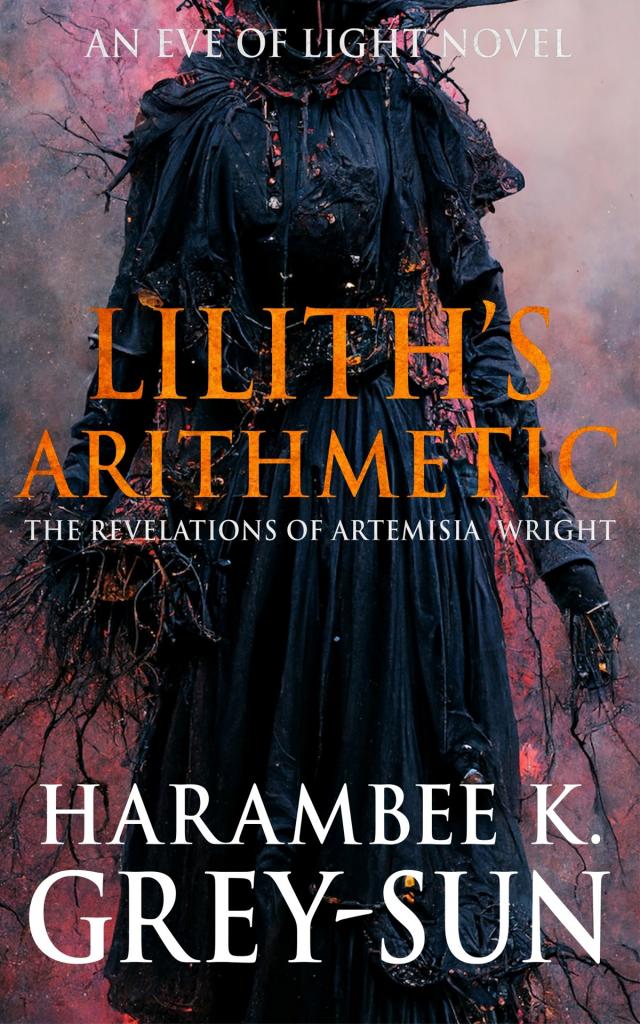
Lilith’s Arithmetic
The Revelations of Artemisia Wright
An Eve of Light Novel
Harambee K. Grey-Sun
HyperVerse Books, LLC
This book is a work of fiction. Names, characters, places, and incidents are the products of the author’s imagination or are used fictitiously. Any resemblance to actual events, locales, or persons, living or dead, is entirely coincidental.
* * *
Copyright © 2023 by Harambee K. Grey-Sun
All rights reserved. No part of this book may be reproduced in any form or by any means, including scanning, photocopying, or otherwise without the expressed written consent or permission from the publisher or author, except in the case of a reviewer, who may quote brief passages embodied in critical articles or in a review.
* * *
Cover design by Kelvin Reese
Cover art copyright © KaiJaeArt | Depositphotos.com
* * *
Published by HyperVerse Books, LLC
PO Box 23642, Alexandria, VA 22304
www.hyperversebooks.com
Crossing genres without apologies.
* * *
Print ISBN-13: 978-1-64044-028-9
Ebook ISBN-13: 978-1-64044-027-2
Contents
Chapter 1
Chapter 2
Chapter 3
Chapter 4
Chapter 5
Chapter 6
Chapter 7
Chapter 8
Chapter 9
About the Series
Eve of Light Story Order
Newsletter Sign-Up
About the Author
Also by Harambee K. Grey-Sun
By Harambee Grey-Sun
One
Traces of wildflowers and other long-gone weeds floated upon the January morning’s breeze, essences almost as sweet to Artemisia as the more metallic aromas expelling from the corpse’s fresh chest wound.
She’d tried to hold her breath while she crouched over the broken body, using the enhanced senses filtered through her eyes and ears to detect any remaining signs of life, any toxic flickers that might revivify the body, making it a newer, stronger threat. But she let her lungs refresh when she realized there was no hope of resurrection for the boy.
It had been easy. Much easier than usual.
Artemisia straightened her legs and back, standing as tall as an upright coffin as she glanced around. She hadn’t a care for witnesses. She’d scared off what few there’d been by casting a trio of well-defined holograms—three furious black bears—an excellent distraction that had allowed her to swoop in on the jogging boy, then trip and trap him as she bent the light around them both, rendering them invisible to any human onlookers as she performed her unique surgery.
Now only she remained, inhaling frigid air among the skeletal red maples. She heard the cawing of crows in the distance, the only sign of life apart from herself.
Lazily, her gaze fell to the body lying flat on the frozen grass before her; her eyes traveled from the gaping hole in its chest, which gave partial view to where its heart had been, to the unhinged jaw, a modification made so that his newly extended mouth might act as a nest for the bloody lump. His skin had gone pellucid, giving a clear look at the multicolored circulatory network that had been so abruptly disrupted. She lingered on the eyelids, thin folds of flesh squeezed as tight as his anguish could manage and now frozen that way. When she spotted the tiny spidery creatures trailing out of his ears like ants, she turned to walk away.
She was getting better at these divine executions. But there shouldn’t have been opportunities to get better. There should have been one opportunity, just one for her to do her best against the archenemy and end him. What was she missing?
Her stroll down the frozen path became less confident with each step. Her posture less erect. Her feet were just as likely to move to the left or to the right as they were to move forward. Dizziness struck her, a sensation of her own blood pressure plunging.
Stumbling about, she was engulfed by a parti-color mist, an opaque congregation of droplets matching the hues of her fallen foe’s arteries and veins. She stopped trying to walk and bent over, her hands on her knees in an attempt to regain stability, to retake control of her breathing.
She felt some measure of balance as the mist faded, giving view to her new hazy surroundings: a grand garden of wondrous flowers, plants, and trees, populated by even more fantastic creatures great and small—amalgamations of beasts she recognized and things she could hardly imagine.
She could, however, understand all the creatures’ calls—their barks, their chirps, their whistles, their roars, their grunts. Her awe increased as her range of vision lengthened. She was fluent not only in all the creatures’ varied tongues but also in their body language—all the communications of their sounds and movements and patterns and (for some) their rapid color adaptions as they passed in and out of camouflage with all the varied leaves and stalks and grasses.
There was one, however, with whom she was not in tune. In the distance, between two irregular rows of spectacular fruit trees with glittering foliage, she glimpsed a lone bipedal figure. It tramped through the garden and toward her at a spritely pace, its movements somewhat robotic.
Artemisia squinted at it, telescoping her vision. Its nude body was clearly human, male. Trying to focus on the hairless figure’s face, she discerned no eyes, no ears, and no mouth. Whatever facial features it had were smeared, akin to a smudged thumbprint. She tensed as she studied the rest of the figure.
It was a bearer of weapons.
Needles and threads, spikes and tendrils, spearpoints and whips—scores of them sprouted and jutted from the figure’s body as it quickened its pace. Running directly at her, it sliced, slashed, stabbed, and lacerated any plant or animal in its path.
The other creatures’ languages left the realm of music and tonal poetry, descending to raucous cries and high-pitched squeals as pain and fear overtook them. The unintelligible chaos imbued Artemisia, stirring her to a primal fury, coercing her to unleash an unearthly scream as she rushed headlong toward the destroyer.
Her bare feet stamped grasses and flowers, further contributing to the cries, further provoking her, rage-blinding her to the extent that her surroundings (and her target) became increasingly transparent. When the garden, its inhabitants, and its primary destroyer became faint as ghosts, leaving a reconfigured gathering of plants as her new environment, her pace slowed to a trot that soon stumbled into a hesitant walk.
Her new surroundings were just as real as the garden yet more mundane. With one exception.
She was the lone living inhabitant of a collection of gargantuan fruit trees that were outnumbered—a massive orchard overpopulated with boisterous spirits.
Noisome with rotten eggs, gasoline, forgotten fish, and feces, the ghosts floated through the area, weaving between the trees, carrying inharmonic melodies that grated her senses. Whispers and scratchy repetitions interspersed the harsh sounds.
Lilith . . . Lilith . . .
The name wasn’t hers, but it spoke to her, revealed to her . . .
Creation . . . As it was below, it was above.
Creator and its creatures were drowning in self-destructive chaos—and at a tipping point. The point of no return.
At this point in human history, there was one last chance to save humanity, to redirect and push them on to their highest potential, before all of Reality simply unraveled and every human’s soul was shredded, left to whisper away into oblivion.
Humankind attaining consciousness—self-awareness—had been the beginning . . . the potential beginning to humankind elevating itself, transcending . . .
But in actuality, it had been the spark that ignited what rapidly grew into a conflagration: the derangement of the Creator and its highest creatures. The would-be angels and demigods, stewards of the process of Creation who’d ensure its beautiful and perfect completion, became darkangels and antigods, ushers of chaos.
As this—Artemisia’s revelation—sunk in again for the nth time, a number of the surrounding orchard’s trees erupted in flames.
She ran to escape but only darted about aimlessly as trees combusted at random. Plumes of smoke billowed from every direction. Soot obscured her sight.
The soot’s particulates choked her. She doubled over, hacking—until her coughs became abbreviated shrieks.
Across her body, pins rapidly jabbed her skin, tunneling deeper with each stutter, deeper and deeper until sufficiently embedded and bent into hooks.
Artemisia clenched her teeth, blinked rapidly, fighting hard to neither scream nor shut her eyes. She had to remain strong, in control. She wasn’t some scared, weak little girl. She was more—much more. But the tears flowed. She was immobilized.
Her surroundings washed away in a searing orange that faded to a cooler black, leaving her suspended in a nothingness, held in place by dozens of immaterial strings. Thin rays of strobing amber light penetrated her naked body, threading through her in every spot where she felt a hook.
With each pulsation, the light drained her of whatever energy she had left. The very thought of resistance was sucked from her body. Only one idea remained prominent: she shared an intimate connection with the abstraction that had destroyed the garden.
She was ready to close her eyes for good, but the amber web of light went dark, dropping her onto a surface as firm as rock, as smooth as glass. She was too exhausted to express pain, let alone attempt to configure herself into a comfortable position. But her senses remained alert.
She registered the darkness around her brightening to a dawn’s graylight. When she heard a prolonged hiss followed by approaching footsteps—a pair of them—she imagined a portal of some kind had slid open, allowing entry to the two figures who hooked their hands under her arms and pulled her up just enough for them to lay her arms over their shoulders. Artemisia figured they were tall, well over six feet. Her toes scraped the ground as they carried her limp body forward.
They approached an irregular archway flush with a blue radiance—an entry or an exit that was wide enough for the three of them to pass through at once. The blue tickled Artemisia’s nervous system, an unexpected and unwanted yet somewhat pleasurable sensation she readily likened to smelling the sweet aromas of fresh fruit while being trapped in a pit. The feeling remained as the portal hissed shut behind the trio. The footsteps of the two taller figures echoed as they crossed the clean white floor of a large, gradually brightening room.
At a distance to their left, behind a clear glass wall, lay a maze of stools and lab tables heavy with all manner of equipment. To their right, beyond an equally transparent wall, was a collection of equipment too large for any table and unrecognizable to Artemisia’s weary eyes. In their own sterile cell, the three passed through a loose cluster of more identifiable medical equipment.
Artemisia saw no other people. Other than her own breathing and her beating heart, she detected no other signs of life in the capacious laboratory. If they hadn’t been moving, carrying her, she’d question the status of her two attendants. As silent as they were strong, only their movements made noise.
They led her to a hospital bed that had been set to an upright chair position. Gently, they sat her down and stepped backward, perhaps waiting to see if she’d stay put rather than slide to the floor or attempt to flee. Artemisia slumped but remained sitting. What energy she had was used to size up her helpers. Their height was no surprise. Their attire was breathtaking.
Covered from neck to toe in skintight black material overlaid with veins of slender gold, the figures’ feminine curves were the most apparent signs of their humanness. The pair wore helmets that put Artemisia in the mind of gas masks. She couldn’t see the women’s eyes, their hair, their expressions. She’d no hope of picking up signs of their mood, nor their intentions. Their body language was silent as the women turned slowly, almost mechanically, and walked away.
Artemisia’s thoughts alternated between wondering about them and about their suits, which seemed to have no zippers, hooks, buttons, or any other indication that the outfits weren’t simply one piece into which the women had been poured. For all she knew, they could have been literal second skins. She’d seen stranger beings.
The two proceeded toward a door-size panel directly opposite from her. The panel slid open as they approached. Artemisia sighed after it hissed shut behind them.
She’d just enough strength to remaining sitting, but not enough to stand. She was as comfortable as she was going to get for the time being. Yet an innate curiosity made her shift her body, grunting and twisting herself just enough to orient her gaze back toward the direction from which she’d come.
What at first appeared to her as a giant half-buried human skull—only half of its nasal cavity and everything above it and the cheekbones visible—soon resolved under her gaze to a silvery geodesic dome wide and tall enough from her perspective to encompass a three-vehicle pyramid of the District’s double-decker tour buses.
That’s where she’d been. Some kind of chamber.
She began to wonder if she’d been subjected to some kind of sensory deprivation experiment when she heard the now-familiar panel hiss open.
Her two helpers returned, carrying satchels and flanking another figure: a tall woman whose appearance was normal—relatively.
She was dressed like a lab technician, but her coat was pitch black; the clothes under it gleamed white. As the woman approached, her ivory skin seemed to glow. Artemisia didn’t avert her eyes, not even when her gaze traveled up from the woman’s smirk to settle on her piercing violet eyes—eyes that didn’t blink.
The attendants approached a nearby cart, onto which they began to place items they removed from their satchels.
Artemisia didn’t recognize all of the items, even when they rolled the cart closer to her, nor did she try, placing the bulk of her attention on the glowing woman who casually slid her hands into her coat pockets as she stopped to stand less than six paces in front of her.
The proximity nauseated her.
“Feeling okay?”
Artemisia said nothing to the woman’s failed joke. She continued to study her face, its subtle radiance. No name came to mind, but the woman was familiar to her. She couldn’t discern the woman’s ethnicity with any certainty, but her accent had its origin someplace south of the U.S. border.
“Headache? Seeing streaks or dancing specks of light?” The woman removed her hands from her pockets to slide on the disposable gloves handed to her by one of the attendants. “Anything tingling? Anything broken?”
The woman didn’t wait for answers. She kept on asking questions as she took Artemisia’s temperature, checked her blood pressure, and shined a penlight into her eyes. Artemisia limply went along with the medical checkup, obeying even when the woman stopped asking and issued simple commands for her to shift some part of her body.
“Bien. All looks well here. The doctor will do a more thorough examination.”
The promise of more invasions ignited muscle spasms across her body. Her subconscious will to resist was bubbling up. Her facial expression must have signaled as much.
The woman smiled with condescension as she looked Artemisia up and down. “Just relax, sweetie. You’ve had quite the day. Just like the third day before. And the third day before that. But don’t worry—the examination won’t take long. We’ll have you revived and dressed in time for supper.”
“Wh—?” A cough overruled Artemisia’s attempt to speak.
She tried again, but the woman placed her index finger on Artemisia’s lips. A cold tingle spread from her lips across her face, stilling her.
The woman’s smile broadened before she parted her own lips. Instead of speaking, she sang.
The lyrics were in Spanish. The tone, doleful. It was a song perhaps sung at funerals, or in the aftermath of some tragedy that had touched many.
Artemisia wanted to squirm, wanted to push herself out of the chair and away from the dreadful songstress. But her body grew heavy. Her vision blurred. Soon she neither felt nor saw anything other than the images and feelings the song gave her as it lulled her from consciousness.
Two
An intense body-wide vibration forced Artemisia’s eyes open. Her vision was as blurry as she last remembered, but her body’s upright position and the leathery binds encircling her limbs, pressing them tight to unyielding metallic bars, made her think she’d been strapped into an electric chair.
She struggled with the binds while her thoughts fought their way through a mental fog. Her heart pounded. Her breathing was erratic. She heard the relaxed tempos of cool jazz yet smelled traces of decay, something rotting.
Heaven and Hell . . .
Her panicked mind concluded she was on the verge of death.
As her vision sharpened, her mental fog cleared. She realized she wasn’t being electrocuted. Instead, she may have been trapped in a worse fate.
In a dim room of indeterminate size, she sat at one end of a long, rectangular dining table. Directly opposite her in an ornate high-back chair sat a sepia-hued man in a gleaming white tuxedo, a beyond-black shirt, and a blood-red tie. He appeared to be in his mid to late forties. Artemisia thought he would’ve been magazine-model handsome save for the sinister smirk that played under his nose as he fingered the crystal goblet next to his plate. The plate was empty. The glass was half full of a glowing, rust-hued liquid. Similar half-full goblets stood adjacent to all eight table settings of empty plates and silverware.