Tea love and war, p.1
Tea, Love and War, page 1


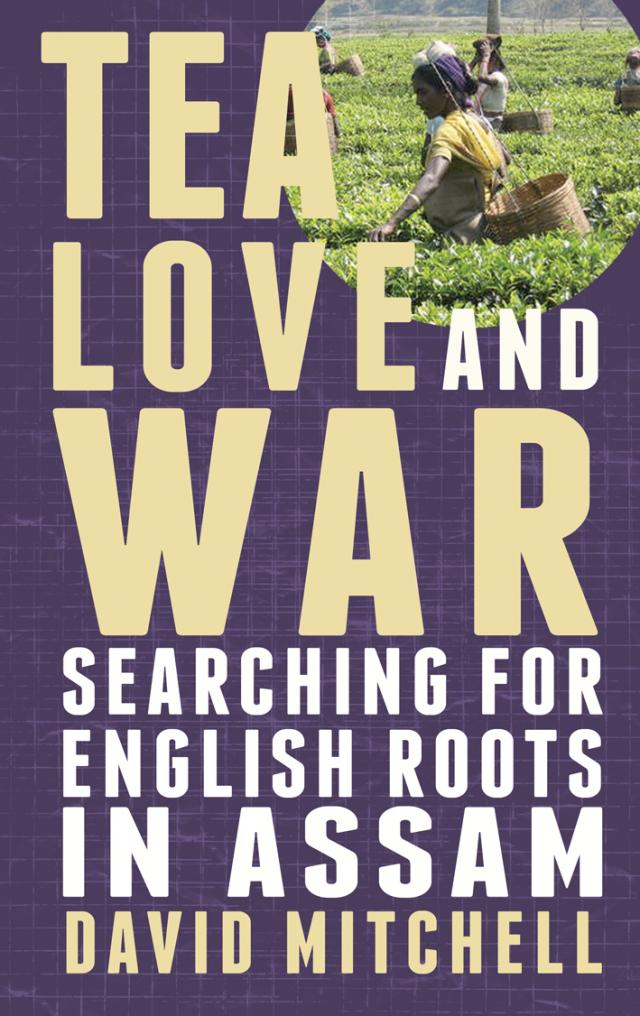
TEA
LOVE AND
WAR
SEARCHING FOR
ENGLISH ROOTS
IN ASSAM
DAVID MITCHELL
Copyright © 2012 David Mitchell
The moral right of the author has been asserted.
Apart from any fair dealing for the purposes of research or private study,
or criticism or review, as permitted under the Copyright, Designs and Patents
Act 1988, this publication may only be reproduced, stored or transmitted, in
any form or by any means, with the prior permission in writing of the
publishers, or in the case of reprographic reproduction in accordance with
the terms of licences issued by the Copyright Licensing Agency. Enquiries
concerning reproduction outside those terms should be sent to the publishers.
Any names, figures, places and events mentioned in this book
are correct to the best of the author’s knowledge. However, if
there are any errors in these accounts, the author will be
happy to amend them in future editions.
Matador
9 Priory Business Park,
Wistow Road, Kibworth Beauchamp,
Leicestershire. LE8 0RX
Tel: (+44) 116 279 2299
Fax: (+44) 116 279 2277
Email: books@troubador.co.uk
Web: www.troubador.co.uk/matador
ISBN 978 1780880 891
British Library Cataloguing in Publication Data.
A catalogue record for this book is available from the British Library.
Typeset in 11pt Bembo by Troubador Publishing Ltd, Leicester, UK
Printed and bound in the UK by TJ International, Padstow, Cornwall
Matador is an imprint of Troubador Publishing Ltd
INTRODUCTION
This is a patchwork of a book – a book conceived as a novel based on the experiences of the dramatis personae it describes – but a book finally born as mixed race with non-fiction the dominant gene.
The embryo of the book was formed by the discovery of long- forgotten correspondence from my uncle Stuart, fertilized first by curiosity and then by my researches concerning the specifics of the war years. This, combined with the vivid memories of the survivors, my mother Mary and Ann herself, across their separate generations enabled the embryo to develop until the child was ready for full-term delivery. It should be said that the descriptions by Mary and by Ann are moulded from their respective personal recollections and it is only in passages of Stuart’s life story that some poetic licence has been used to merge the text of his long letters with knowledge gleaned from other contemporary documents and records of the time.
Rather than interpose myself as narrator it has been an easy decision to appoint my mother to that role. Much of the text is already taken from the many exercise books that she filled with her memories, and whilst my investigations have expanded and updated her story, the history of the relevant elements of the Second World War, the Blitz and public perception of the Malayan campaign leading to the fall of Singapore are more eloquently seen from her individual viewpoint. For those interested in the Malayan campaign a more detailed description of that theatre of war and Stuart’s particular exploits will be found in Book Two.
I will conclude this introduction by saying that the first five years of Stuart’s time in India were meticulously recorded in his weekly letters home. Sadly, my mother loaned the letters to an aunt on my father’s side of the family who had determined to write a novel based on Stuart’s tea planting experience. The aunt died, and it can only be surmised that the letters were destroyed. My mother’s recollections of what Stuart wrote to her and told her, together with other records, photographs and stories, have been combined with memories from those in Assam at the time and have thus enabled the story of his first posting to be told; but it is to my huge regret that the first-hand description, with all its individuality, is lost.
The letters from Stuart’s return to India after his first leave remain intact, and the narrative of his subsequent adventures is taken from them and from contemporary histories of the Malayan campaign.
David Mitchell
PREFACE
This book is completed in my 97th year – and would not have reached fruition save for the industry of my son in assembling the various disparate elements, and massively expanding the handwritten scribblings on which my side of the story is based. I have told him that I do not think my part in the events described was abnormal and he knows that I am far from convinced that my involvement will be of interest to other than members of the family, but his determination that there is a wider audience has carried the day.
I am conscious that my mind is narrowing, excessively concerned with the minutiae of day-to-day survival, at the expense of my constant concerns at the state of the nation that measured the progress of earlier years. Not that my present daily perusal of the newspapers does not arouse indignation and fuel an enthusiasm – fortunately rarely indulged – for penning an appropriate diatribe for the correspondence columns, but more immediate problems of day-to-day existence tend to gain precedence.
Having said all that, as one reaches my time of life, the mind seems to focus more clearly on the past, and one spends – one could say wastes – many hours recalling and reliving the events of the past. Sometimes the memories are painful, sometimes they are joyful, but they define what we were and what we are – and one dares to hope that those events have made some mark on future generations, and contributed to a better world. If so, then that might be a sufficient epitaph for those who are no longer with us.
Mary Mitchell
Contents
Introduction
Preface
Book One
Chapter One
Chapter Two
Chapter Three
Chapter Four
Chapter Five
Chapter Six
Chapter Seven
Chapter Eight
Chapter Nine
Chapter Ten
Chapter Eleven
Chapter Twelve
Chapter Thirteen
Chapter Fourteen
Chapter Fifteen
Chapter Sixteen
Chapter Seventeen
Chapter Eighteen
Chapter Nineteen
Chapter Twenty
Chapter Twenty-One
Chapter Twenty-Two
Chapter Twenty-Three
Chapter Twenty-Four
Chapter Twenty-Five
Chapter Twenty-Six
Chapter Twenty-Seven
Chapter Twenty-Eight
Chapter Twenty-Nine
Chapter Thirty
Chapter Thirty-One
Chapter Thirty-Two
Chapter Thirty-Three
Chapter Thirty-Four
Chapter Thirty-Five
Chapter Thirty-Six
Chapter Thirty-Seven
Chapter Thirty-Eight
Chapter Thirty-Nine
Chapter Forty
Chapter Forty-One
Chapter Forty-Two
Chapter Forty-Three
Book Two
Chapter One
Chapter Two
Chapter Three
Chapter Four
Chapter Five
Book Three
Chapter One
Chapter Two
Chapter Three
Chapter Four
Chapter Five
Chapter Six
Chapter Seven
Chapter Eight
Chapter Nine
Chapter Ten
Chapter Eleven
Chapter Twelve
Chapter Thirteen
Chapter Fourteen
Chapter Fifteen
Chapter Sixteen
Chapter Seventeen
Chapter Eighteen
Chapter Nineteen
Chapter Twenty
Chapter Twenty-One
Epilogue
Bibliography
BOOK ONE
Stuart Poyser with his sister Mary on holiday in September 1931, eight months before Stuart’s departure for Assam
CHAPTER ONE
The mist of the early morning began to lift as the cluster of mourners slowly made their way to the small grave that had been carved out of the sun-baked earth of the isolated cemetery. The three nuns were in their usual white, two of them whispering in Italian whilst the third held the little Asian girl firmly by the hand. The girl wore the simple cotton dress in which her sister would carefully dress her on Sundays at the convent school. It was the dress given to her by her mother when the two girls had left her to start their long journey from the tea plantation in distant Assam so many months ago. Her sister would dress her and comb her hair and try so hard to make up for the longing she knew the four-year-old had for her mother and the faraway village in which they had both grown up.
Now the small wooden casket was lowered into the grave and the native gravediggers replaced the earth as the priest murmured his long liturgy. Sister Maria, the nun whose native Italian accent mixed so badly with her broken Hindi, let go of the little girl’s hand and handed to her the wreath of wild flowers that she had carried during the journey from the school. Hesitatingly, holding the wreath tightly in her small hands, the child went forward and gently placed the flowers on the mound of bare earth. The tears glistened as she turned back to the white folds of the nun’s habit and the disapproving murmurs of th e other sisters.
It was a lovely May morning when I joined my parents in taking my brother Stuart down to catch the boat for India from Tilbury Docks on 11th May 1932. I was wearing a new green dress with a matching hat of which I was very proud. We went on board to see Stuart’s cabin and then said our farewells.
Stuart’s passage on SS Rajputana had been arranged by Shaw Wallace & Co. Ltd with whom his new employment as junior assistant manager on the Budla Beta tea estate in Assam had been arranged. I recall my brother’s small but sturdy figure standing on the upper deck, waving at the three of us on the quayside, his figure receding as the ship moved further from the shore. We were a close family, and at my young age the thought that my brother was going to be away for at least five years was dreadful. My father Vernon Poyser, a doctor who in his spare time was an amateur philatelist of some repute with a speciality in postmarks, had tried to conceal his sadness by constantly reminding Stuart of the need to post ‘covers’ from every carefully chosen post office in every port, so that his stamp collection could be suitably enhanced. I could tell that my mother Millicent was completely grief stricken, but on the way down the gangway my nose had started to bleed and her concern to staunch the flow before my new dress was stained helped her to concentrate on more mundane matters.
My own distress at my brother’s departure, not knowing when I would see him again, had been increased by embarrassment at the nosebleed which had rather spoiled the dignified way in which I had planned to say my farewells. Through my own tears, as we stood waving on the quay, I had barely been able to make out the impassive features of my father beside me. He was always a man to suppress emotion, partly derived from his time as a surgeon in the bloodbath of the First World War trenches and partly from his generation’s instinctive determination to appear calm in all situations; and my teenage mind failed to sense the desolation he felt. As we left the ship his swift parting grasp of Stuart’s shoulder, a clumsy clutch and a repeated exhortation to remember to post his wretched ‘covers’ had annoyed me, but with hindsight this seeming detachment must have served to conceal his considerable anguish.
No such concealment from my mother, her dark and depressive nature very much in evidence that day. During the long journey down in the family Austin 10 she had striven to be normal, talking of Stuart’s good fortune in obtaining work, speculating as to the excellence of the quality of life he would find. Finding employment in the depressed years of the early 1930s had not been easy, even for an engineer trained by the renowned Tangye company, but the persuasive powers of Stuart’s aunt Kitty and her husband David, formerly a doctor on the tea plantations, had succeeded in pulling the necessary strings.
I know that Stuart had talked to Aunt Kitty and Uncle David in an attempt to discover the conditions he might expect – they had not been as expansive as he had hoped and he had told me that constant reference to the weather and to ‘the coolies’ had not impressed him. He told me he knew it was going to be hot; and as to servants he regarded himself as well used to that concept since our parents now had a maid, Daisy being the current incumbent, and this was common amongst our other middle-class friends. Stuart said he could not see that the Indian equivalent was likely to represent any great change. Uncle David, in an unguarded moment, had talked to him of ‘inner strength’ apparently in the context of the remoteness of the tea estates, but Stuart assured me that he could not see that this would be a problem that could not be overcome with local transport.
I now suspect that Stuart’s main sympathies lay with me on that day of departure. For the past three years we had been allies against the inevitable parental disapproval of his adolescence. Not that I had seen myself as having stepped out of line: I was young and rather innocent, full of life and enthusiasm with my love of sport and I rarely outstayed the unofficial curfew hours that the parents imposed.
My brother’s extrovert character had been another matter. It was not unknown for him to call on me for a suitable alibi for his extensive network of liaisons. I recall one occasion the previous summer at Shoreham where I had sat in lonely and rather cold vigil on the pebbled beach whilst Stuart and a big-breasted girl called Pauline concealed themselves behind one of the fishing boats drawn up on the shingle. I also remembered Beth, Stuart’s last-but-one girlfriend; and then there was Grace, to whom Stuart had told me of a tearful farewell during the week prior to his departure, hinting at some fever of their departing lovemaking, but as ever appreciative of the way in which his faithful sister had covered for his absence.
Not that I had ever wished to know the detail of those particular activities, perhaps out of embarrassment or the coyness of my lesser years, but in all other respects I liked to think that we had no secrets. Stuart would never say so, but I believe he was proud of my developing sporting abilities, bearing in mind that I was four years younger so at that time they did not come close to matching his own skills at tennis, hockey and cricket. We still competed against each other as far as we could, and many were the evenings when father would join us in cricket catching practice, and I learned not to complain when my nails were broken by mistiming a hard-flung ball.
On his departure Stuart was just twenty-one years of age. I speculate now, looking back to the vision etched in my mind of the twin-funnelled ship moving away from shore, whether he would have had a flashback to the time when he was left by our parents at his boarding school, Epsom College in Surrey. Whilst a common destination for the children of the medical profession, made more certain in his case by the fact that father had himself been there, it is probable that none of this would have diminished the welling up of homesickness in my then thirteen-year-old brother. Now, only eight years but seemingly a lifetime later, Stuart was departing from all that he knew for a term of what was expected to be at least five years. I still wonder whether his eager anticipation of the new adventure ahead of him, which had so lifted him in the previous weeks, would have been as suddenly extinguished by apprehension. Anyway, my parents’ emotions on the quay and on the long journey home mirrored the devastation that I felt at the time.
CHAPTER TWO
The nuns had given Mary’s dress, the lemon-coloured one with the tiny red flowers, to Pantoo because it was her size. Ann wondered if her fists had hurt Sister Maria as she hammered them into the nun’s plump waist and whether it was her sobbing or her shouts of rage that had caused the dress to be returned. Crumpled now it was held tightly between Ann’s arms and legs under the thin blanket. In the morning she would put it back into the cardboard box where it lived with Mary’s big brown shoes in which Ann had tried so hard to walk without tripping. It had probably been Sister Teresa who had made them return the dress. Ann loved Sister Teresa who was so kind to her and Aileen, the youngest children in the convent school.
An atlas will show the familiar triangle of the Indian subcontinent with Bombay (or Mumbai as it is now called) at the middle left and Calcutta (today known as Kolkata), the then capital city, at the top right where the many tributaries of the vast Ganges river system flow into the sea from the heights of Nepal. Bangladesh, the former Bengal, now a separate country having formed the eastern wing of Pakistan following the 1947 partition from India, flanks Calcutta upwards from the right and makes it easy to forget the almost detached north-eastern part of India as it climbs up into the foothills of the Himalaya range and touches China and Burma. That vast area of eastern India is bisected by the Great River, as the mighty Brahmaputra is often called. It runs for a thousand miles from its source in Arunachal Pradesh and drains the whole of the valley of Assam and about a third of the Himalayan mountain range. It is hard to comprehend that the river will have expanded to a width of around twelve miles by the time it finally meets the Ganges following its long journey from the distant mountains.
Assam is five hundred miles to the north-east of Calcutta between Bhutan and the north of Burma and has a landscape totally unlike the remainder of the country. It is an isolated place, living in the shadow of the eastern Himalayas and facing west towards the distant blur of Kanchenjunga. Heavy monsoons fall on the Naga Hills and provide a vegetation of teak and bamboo and dense evergreen forests. It is a land of thick jungle, the legendary haunt of tigers, and peopled by warlike hill tribes.