

A p b, p.1
A.P.B., page 1
part #1 of Whit Pynchon Series
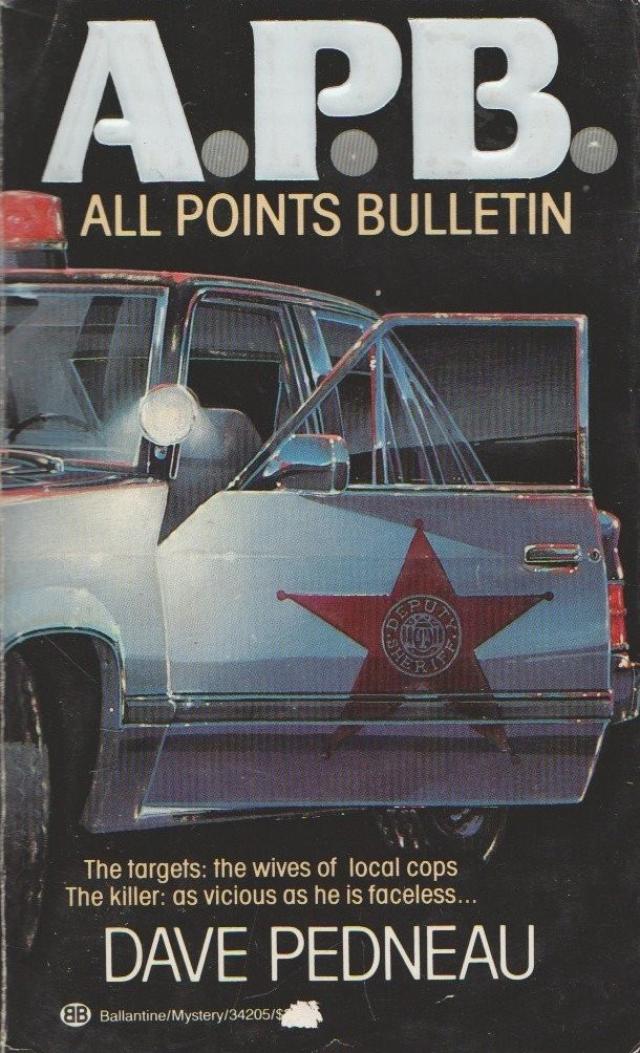


A.P.B.
Book 1 of the Whit Pynchon Mysteries
By Dave Pedneau
A.P.B.
In official police jargon an “All Points Bulletin”
Prologue
The crackling hiss of radio static.
The voice of the dispatcher—words clipped, slurred by urgency.
“County to Unit Three. County to Unit Three.”
Gil Dickerson—Unit 3—fumbled for the cruiser’s mike. “County, go ahead.” No sense saying more. He was the only unit working the hoot owl.
“County to Unit Three.”
Gil frowned. “I’m here, asshole.” The words didn’t go over the air because he didn’t key the mike. When he did key it, he said, “Unit Three, reading you loud and clear. Go ahead.”
“Unit Three, a caller reports a body—a dead person—at the front entrance to the high school.”
Gil’s frown deepened. The dispatcher, by tradition the most virgin of the county’s deputies, had fucked up. He hadn’t coded the message. Any son of a bitch with a scanner now knew what was going on. And everyone owned one. If it hadn’t been so late, half the goddamn town would reach the scene before Gil. There wasn’t much else to do in Milbrook.
Gil dismissed the error as the full import of the radio traffic sunk in. His adrenaline started to pump; his heart galloped. “Who called it in?”
“The guy wouldn’t give no name.”
“That’s all he said?”
“Yeah … Uh, affirmative,” the voice crackled. “Just wouldn’t give me no more info. I tried. I really honest to God tried to—”
“Okay … okay,” Gil said, again without keying the mike. No reason to as long as the dispatcher was still yapping. When the whining radio transmission ended, Gil said, “Ten four. On the way, and keep my times for me.”
Gil was south of Milbrook, patrolling fly-by-night used-car dealers and greasy hamburger stands cluttering the highway to Virginia. Milbrook High sat on the northern boundary of the small city. He whipped the cruiser around.
It was Sunday night—well, actually 1:12 A.M. Monday morning … nontraditional Memorial Day. On Sunday and Monday nights Gil patrolled the entire county by himself. Not that much ever happened—an occasional wreck, sometimes a drunk driver, the customary prowler and disturbance calls. Gil hated those two nights of the week. You never knew when something really big might go down. And this was the climax of the first holiday of the summer. So far it had been a quiet weekend.
Maybe the tranquility had just ended. On the other hand, maybe some drunk was passed out on the high school steps. Most “dead body” complaints climaxed in the arrest of “the body” for public intoxication.
“Unit Three to County.” He waited for an acknowledgment. When it came, he told the dispatcher to call the city police. “See if they have a unit to back me up.”
“Ten four.”
The city cops had no jurisdiction beyond the city limits, but they were willing to lend a hand if the call was on the fringe of town.
He flipped a switch to engage the blue light and ignored the one that sounded the whooping siren. Department policy required him to use both—never one without the other—but Gil wasn’t driving fast, and the streets were deserted. No reason to roust the whole town. Like most officers, Gil figured policies were a matter of interpretation. The pavement glistened from a brief rain around midnight, just a splash-and-dash shower. Gil had noticed flashes of lightning on the far side of Tabernacle Mountain. The storm must have glided up the mountain ridges, passing east of the county.
A body.
More than likely a prank call.
Television made police work look more glamorous and exciting than it really was. Once in a while, reality fused with fiction, and something exciting did happen. Gil dreaded and craved those rare moments of action.
“County to Unit Three.”
Gil gripped the mike, ready to answer. “Go ahead.”
“The city unit is tied up on a domestic matter. They’ll come your way when they wrap it up.”
Shit. Never around when you need them. “Ten four, County.”
He rolled down the city’s main street. Vapor lamps cast an amber aura over the damp streets. A haze of moisture floated in the night air. The day had been a scorcher, a record high temperature for the date. Perhaps it foreshadowed a hot summer. Gil hoped so. Inside the cruiser the air conditioner kept it crispy cool, but, with the potential of the call in mind, Gil’s sweat dampened his summer-weight uniform. The cool air made him chill.
Nothing much stirred, just the squadrons of insects circling the high streetlamps. He left the business district behind, entering an area of upper-middle-class homes, all of which were dark. Their inhabitants slept, secure in the knowledge that guys like Gil kept them safe.
If only you knew.…
Gil lived two blocks west of the main street. Not that he considered himself upper-middle-class. He and his wife worked. They were frugal. They sacrificed to own a house nicer than their level of income should permit.
A vision of his wife formed inside his head. The look on her imagined face urged him to ease back on the accelerator—to give the city officers a little more time to clear the domestic complaint. Cops lived longer if they played it close to the chest, and Gil wanted to live a very long time. He was getting to the high school much too quickly. DeeDee Dickerson was just too young to be a widow. And Gil hadn’t purchased that extra life insurance policy, which he would do on Tuesday, if he didn’t forget it once again.
He brought the mike to his lips. “Unit Three—County.”
“Go, Three.”
“How about that city unit?”
“Stand by.”
Gil reached in his shirt pocket and pulled out a nearly consumed roll of Rolaids. He popped two in his mouth. “County to Unit Three.”
“Go, County.”
“The cities are still tied up.”
The hell with them then. “Ten four. I’m there. Stand by.”
Gil eased the gray and black cruiser into the parking area fronting the school. Its headlights flashed across the empty lot. He rolled down the window and adjusted the cruiser spotlight. As the vehicle crept through the lot, Gil played the thick beam of light over the grounds. Wet grass twinkled at him. Two bright, sparkling eyes made Gil stomp his brakes. The eyes vanished. In the light beam Gil caught a glimpse of a furry object darting for cover.
A fucking possum.
He mopped away brow sweat, then allowed the cruiser to roll forward. The searchlight beam reached the corner of the brick high school. Its beam flashed back in his eyes as it touched the panes of floor-to-ceiling glass that enclosed the building’s breezeway. The glitter of shattered glass, lying on the front walk, sent his heart throbbing. The circle of light danced across the glass walls.
“Holy shit!”
The body lay half in and half out of the breezeway, bent double over the lower half of the fractured pane. The upper portion of the panel lay in pieces all over the concrete.
No prank call or drunk this time. Gil ran his hand over his face. “Just what I need,” he said aloud.
His hands turned clammy on the steering wheel. Things had to be done at the scene of a homicide. The state police academy had trained him to secure a crime scene, but that had been several years ago. Now what do I do? He ached for a drink of water.
The cruiser pulled into a spot in front of the body. The headlight beams laid a spotlight on the gory scene. Before jumping from the car, Gil scanned as much of the surrounding area as the spotlight would reach. He released the hammer guard on his .357 service revolver. Almost as an afterthought, he picked up the mike. “Unit Three to County. We do have a ten-seventy here. I repeat, we do have a ten-seventy.”
“Come again, Unit Three.”
The green asshole didn’t even know the call codes.
Thank God he’d be going to second shift soon. “I said we do have a ten-seventy. Check your codes!”
“Oh, the codes! Oh … Oooh! Ten four!”
“Dumb bastard!” Gil snapped just before keying the mike. “Call and advise the sheriff—”
“Ten four.”
“—and get me some assistance.”
“Gotcha.”
Gil doubted it
With his right hand on the butt of his gun, he exited the cruiser. His left hand wielded a large, black flashlight. Blood smeared the intact pane to the left of the body. The flashlight beam paused on the blood. Gil squinted at it. It looked like—
Not a smear at all. He edged closer. Words, written in blood. A message … reading, “NO. 1.”
Gil wondered if it was his imagination, but he let it go, forcing his attention to the body. It had been thrown into the glass. The body had then sliced down on the lower two or three feet of the pane. Some of the glass had popped to the exterior of the building. The exposed, naked buttocks bore deep gashes from the cascading slivers of glass, and blood pooled on the concrete, spreading out in a wide halo around the body.
A woman, he thought. The buttocks, disfigured though they were, appeared soft, feminine. He could not see her face. To reach her, Gil had to step into the pool of congealing gore. He hesitated.
At that instant headlights flashed over him. He looked to the entrance and saw a city police cruiser. “Thank God,” he said aloud, no longer feeling so helplessly alone.
His courage reinforced, he stepped into the slippery stain, careful not to fall, and moved toward the body. Glistening gashes m arred her smooth back. She had worn her hair long. The soaking blood obscured its color. Gil reached down and grasped the sticky hair, lifting up her head as car doors slammed behind him.
The head snapped free of the torso.
The two city officers—Cpl. Jay Sanchez and Patrolman Stan Kilgore—saw him reach down. They both knew Gil, Sanchez the better of the two. The Sanchezes and Dickersons socialized. They were casual friends.
For a second Gil stood there, gaping at the head. Sanchez noticed the deputy start to shake. He hurried toward the scene.
“What is it?” Kilgore asked.
With quivering and caring hands, Gil lowered the severed head to the concrete. He settled to his knees in the gore. When Sanchez reached him, Gil was sucking in air, blowing it out, in fast, violent breaths.
Sanchez looked back to his partner. “He’s hyperventilating.”
Gil’s whole body quaked as his breath came faster and faster. “Easy!” Sanchez said, his hand clutching the shoulders of his friend. “Take it easy. You’ve seen worse.”
Gil’s mouth and lips moved to form words, but only air came out.
Sanchez glanced at the victim. It was bad, no doubt about it. “Watch him, Stan.”
Sanchez leaned down to inspect the corpse. He touched the head. It rolled over to the side, the face grinning at him.
“Sweet Mother of God!” Sanchez crossed himself.
“What the shit is it?” Kilgore cried, growing angry because he didn’t know and no one was rushing to tell him.
Sanchez backed away. “It’s … it’s DeeDee. It’s Gil’s wife!”
At the sound of his wife’s name, Gil found his voice. His soul-deep pain escaped in a cry that echoed over the lonely grounds of the high school.
In dark shadows not a hundred yards away, the hunter smiled, lifted a bloody hand to his nose to smell the woman’s gore, then hurried away.
It had begun.
Chapter One
Whit Pynchon gave passing thought to going to bed. He shrugged off the idea; sleep wasted time. Instead he visited a desk in his living room, opened the center drawer, and withdrew a thick, hand-worn manila folder. It contained his dreams. He settled into his favorite chair, lit a menthol cigarette, and pulled a handful of the colorful pamphlets from the folder. Each one of them advertised a condo or resort community along South Carolina’s Grand Strand.
No matter the design, each of the resorts boasted a typically tropical name. Pirate’s Cove or The Reef or whatever. He shuffled through them with little interest. Whit wasn’t certain why he kept them. Not because the plastic buildings interested him. He did enjoy the photos, filled with green palms and sand and blue ocean vistas. They offered a touch of the Carolina Low Country that he loved and to which he would retire—very, very soon.
Whit wanted a small house on the landward side of an inlet. The beach houses, even the huge condos, were careless offerings to the first strong hurricane that decided to make landfall along the Strand. It wouldn’t take much of a storm surge to undercut most of them. Whit had been vacationing there when Diana danced by a few miles off shore. A 135-mile-per-hour whirling dervish, she’d made a believer of him. The September storm had eventually beached itself near Wilmington, North Carolina. Whit, anxious to experience something new, had raced her north, fighting the torrential feeder bands of rain that she had whipped over the Carolina coastal plains. He’d rented a motel room just beyond the evacuation area.
Big, tough Whit Pynchon, investigator for the office of the Raven County prosecuting attorney, had suffered twelve dark hours in a howling nightmare. The storm’s eye, knocked askew by ten miles of land that separated Whit from the coast, passed right over that little motel. The walls of his room had vibrated under Diana’s assault. Wind squeezed water through the tiniest fissures around the door and windows. The lights had flickered, dimmed, then died, leaving Whit a cigarette lighter and the frequent flashes of lightning by which to see.
Weakened or not, never again. The banks of an inlet were plenty close enough to satisfy his love of the ocean—and not so close as to be threatened by it.
The cop ached to retire, to bid goodbye to West Virginia. The weather in the Mountain State was atrocious. If it wasn’t raining, it was about to. He despised it. Maybe its residents didn’t have to worry about climatological disasters, but for Whit the constant mediocrity was much worse.
He leaned his head back in his easy chair and lit another cigarette. So what if he was just past forty? People hiked their eyebrows in shock when he told them he planned to turn in his badge and gun at forty-two.
A year and six months away.
In a year and seven months Whitley Francis Pynchon would be a bona fide resident of Georgetown County, South Carolina.
The phone rang.
Its shrill warbling jolted Whit, sending an emotional shock coursing through his body. Christ! How he hated phones. He glared at it for two … three rings, hoping it would stop. When it didn’t, he answered it.
“It’s after one,” he said as the handset reached his mouth. “You’d better have something damned important to say.”
A moment of stunned silence on the other end.
Then, “I was gonna apologize for calling so late, but the hell with it.” The tart voice belonged to Whit’s boss, Prosecutor Tony Danton. “That’s a shitty way to answer a phone, Whit.”
“It’s a shitty time to call. Besides, it’s my phone. I’ll answer it any way I like.”
“Why in the hell do I feel like I work for you instead of vice versa?”
Whit smiled but maintained an irascible tone to his voice. “If you worked for me, you damn sure wouldn’t be calling me at this hour.”
Tony Danton’s voice turned serious. “We got a mess, Whit.”
“Who got arrested for drunk driving? The judge again?”
Tony’s silence conveyed his disapproval. “Serious up, Whit. And knock off the drunken-judge jokes. We have a murder.”
“A domestic squabble, I guess.” Most of Raven County’s violence resulted from love turned sour.
“Goddammit, Whit! Stop with the flicking know-it-all crap.” Tony had been prosecutor for sixteen years, and Whit had been with him for fifteen of them. Whit knew the lawyer as well as anyone, probably better than anyone, including his wife. The short, feisty lawyer wasn’t flustered easily, but on this night an uncharacteristic tremor tinged his voice. Usually he wasn’t so testy.
“So what is it?”
Tony wasn’t through fussing. “You’re always Mr. Friggin’ Experience. Always so quick with an asshole quip.”
“Damn, Tony. I’m sorry. I apologize. I surrender. Whadaya want? A human sacrifice?”
“Smartass.” The lawyer paused. “Someone murdered—no, the word is ‘butchered’—Gil Dickerson’s wife tonight. He made sure Gil got to the scene first. The poor bastard didn’t know it was his wife, not until he … well, you know what I mean.”
Whit’s jaw slackened. “You’re kidding?”
“Nope.”
“Jesus, Tony. I remember her. A pleasant, classy lady.”
“Her death wasn’t pleasant or classy. She mighta been killed at her home. Or at least badly injured there. And raped. The killer then took her a few blocks to the high school and tossed her into a glass window. Sliced her up to a fare-thee-well. The fallin’ glass decapitated her. The sheriff’s department got an anonymous tip. Gil was the only one working.”
Whit liked Gil Dickerson, which made Gil something of a rarity. Whit Pynchon didn’t care a lot for most of his fellow peace officers. Dickerson, though, was a quiet guy, the strong silent type not given to macho displays of nightstick authority. “How is Gil?”
“The ambulance crew sedated him. I gather he lifted up her head. It came off in his hands. That’s when he saw who it was.”
The story would be told time and again in Milbrook—for years to come.
Whit cringed. “Jesus!” Then his mind went into official gear. “Was Dickerson patrolling alone?”
“Yeah. He always works the Sunday and Monday hoot owl alone.”






