A guest at the feast, p.1
A Guest at the Feast, page 1
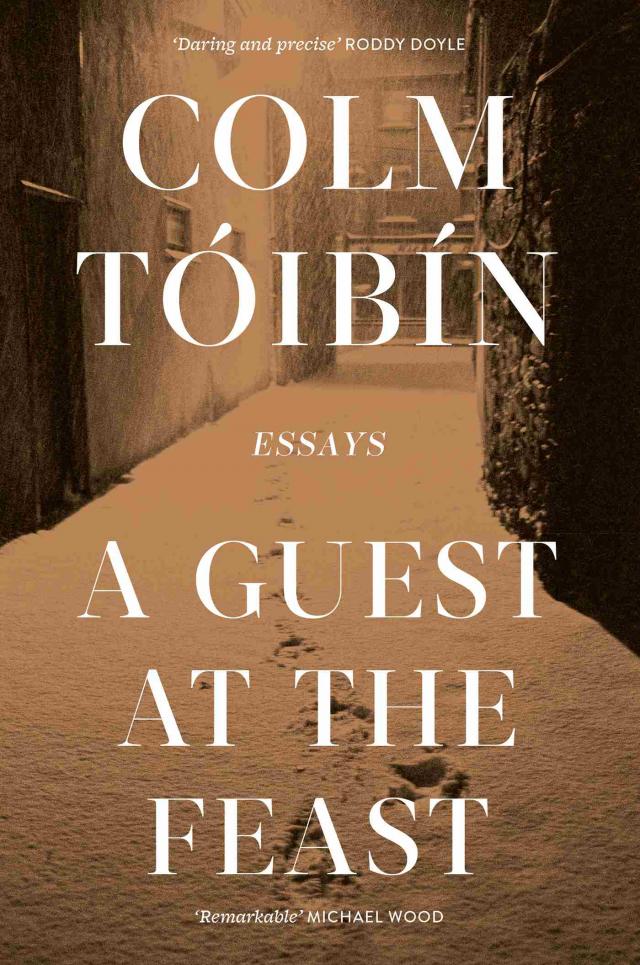


About A Guest at the Feast
A Guest at the Feast uncovers the places where politics and poetics meet, where life and fiction overlap, where one can be inside writing and also outside of it.
From the melancholy and amusement within the work of the writer John McGahern to an extraordinary essay on his own cancer diagnosis, Tóibín delineates the bleakness and strangeness of life and also its richness and its complexity. As he reveals the shades of light and dark in a Venice without tourists and the streets of Buenos Aires riddled with disappearances, we find ourselves considering law and religion in Ireland as well as the intricacies of Marilynne Robinson’s fiction.
The imprint of the written word on the private self, as Tóibín himself remarks, is extraordinarily powerful. In this collection, that power is gloriously alive, illuminating history and literature, politics and power, family and the self.
By the same author
fiction
The South
The Heather Blazing
The Story of the Night
The Blackwater Lightship
The Master
Mothers and Sons
Brooklyn
The Empty Family
The Testament of Mary
Nora Webster
House of Names
The Magician
non-fiction
Bad Blood: A Walk Along the Irish Border
Homage to Barcelona
The Sign of the Cross: Travels in Catholic Europe
Love in a Dark Time: Gay Lives from Wilde to Almodóvar
Lady Gregory’s Toothbrush
All a Novelist Needs: Essays on Henry James
New Ways to Kill Your Mother
On Elizabeth Bishop
Mad, Bad, Dangerous to Know: The Fathers of Wilde, Yeats and Joyce
plays
Beauty in a Broken Place
The Testament of Mary
Contents
About A Guest at the Feast
Title Page
Dedication
Part One
Cancer: My Part in Its Downfall
A Guest at the Feast
A Brush with the Law
Part Two
The Paradoxical Pope
Among the Flutterers
The Bergoglio Smile: Pope Francis
The Ferns Report
Part Three
Putting Religion in Its Place: Marilynne Robinson
Issues of Truth and Invention: Francis Stuart
Snail Slow: John McGahern
Alone in Venice
Text Permissions
Acknowledgements
About the Author
Copyright Page
for Mary Mount
Part One
Cancer: My Part in Its Downfall
London Review of Books, 2019
It all started with my balls. I was in southern California and my right ball was slightly sore. At the beginning I thought the pain might be caused by the heavy keys in the right-hand pocket of my trousers banging against my testicle as I walked along the street. So I moved the keys into my jacket pocket. The pain stayed for a while and then it went away and then it came back. I was doing readings every day, selling my melancholy stories to the people of Orange County and places south. I wondered, some days, if there might be a doctor in the audience who, if I made a suitable announcement at the end of the reading, could make this pain in my right testicle go away. But I didn’t want to make a fuss.
When the readings were done, I went to LA and ignored my balls. Then I went to London and looked them up on the internet. It was clear what I had. The right testicle was painful but not swollen. But the veins around it had decided to swell up a bit. The internet made clear what this condition was called:
A hydrocele is a type of swelling in the scrotum that occurs when fluid collects in the thin sheath surrounding a testicle . . . Older boys and adult men can develop a hydrocele due to inflammation or injury within the scrotum.
A hydrocele usually isn’t painful or harmful and might not need any treatment . . . Adult men with a hydrocele might experience discomfort from the heaviness of a swollen scrotum. Pain generally increases with the size of the inflammation . . . A hydrocele might be associated with an underlying testicular condition that can cause serious complications, including infection or tumour. Either might reduce sperm production or function.
I wrote stuff during the day and then attended a few parties and wandered in galleries in London and went about my business in the pretty sure knowledge that I had a hydrocele. Had I been sure how to pronounce it, I might even have started to boast about it. Sometimes, however, my ball was really sore, and the swelling became more significant. One evening, I made my way to one of the London hospitals and was put in the line for accident and emergency. They took blood samples and a urine sample. When a doctor finally saw me, because she was a woman and it involved my balls, she had to have a nurse with her while she was inspecting me. As the doctor looked at my testicles, the nurse looked at me or at the doctor. I looked at the nurse or at the floor.
The doctor said there was nothing in the blood or the urine that pointed towards a clear diagnosis. For that, I would have to get an ultrasound; the hospital would contact me to arrange that. She didn’t think it was cancer, she said, as there was no sign of a lump anywhere. So that was good news. The bad news was that the pain in my right ball grew more annoying. I managed to make an appointment with a urologist in Dublin and flew home one morning in late June. As soon as he examined me, the Dublin urologist seemed concerned, though he said nothing. He arranged some blood tests and an ultrasound, telling me that, unlike with kidneys and livers, a biopsy on a ball is rarely a great idea.
The ultrasound was done by two young guys filled with kindness and sympathy. Fully aware that taking your trousers and underpants down and lying flat on your back and then having some sort of gel poured on your junk before a type of prod begins to zoom around the outside of your balls is no fun, they outdid each other in being nice to me. When they had performed their magic, they told me they would have to go further and this meant that the little towel they had put over my dick, such as it is, would have to be removed. ‘I know this is shaming for you,’ one of them said. I sat up, rested on my elbows, and looked at him. ‘When you get to my age,’ I told him, ‘nothing is shaming.’
It was decided that I should go on various antibiotics for a week and then they would see what to do. In that week, the swollen veins disappeared, but the ball itself got harder and bigger. When I came for the next appointment, the urologist asked me if I was fasting. I hadn’t bothered to have breakfast so I told him truthfully and innocently that I was. ‘In that case,’ he said, ‘I can fit you in today.’
I knew what he meant; he meant to remove my ball. I went home and packed a small suitcase and presented myself at the hospital. As the afternoon waned, dressed in a gown with no back, I was wheeled down the corridors. Soon, with the help of the anaesthetist, I was fast asleep. This was just as well, since during the time that followed, the urologist, with efficiency and speed and skill, removed my right testicle.
As I recovered in my hospital bed, I was told that it would take a week for a laboratory to report back on the intricacies and inner workings of what had been removed. I also got a CT scan so that my insides could be examined by another group of doctors. I was asked if I had a problem with being told the result on the phone rather than waiting for an appointment. I said I had no trouble with the phone.
A week later the phone rang and I was told that I had a cancer of the testicles that had spread to a lymph node and to one lung. Instead of seeing the urologist, I would now need to see an oncologist. For a few days I comforted myself by pretending that, because of my abiding interest in the mysteries and niceties of Being, I had to see an ontologist. Nobody except one of my fellow Irish novelists thought this was funny. The oncologist showed me the scan of my insides on his computer. At first I could not work out from what angle these images had been taken. Then I understood that the scan was a sort of carpaccio of the middle and lower parts of my torso, a slice of the inside of the self. While I saw some well-known organs clearly, the cancer as it appeared on the screen was nothing more than a smudge, a few faint grains. If the doctor had not pointed them out to me, I would have given myself a clean bill of health and gone to play tennis.
To get rid of this cancer, the oncologist told me, I would need chemotherapy. Four week-long sessions of it, with a break of two weeks between each session. He told me I could stay in the hospital while getting the chemo, which seemed sensible. If something went badly wrong in the middle of the night, I thought, I would be in the belly of the whale rather than at home wondering what to do. ‘It’s curable,’ he said, his voice low and reassuring, his tone modest and reserved. ‘We have not lost anyone to it yet.’
I had looked the whole business up on the internet and was concerned that the chemo would cause deafness and also a thing called ‘chemo brain’, when a patient starts not to be able to remember things after treatment. The oncologist directed me to a nurse who arranged for me to have a hearing test so that they would have a baseline from which to judge, should there be any deterioration. She was less sure about ‘chemo brain’. Her response was the sort I became accustomed to over the coming months: it depends on the person, it’s hard to predict, everyone is different. As Mrs Cadwallader in Middlemarch says, ‘Everything depends on the constitution: some people make fat, some blood, and some bile.’
The nurse noted a great number of details about me before asking me if I drank much alcohol. I thought it wise to respond that I was sober in all my habits, a quiet-living person. The nurse did not seem fully reassured by this. And then she told me that people who drank a good bit of alcohol found chemo easier, since chemo was, like alcohol, a sort of distilled liquid with a poisonous edge that could change your mood and cause you aches and pains and generally damage your system. The more alcohol you had drunk in your lifetime, the less shock chemo would be to your system. In Ireland, there are people who have taken a pledge not to drink ever; they are often members of the Pioneer Total Abstinence Association of the Sacred Heart, founded in 1898. When I was growing up they were simply called Pioneers. You don’t hear much about them now, except in the deepest countryside. Nonetheless, the young nurse now invoked their presence. ‘Among those who have chemo,’ she said wistfully, ‘it is the Pioneers who suffer most.’
Both she and the oncologist were oddly unalarming. They spoke calmly and sympathetically. Neither of them was interested in spelling out all the terrible things that could happen. They made the future sound manageable and bearable. It was arranged that I would present myself in the hospital the following Sunday afternoon. The Irish poet Patrick Kavanagh has a poem called ‘The Hospital’, which begins: ‘A year ago I fell in love with the functional ward/Of a chest hospital’. This did not happen to me, but it was surprising how quickly the routines of the hospital became comforting and absorbing. They had a way of filling the day, which was long. It was hard to sleep because of the intravenous steroids that were part of the treatment. On one of the first nights, something started to bang and clash in my head. It was not made up of words, but it was like words, or like sentences; it possessed the shape of a sentence or two that were violently seeking an outlet. Every so often, there would be a break and a single word that had nothing to do with anything would suddenly emerge.
All this happened in the silence of my head, but it was like sound, and loud sound. I supposed it was the unconscious taking an opportunity to make itself heard, or perhaps it was what happened if you began to go stark raving mad. When I called the nurse and told her about it, she offered me a sleeping pill. I took it and fell asleep. The next night I had a notebook ready to write down any sentences and words that might come banging into my head, but nothing happened. I never got that strange visitation again. Soon I got into a routine. A sleeping pill every night gave me rest from about 1 a.m. to 5 a.m. I woke knowing it wouldn’t be long before I heard noises in the corridor; a nurse would check my blood pressure and take my temperature. Then someone – often a very glamorous Asian woman – would visit to take blood that would go to the laboratory. Then – usually between 6.30 a.m. and 7 a.m. – the oncologist would arrive, turn on the light, and ask me in a soft voice how I was. Early on, I decided that unless I was fully falling apart, I would tell him I was well. I enjoyed adding that there were ‘no issues’. I had never used the word ‘issues’ before. I had heard it used most memorably by an English novelist at a foreign literary festival when he told his publisher that he ‘had issues’ with his bedroom. Now, I could use it every morning if I wanted. It was one of the small compensations for having cancer.
On one of those mornings in that first week, the oncologist told me that a more recent scan had shown a tumour on the liver as well; this meant that the chemotherapy would have to stick rigidly to schedule. In other words, there could be no more than two weeks between each five-day session. He said all this very calmly. After his visit, breakfast came, and the newspapers. Sometimes, I had a drip putting water in my system through the night. And then steroids in the morning, and something else too to stop nausea. All this before the holy ceremony of chemo, also known as the juice.
Two senior nurses would arrive in the room with the chemo on a trolley. They would ask me my name and my date of birth. They would check the number on my wristband. Then one nurse would read out the details of the chemo to the other. This would be done with such seriousness and sense of sombre occasion that, the first time, I presumed there would be some response from me when the first drops of liquid went coursing through my veins. Maybe I would shake all over or let out an unmerciful cry. (I later learned that another nurse was waiting outside the room in case I had a bad reaction to the juice.) Instead, nothing happened, nothing at all. The juice was neither cold nor hot. It caused no pain. I wondered if all the talk about it wasn’t exaggerated. Instead of shaking all over, I read the newspapers. I listened to the radio. I had my lunch. When the chemo finished, I had a shower and put on my dressing gown and slippers and did a tour of the hospital corridors to see if anything was going on.
In those first five days, I also read a long and difficult novel. When I went home, it looked as if there was going to be no problem. I was able to go to the supermarket, and go up and down the stairs in the house. They had given me anti-nausea pills so that not once in all the time I was on chemo or afterwards did I have any desire to vomit or suffer any stomach problems. The steroid pills, however, were more difficult. Once I’d taken them in the morning, I could feel them grinding away inside me all day. In the early evening, they gave me a sort of energy that dissolved quickly enough but also meant that I could not sleep without sleeping pills, and the pills only guaranteed sleep for four hours.
I lay on the sofa in the house in Dublin and thought about things. I read a bit, but not much. I found that I had no interest in listening to music. For the next three months, I would not need to shave. My eyebrows would thin out but not disappear. The hair on my head would more or less go. The hair on the rest of my body remained in place until towards the end of the chemo, when it disappeared. It took a long time to grow back. In that first week after chemo I lost any desire to eat or drink, and I lost all sense of taste. Instead, my sense of smell became acute. For the next few months, on the street, I could smell everyone’s perfume or aftershave or deodorant. It grew to be confusing and surprising. In the house, when I was upstairs, I could smell any food in the kitchen even when there was nothing cooking. I could smell the soot in the chimney.
I wanted to be on my own in the house in those two weeks between chemo sessions. Friends offered to come and stay, or look in every morning, and Hedi, my boyfriend, wanted to come from LA, but I found the possibility of company oddly alarming. It was easier just to lie on the sofa, my head propped up, and think about nothing than have a friend bringing drinks of water or checking to see whether I was still alive. It wasn’t as though I was enjoying a period of inwardness and introspection. There was no inner self to examine or get in touch with. There was a surface self and all it could do was stare straight ahead. Over the months, I got used to a few friends who came regularly and looked forward to their visits in the evenings. But I needed, for the most part, to spend the days alone. People often talk about their ‘battle’ or ‘fight’ against cancer. It was really hard to know what this meant. I was sure that the nurses and doctors were involved in some battles, as were the cleaners and the kitchen staff, but I just lay there not thinking much. All I really wanted to do was fall asleep and not wake up until it was over.
What I never want to hear again is the screeching of seagulls. Dublin, I discovered as I lay on that sofa for much of July and August and September and October and November, is awash with them. They peak in early August and fade somewhat by late October. They would sail towards the house in groups and start to shriek in the upper air. Then they would move lower and shriek some more. They are scavengers and they love the fact that the centre of Dublin has so many new restaurants. They get fat on garbage.
As soon as there was the faintest glimmer of sun in the eastern sky, the gulls began their ghastly cries, and they went on screaming even after night had fallen. Even worse, they would breed. Their progeny found rooftops, where they perched, seeming to be immobile, but moving an inch or two back and forth on their horrible little webbed feet. All summer, they did this incessantly over my bedroom; they made their irritating noises against the slate through the night until I came to believe that they and their parents had been sent by some force of darkness to mock me.