Buffalo wolf, p.1
Buffalo Wolf, page 1


Buffalo Wolf
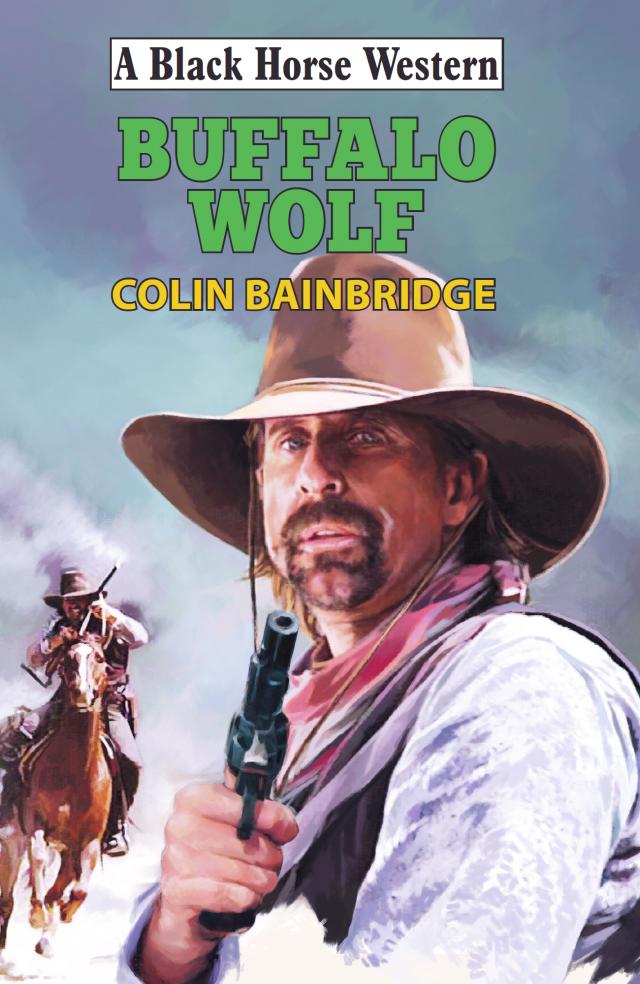
John Creed is a loner, a buffalo wolf – till he meets Polly Chantry. Each of them has a reason to be making their separate ways from Tamarack Creek to the diggings. Creed has letters to deliver, Polly is looking for her father. Then fate throws them together as they struggle to get through.
At the diggings they meet with Timber Wolf Flynn and his Sauk wife, White Fawn, but there is no sign of Polly’s father. Creed and Polly set out on a double mission; to find Polly’s father and acquire weapons to help the prospectors fight off the increasing threat from outlaws.
Their quest leads them high into the mountains and a frightening discovery at Gaunt’s Peak. From there the trail leads to an unexpected encounter with the Sioux and another confrontation with the outlaws, before the decisive showdown and a shattering denouement back at the diggings. At the end, will Creed still be a buffalo wolf?
By the same author
Pack Rat
Coyote Falls
Shotgun Messenger
Guns of Wrath
North to Montana
Blood on the Range
Six-Gun Nemesis
Back From Boot Hill
Tough Justice
Buzzard Roost
Gila Monster
Hoofbeats West
Desolation Wells
Flame Across the Land
Writing as Emmett Stone
Last Reckoning for the Presidio Kid
A Message for McCleod
Payback at Black Valley Forge
Applejack
Splintered Canyon
Writing as Jack Dakota
Showdown at Dirt Crossing
Hell Stage to Lone Pine
Comanchero Trail
Stop Ollinger!
Writing as Vance Tillman
Riders on the Wind
Dust and Bullets
Late for Gettysburg
Buffalo Wolf
Colin Bainbridge
ROBERT HALE
© Colin Bainbridge 2016
First published in Great Britain 2016
ISBN 978-0-7198-2205-6
The Crowood Press
The Stable Block
Crowood Lane
Ramsbury
Marlborough
Wiltshire SN8 2HR
www.bhwesterns.com
Robert Hale is an imprint of The Crowood Press
The right of Colin Bainbridge to be identified as author of this work has been asserted by him
in accordance with the Copyright, Designs and Patents Act 1988
Chapter One
John Creed was at a loose end. The young lady who had attracted his attention the day before was absent from the breakfast room, so when he had drunk his last cup of coffee he wandered outside. It was just as well. He was passing through. Still, she hadn’t been easy to ignore. Down the street he could see the old man dusting the boardwalk outside the stage depot; he meandered in that direction. When he got there the oldster looked up over his broom.
‘I got me a problem.’
‘Yeah? What’s that?’
‘The wagon’s ready with the mail, but I ain’t got nobody to drive it.’
It was early morning and the street was deserted. The old man spat into the dust.
‘Unless you fancy taking it out, sonny?’
The person he addressed was in his early twenties. Creed walked around the small wagon and examined the horses.
‘Give me ten minutes,’ he said.
He turned on his heel, walked back up the street and entered the Ground Hog Hotel. In five minutes he reappeared carrying a roll, a sheepskin jacket and a Paterson rifle. These items he slung into the wagon, alongside a number of sacks that were lying there. His six-guns were slung low, tied with rawhide thongs.
‘How far and where to?’ he asked.
‘Just head for the diggings. Less than sixty miles.’
The old man went inside the building and returned with some blankets and a buffalo robe.
‘Take these,’ he said. ‘I see you travel light and it can get real cold up in the mountains.’
Creed took them and threw them into the wagon alongside the other things.
‘Appreciate it,’ he said.
He stepped up on to the wagon box and flicked the reins. The horses strained and the wagon began to trundle slowly down the dusty street.
‘Ain’t you forgot somethin’?’ the old man called.
‘What’s that?’ Creed replied.
‘Pay!’ the man called. ‘If you get back within the month it’s one hundred dollars.’
Creed nodded.
‘If you ever get back,’ the oldster added beneath his breath. If the boy did return he calculated to be still well in profit at fifty cents for letters and twenty-five cents for newspapers, even allowing for the wagon and horses.
As the wagon rolled out of town Creed turned his head to take another look at its contents. The old man had included supplies. Creed had his own, anyway. In addition to the blankets and the buffalo robe, there was feed for the horses, and various other items were wedged in and lashed with ropes. With one hand he built himself a smoke. It was quite pleasant up on the wagon box with the early sun just gathering strength and a cool wind blowing from the east. Along about mid-afternoon he met two riders heading towards town, but otherwise the country seemed deserted.
It was flat here and featureless. He had no worries about getting the wagon with its team of four horses as far as the foothills, but the mountains were a different proposition. Even though he had taken the job on the spur of the moment, it never occurred to him not to see it through.
On the next day he saw the smoke signals. He did not have the knowledge to read them, but he figured they spelt trouble. But why would the Sioux bother about him? It would be sensible to be cautious. It was now mid-morning. The smoke signals continued, a single column followed by spherical clouds rising into the air. Then they ceased. Creed kept a watchful eye on the surrounding country. His rifle lay across his knee. It seemed to him that a strange intense silence lay across the prairie.
He stopped the wagon early in the afternoon and ate some pemmican washed down with water from the canteen. He took out his Colts, checked them and slid them back into their holsters. The chomp of the horses cropping the grass seemed unnaturally loud. The sun was hot and the landscape shimmered. A roadrunner crossed in front of the wagon and entered a thicket of thorny shrubs. The atmosphere was oddly hypnotic.
Soon he became aware of a distant drumming. At first it seemed to be inside his head but suddenly he realized that it was the sound of hoofbeats. Seizing the rifle he snapped to attention. Riding into view was a group of six Indian warriors. Their faces were painted and the leader, riding a white pony with a warpaint hand imprinted on its neck, wore a split-horn headdress and carried a lance lined with eagle feathers. He drew his sinewy horse to a halt, raised the lance, then lowered it again. Creed, placing the Paterson across his chest, held the upraised palm of his right hand towards the chief. The Sioux returned the greeting. So far, so good, thought Creed, but now what? The Indian turned and his glance swept the landscape in an inclusive gesture. Then, fixing the lance into the ground, he slid from his horse and approached the wagon.
Creed stood aside as the warrior began to riffle through the mail bags. The Indian drew a knife from a scabbard at his side, slit through one of the bags and emptied some of its contents on to the floor. He picked up first one of the letters and then another. Seemingly not able to make anything of them, he threw them back. He walked around the wagon, stopped to examine the horses, and stood face to face with Creed. For a few moments they regarded one another.
The Sioux chief had a broad forehead, high cheekbones and a strong nose. There was a resolute quality to his features. He nodded, turned and vaulted back on his horse. Taking up his lance, he muttered some words to the others, then turned again to Creed. With his forefinger pointing first to Creed, then to himself, he traced a rippling motion in the air. There could be little doubt that this signified the crawling movement of a snake.
Creed was thinking fast; a snake might mean an enemy, but the Indian had already returned his sign of friendship. His pointing movement was inclusive; maybe he was indicating a mutual enemy. Without further ceremony the Indians wheeled their horses and began to ride in the direction they had been following before coming upon the wagon. Creed watched them go. He was trying to puzzle it all out. The best he could come up with was that the Indians were giving him some kind of warning. Could they be trusted? He had liked the look of that chief.
The rest of the day passed without further sign of the Sioux. Creed was enjoying himself. So far this job was proving simple. He would deliver the letters and then pick up easy money at the end. He was in a state of limbo but the dice would have time to roll. For the moment he didn’t have to think too much. Although it was autumn the days were mild. The landscape was still flat but varied with bushes and trees. Large balls of tumbleweed blew across the plains, sometimes spooking the horses.
Occasionally Creed came upon the vestiges of camps: objects that had been abandoned by migrants heading West. Some of these – mining tools, a bookcase – he claimed for himself, thinking that they might come in useful. The bookcase he broke up for fuel to boil his battered coffee kettle. He was making pretty good progress and reckoned he would soon be among the foothills of the mountains.
On the next day he picked up sign of riders. He got down from the wagon and examined the ground carefully. It was well churne d up. He calculated there must be at least a half a dozen horsemen. The horses were shod, so they were not Indian ponies. They had come down from the direction of the hills, in which case he was now ahead of them. He recalled the gestures of the Sioux chief. Could this have something to do with what the Indian had seemed to be warning him about?
Later that afternoon the wind grew stronger and big cumulus clouds began to fill the sky. Creed knew that he was in for a storm. Soon he could see squalls streaking towards him through the turbulent grey heavens. He jumped from the wagon and he did what he could to secure the contents, covering the bags of letters with the buffalo robe; then he took shelter underneath. The sky was almost black now, and the wind howled across the empty land. The rains swept in and Creed gathered his slicker around him. He was reasonably well protected but soon long streams of water were flowing beneath the wagon. The drumming of the rain was incessant and, high over the prairie, silver lightning forked across the sky. Thunder crashed and reverberated. Creed was concerned that the iron wheel-rims might attract the lightning and, reluctantly, he crawled out to take his place by the horses sheltering miserably behind some rocks. The storm was passing overhead. Again lightning flashed across the heavens, illuminating the landscape for a brief moment in an eerie blue glow.
For what seemed like hours the storm continued, but at length the wind and rain began to falter as the deep low tones of the thunder grew steadily fainter, rolling through the foothills. The storm was raging towards the south and east after beginning as snow in the mountains.
Just then the sun burst through a rift in the clouds and across the heavily overcast sky a rainbow spread its radiant arch. From under the brim of his dripping hat Creed observed it with admiration. Then he rolled himself a cigarette.
The uplands here were crossed and scarred by run-offs and washes. After the rain the streambeds were babbling watercourses. The grass had become boggy and the horses’ hoofs sank into the marsh. Creed was finding it hard going after the storm. Only when he had stopped to rest the horses did he become aware of an object in the distance. He took out his field glasses and trained them in that direction. It was a wagon and it seemed to be leaning over. Creed guessed that it had become bogged down in the soft ground. He looked again; the front wheels had sunk almost up to the axle. A figure appeared from around the side of the wagon and Creed involuntarily blinked.
‘Goldurn it,’ he muttered. ‘It’s a girl!’
Tugging on the reins, he turned his own wagon in her direction. He made slow progress and it was some time before she seemed to see him. When she did she disappeared into her wagon, then came back again carrying a rifle. She jumped down from the wagon box and, planting her feet firmly on the ground, she swung the gun towards him but pointed high.
‘Hold it,’ he called. ‘I am a friend.’
The response was a shot, which went singing harmlessly over the prairie.
‘Now that ain’t what I would call friendly,’ he muttered.
He carried on in her direction, to be greeted by a second shot. Then he realized that she wasn’t shooting in self-defence or in an effort to scare him off. On the contrary, she was signalling that she had seen him and needed help. In response he waved his hand and was rewarded by her waving back. She went back into the wagon, to reappear once more as he approached.
‘Mister,’ she said, ‘I sure am glad to see you.’
Creed jumped down. To his surprise he recognized her. He had seen her only briefly at the Groundhog Hotel, but she was not the type to be easily forgotten.
‘Stuck?’ he said.
She nodded. ‘Can’t seem to make any headway. I was beginning to think I might not be able to make it any further.’
‘Let’s take a look,’ Creed responded.
He climbed down and made his way to the back of the woman’s wagon. The rear wheels were on firmer ground and she had already begun to unload the wagon in order to make it lighter.
‘Give me a hand to unload the rest,’ he said.
It took a while. There were trunks and boxes, some of them quite heavy, and several items of furniture. When they had finished he blocked the rear wheels, unhooked the traces and led one of the horses to the back of the wagon. He fastened a rope to each side of the axle underneath, then slapped the horse across the rump, tugging on the reins and encouraging it to pull. Fortunately the front wheels were not too firmly embedded; slowly at first but then with a jolt they came up out of the marsh. Then there came a loud snap and the wagon sank down.
‘Hell!’ said Creed. ‘Looks like the whole wagon-box has collapsed.’
He glanced at the piles of equipment they had removed. ‘Guess the weight was just too much.’
The girl looked at the discarded items, then back at him. Suddenly the edges of her mouth turned up and she laughed.
‘I think you’re right,’ she said. ‘So what do you suggest we do now?’
She said it in such an almost light-hearted way that Creed was taken aback, but he liked the way she seemed to include him in whatever action was to be taken. She certainly didn’t seem to be fazed by the affair; which, to say the least, was unusual given that she was a lone woman stranded in a hostile country a long way from anywhere in particular.
Then he noticed the way her laughter had caused little dimples to appear on either side of her mouth. She was tall and had short black hair cut somewhat carelessly across her forehead and her eyes were a deep shade of blue. She wore a light-coloured riding habit and boots.
‘There ain’t any choice,’ Creed replied. ‘I guess you’ll just have to ride alongside of me. We can hitch your horses together with mine, but I’m afraid you’re gonna have to leave some of that merchandise behind.’
She hesitated for just a moment before replying.
‘I believe you’re right, in which case perhaps we’d better introduce ourselves. My name is Polyphema Chantry, Polly for short. And you’re John Creed.’
He looked at her sharply.
‘How did you know that?’ he asked.
‘Easy. I saw it in the hotel register.’
Why hadn’t he thought of that? He wasn’t sure how to proceed.
‘If I’d have known you were headed this way too, I’d have come with you in the first place,’ she said.
‘It was kind of a snap decision,’ he answered confusedly.
‘They’re always the best ones,’ she replied.
He looked about. There were some low hills and, off to the right, a mesa indicated a possible river valley. He thought again of the indications he had found of riders. He was wary of being ambushed.
‘Best be on our way,’ he said.
After rerigging the horses he loaded the wagon as quickly as he could with Polly’s assistance, transferring as many of her possessions as he thought the wagon could manage. There was a lot they had to leave behind.
‘It doesn’t matter,’ she said. ‘I was being too optimistic in the first place. Besides, most of it probably won’t be needed.’
‘I was wonderin’ about that. The question seems too obvious to ask. What in tarnation are you doing out here?’
‘I could ask you the same thing.’
‘I’m headed for the diggings. There are letters in those bags I’m carryin’.’
‘Then you’re headed for the same place as me. And I bet my letter is in one of those bags.’
‘Your letter?’
‘The letter I wrote to my father telling him I was coming. But I suppose he’ll already have it by now.’
‘I wouldn’t count on it. There hasn’t been a delivery for a long time.’
‘My father is a prospector. He reckons he’ll make his fortune one day. He put me in a college back East but I’ve had enough of it, so I decided to come and join him.’
‘What will he make of it? Your decision to come out West, I mean.’
‘Oh, he’ll probably not be very pleased, at least to start with. But I think I can soon win him round.’
Creed thought for a moment, looking at her.
‘Yeah,’ he said. ‘I guess you probably can.’
The following day they were in the hills and had their first real glimpse of the mountains. From this distance the effect was magical. Like a battlemented wall of crystal they stretched across the skyline, the snow-capped higher peaks towering high into the air. It seemed that there could be no way through, but Creed knew there were canyons and passes that buckskinned mountain men had discovered and explored. Now the goldminers had arrived, Polly’s father among them. Creed did not doubt but that he would find a route through to the diggings.