

The long fall, p.1
The Long Fall, page 1
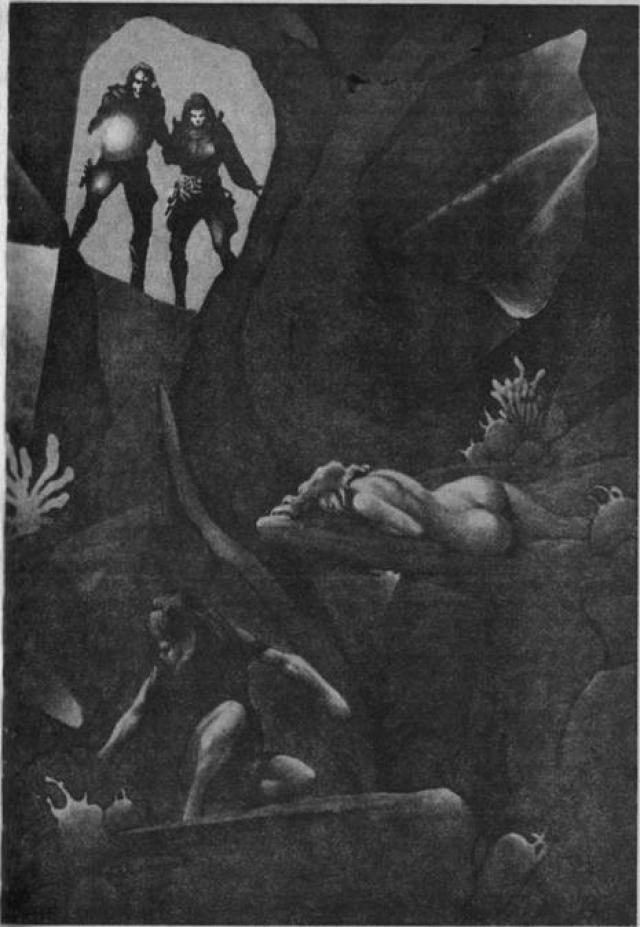


A. Bertram Chandler is the dean of Australia's science fiction writers and returns to this magazine after far too long an absense with a puzzle: How could a planetary colony based on religious ideals have regressed to primitive squalor? What caused—
THE LONG FALL
A. BERTRAM CHANDLER
Illustrated by STEVE FABIAN
“YOU ARE getting the feel of the ship, Captain?" asked the Baroness.
Grimes, with a mouthful of tea, could not reply at once. He hastily swallowed the almost scalding fluid and was embarrassed by the distinctly audible gurgle. He put the fragile cup down in its saucer with too much of a clatter.
"Perhaps," he admitted cautiously, "the ship is getting the feel of me . . . He realised that she was regarding him even more coldly than usual and hastily added, "Your Excellency."
"But surely, to a spaceman of your experience, a ship is only a ship," she said.
You know bloody well that this one isn't, he thought mutinously.
To begin with, a normal ship is not built of gold—even though that precious metal, its molecular structure rearranged by the Electran metallurgists, is superior to any of the alloys usually utilised by naval architects. And a normal ship is not automated to the extent that The Far Traveller was. A normal ship does not possess a mind of her own—although many generations of spacemen, and of airmen and seamen before them, have half believed that such is the case. A normal ship, come to that, does not have a Master who is on the run from the long, punitive arm of the Interstellar Federation's Survey Service as ex-Commander Grimes, lately captain of IFSS Discovery, most certainly was.
A normal ship does not boast an Owner's Suite decorated and furnished in a style appropriate to the salon of a well-heeled titled lady in Eighteenth Century France ...
Michelle, Baroness d'Estang, was more than merely well-heeled. She was filthy rich; as a member of the financial elite who had made their home on El, Dorado she could not possibly have been anything else. Her spaceyacht, The Far Traveller, had been built to her own specifications by Astronautics and Electronics of Electra, a yard specialising in the construction of non-standard vessels. The Baroness had not intended to employ any crew whatsoever; the pilot-computer was programmed to cope with almost every possible astronautical problem. But Lloyd's of London had refused to supply insurance cover unless a qualified, flesh-and-blood Master were on the Register. A Captain Billinger had been the first such and he had been happy to resign during the vessel's stay on Botany Bay. Grimes, anxious to get away from a planet on which his popularity had diminished, had replaced him.
So here he was, seated on a spindly-legged chair in the Baroness's boudoir, sipping tea that was far too weak for his taste. He was attired in a uniform that he hated, all purple and gold, that would have been more appropriate to a Strauss operetta than to a spaceship—but one of the conditions of his employment was that he wear his employer's livery. What rankled most was that his captaincy was only nominal. To begin with, the Baroness knew far too much. As Billinger had coarsely said, she shoved her tits into everything. And then the ship herself had a brain—a real brain, although nonorganic—and a personality. Definitely female it was, and . . . bitchy. Billinger had referred to it—her—as Big Sister. The nickname was apt. After lift-off from Botany Bay she had set her own trajectory for Farhaven, one of the comparitively recently rediscovered Lost Colonies that the Baroness was visiting in search for material for her doctorial thesis.
And what did she, a typical rich bitch from El Dorado, want a doctorate for? Grimes wondered, regarding her over the gold rim of his teacup. She was ornamental enough without any academic titles. She was languidly at ease on her chaise lounge, attired, as usual, in a filmy robe that revealed more than it concealed. Her dark auburn hair was braided into a coronet in which clusters of diamonds sparkled. She could have been posing for a portrait of a decadent aristocrat from almost any period of Man's long history. Decadent she may have looked—but Grimes knew full well that the rulers of El Dorado were tough, ruthless and utterly selfish.
She said, looking steadily at Grimes with her big, violet eyes, "We have decided to let you handle the landing."
He replied, as nastily as he dared, "I am sure that the ship can manage by herself quite nicely."
She said, "But you are being paid—handsomely, I may add—to do a job, Captain Grimes. And this Farhaven is a world without radio, without Aerospace Control. During your years in command in the Survey Service your brain has been programmed to deal with such situations. The ship's brain has not been adequately programmed in that respect." She frowned. "As you already know, I have brought such deficiencies in programming to the attention of the builders on Electra. Fortunately the guarantee has not yet expired."
The golden robot butler refilled her cup from a golden teapot, added cream from a golden jug, sugar from a golden bowl. Grimes declined more tea.
He said, "Please excuse me, Your Excellency. Since I am to make the landing, I should like to view again the records made by Epsilon Pavonis and Investigator ...
"You may leave, Captain," said the Baroness.
Grimes rose from his chair, bowed stiffly, went up to his far from uncomfortable quarters.
HE SAT BEFORE the playmaster in his day cabin watching the pictures on the screen, the charts, the presentation of data. As he had done before, as soon as he had learned of The Far Traveller's destination, he tried to put himself in the shoes of Captain Lentigan of Epsilon Pavonis, one of the Interstellar Transport Commission's tramps, who had first stumbled upon this planet. Epsilon Pavonis had been off trajectory, with a malfunctioning Mannschenn Drive. As far as Lentigan was concerned Farhaven had been merely a conveniently situated world on which to set down to carry out repairs and recalibration. He was surprised to find human inhabitants, descendants of the crew and passengers from the long-ago missing Lode Venturer. He had reported his discovery. Then Investigator was sent to make a proper survey. Her captain, a Commander Belton, had run into trouble. And as Farhaven was of no commercial or strategic importance to any of the spacefaring races its people were left to stew in their own juice.
Grimes allowed himself to wonder what they would make—if anything—of the Baroness, himself and Big Sister ...
GRIMES SAT in the captain's chair in The Far Traveller's control room. The Baroness occupied the chair that, in a normal ship, would have been the seat of the second in command. She was dressed in standard spacewoman's uniform—white shorts and shirt, but without insignia. She needed no trappings of rank; in the functional attire she was no longer the decadent aristocrat but still, nonetheless, the aristocrat.
The yacht was not equipped with robot probes—a glaring omission that, said the Baroness, would cost that shipyard on Electra dearly. There were, however, sounding rockets, a necessity when landing on worlds with no spaceport facilities; a streamer of smoke is better than nothing when there are no Aerospace Control reports on wind direction and velocity—and at least as good as a primitive windsock.
The Far Traveller dropped steadily down through Farhaven's atmosphere. She was in bright sunlight although the terrain below her was still dark. Grimes had told Big Sister that he wanted to land very shortly after sunrise—which was S.O.P. for the Survey Service. The almost level rays of a rising luminary show up every smallest irregularity of a surface and, when a landing is being made on a strange world, there is a full day after the set-down to make initial explorations and to get settled in.
Grimes, during the preliminary orbitings of Farhaven, had selected his landing site—an unforested plain near the mouth of one of the great rivers, a stream that according to the charts was called the Jordan. Epsilon Pavonis had set down there. So had Investigator. A little way upriver was what Captain Lentigan had referred to as a small town and Commander Belton as a large village. Neither Lentigan nor Belton had reported that the natives were hostile, their troubles had been with their own crews. None of the material that Grimes had seen went into great detail but he could fill in the gaps from his imagination. He had experienced his own troubles with his own crew on Botany Bay.
Big Sister broke into his thoughts. She said, her voice metallic yet feminine, seeming to come from everywhere and nowhere, "I would suggest that I fire the first sounding rocket, Captain."
"Fire at will," ordered Grimes.
(In a normal ship some alleged humourist would have whispered, "Who's Will?")
He watched in the screen the arrow of fire and smoke streaking downwards. Its trail hardly wavered.
"Ideal conditions, Captain," commented the Baroness.
"It would seem so, Your Excellency," agreed Grimes.
But from his own, highly personal viewpoint they were far from ideal. Over many years he had regarded his pipe as an essential adjunct to shiphandling—and for those many years he had been absolute monarch in his own control room. But the Baroness neither smoked nor approved of smoking in her presence.
He allowed his attention to stray briefly from the controls to what he could see of the sunlit hemisphere through the viewports. Farhaven was a wildly beautiful world but, save for patches of fertility along the rivers and coasts, it was a barren beauty. To the east, beyond the narrow sea, reared great, jagged pinnacles, ice-tipped, and to the west similar peaks were already scintillant in the first rays of the rising sun. Unless there were considerable mineral wealth about all that this planet would be good for would be a holiday resort—and it was too far from anywhere for the idea to be attractive to those shipping companies involved in the tourist trade.
Big Sister said, “I would suggest, Captain, that you pay more attention to your controls. It was, after all, with some reluctance that I agreed to let you handle the landing."
Grimes felt his prominent ears burning as he blushed furiously. He thought, I'd like five minutes alone back on Electra with the bastard who programmed this brass bitch . . . He saw, in the screen, that the sounding rocket had hit and that its luminous smoke was rising directly upwards. But it was thinning, would not last much longer.
He ordered, "Fire two.”
Big Sister said, "It is not necessary."
"Fire Two!" snapped Grimes. He added, grudgingly, "Wind can rise suddenly, especially just after sunrise, especially in country like this."
"Fire two," acknowledged Big Sister sullenly as the second rocket streaked downwards, hitting just as the first one expired.
And there was wind, Grimes noted with smug satisfaction, springing up with the dawn. The luminescent pillar of smoke wavered then streamed seawards. Grimes applied lateral thrust, kept the flaring rocket heal-in the centre of the stern view screen.
The sun came up relative to the land below the ship, topping the jagged rim of the range to the eastward. The plain toward which The Far Traveller was dropping flared into colour—blue-green with splotches of gold and of scarlet, outcroppings of white from which extended long, sharply defined black shadows. Boulders . . . thought Grimes, stepping up the magnification of the screen. Yes, boulders, and the red and yellow patches must be clumps of ground-hugging flowers since they cast no shadows. The second rocket, still smoking, was almost in the centre of one of the scarlet patches; there was no unevenness of the ground there to worry about.
The ship dropped steadily. Grimes was obliged to make frequent small adjustments to the lateral thrust controls; that wind was unsteady, gusting, veering, backing. He reduced the rate of descent until The Far Traveller was almost hovering.
"I am not made of glass, you know," remarked Big Sister conversationally.
"I had hoped to make the landing some time before noon," said the Baroness.
Grimes tried to ignore them both. That bloody wind! he thought. Why can't it make up its mind which way to blow?
He was down at last—and the ship, suddenly and inexplicably, was tilted a full fifteen degrees from the vertical. She hung there—and then, with slow deliberation, righted herself, far more slowly than she should have done with the lateral thrust that Grimes was applying. There was no real danger, only discomfort and, for Grimes, considerable embarrassment. He had always prided himself on his shiphandling and this was the first time that he had been guilty of such a bungled landing.
When things had stopped rattling and creaking the Baroness asked with cold sarcasm, "Was that necessary, Captain?"
Before he could think of a reply Big Sister said, "Captain Grimes was overly cautious. I would have come down fast instead of letting the wind play around with me like a toy balloon. I would have dropped and then applied vertical thrust at the last moment."
And you, you cast-iron, gold-plated bitch, thought Grimes, deliberately made a balls-up of my landing . . .
"Perhaps, Captain," said the Baroness, "it will be advisable to allow the ship to handle her own lift-offs and set-downs from now on.”
The way she said it there wasn't any "perhaps" about it.
BIG SISTER carried out the routine tests for habitability. The captains of Epsilon Pavonis and Investigator had reported the atmosphere better than merely breathable, the water suitable for drinking as well as for washing in and sailing ships on, a total absence of any micro-organisms capable of causing even mild discomfort to humans, let alone sickness or death. Nonetheless, caution is always essential. Bacilli and viruses can mutate—and on Farhaven, after the landing of Lode Venturer, there had been established a new and sizeable niche in the ecology, the bodies of the original colonists and their descendants, just crying out to be occupied. The final tests, however, would have to wait until such time as there was a colonist available for examination.
Big Sister said, "You may now disembark. But I would recommend . . .
Grimes said, "You seem to forget that I was once a Survey Service captain. Landings on strange planets were part of my job."
"You are no longer in the Survey Service, Captain," Big Sister reminded him.
The Baroness smiled maliciously. "I suppose that we may as well avail ourselves of Captain Grimes' wide range of experience. Quite possibly he was far better at trampling roughshod over exotic terrain than bringing ships, to a gentle set-down prior to the extra-vehicular activities." She looked away from Grimes. "Big Sister, please have the pinnace waiting for us. We shall board it from the ground. Oh, and an escort of six general purpose robots. Armed.”
"Am I to assume, Your Excellency," asked Grimes stiffly, "that you are placing yourself in command of the landing party?"
"Of course, Captain. May I remind you that your authority, such as it is, does not extend as much as one millimetre beyond the shell of this ship?"
Grimes did not reply. He watched her sullenly as she unbuckled herself
From her seat, left the control room.. He unsnapped his safety belt, got up, went down to his quarters immediately below and abaft control. He found that his robot stewardess had already laid out a uniform of tough khaki twill with shoulder boards of gold on purple, gold-braided cap, boots, a belt with attached holsters. He checked the weapons. These were a Minetti projectile pistol—as it happened his favourite personal weapon—and a hand laser. They would do. He changed slowly. Before he was from the too familiar voice came from the speaker of the playmaster in his day cabin, "Captain Grimes, Her Excellency is waiting for you."
He buckled on the belt, went out to the axial shaft, rode the elevator down to the after airlock. He walked down the golden ramp to the blue-green grass. The pinnace was there, a slim, torpedo shape of burnished gold. The Baroness was there, in khaki shirt and breeches and high boots, looking like a White Huntress out of some archaic adventure movie. The general purpose robots were there, drawn up in a stiff line, staring at nothing. From belts about their splendidly proportioned metal bodies depended an assortment of hand weapons.
"We are waiting," said the Baroness. "Now that you are here, will you get the show on the road?"
"I thought you said that you were to be in command, Your Excellency," Grimes reminded her.
"I am in command, but I do not believe in keeping a dog and doing my own barking," she told him.
Grimes flushed angrily. "Your orders?" he asked.
"To take this pinnace to the settlement mentioned by Epsilon Pavonis and Investigator. Then, when Grimes made no immediate move, "Don't just stand there. Do something."
He turned to the escorting robots, tried to imagine that they were Survey Service marines. "Embark!" he ordered sharply.
The automata turned as one, strode in single file to the pinnace's airlock, stepped aboard.
He said to the Baroness, "After you, Your Excellency."
He followed her into the pinnace. She took the co-pilot's seat in the control cab. The robots were already standing aft, in the main cabin. The airlock doors shut while he was still making his way to his own chair. He noted that the Baroness had not touched the console before her. He sighed. This was Big Sister again, showing him who was really in command.
He buckled himself into his seat. Before he was finished the voice of the ship came from the transceiver, "Proceed when you are ready, Captain Grimes."
The inertial drive was already running, in neutral. He swiched to vertical thrust, lifted. The river was ahead; in the bright sunlight it was a ribbon of gleaming gold winding over the blue-green grasslands. There was altogether too much gold in his life these days he thought. He flew until he was directly over the wide stream then turned to port, proceeding inland at an altitude of about fifteen metres. Ahead of him were the distant, towering ranges, their glittering peaks sharp against the clear sky.
The Baroness was not talkative. Neither was Grimes. He thought, If those were real marines back there they'd be making enough chatter for all of us.
He concentrated on his piloting. The river banks were higher now, rocky, sheer, with explosions of green and gold and scarlet and purple where flowering shrubs had taken hold in cracks and crevices. He considered lifting the pinnace to above cliff-top level then decided against it. While he was here he might as well enjoy the scenery. There was little enough else to enjoy.






